


A Legacy of Growth and the Possibility of Revival
Recently, I was in conversation with a denominational leader, lamenting the state of our denomination in Colorado. In the midst of this discussion, I expressed a hopeful prayer for revival—a vision of renewed growth and vibrancy for our churches. The leader’s response gave me pause: they suggested that such a revival was unlikely, framing the church’s current state as a reversion to a median level, with much of the past growth attributed to the post-WWII boom.
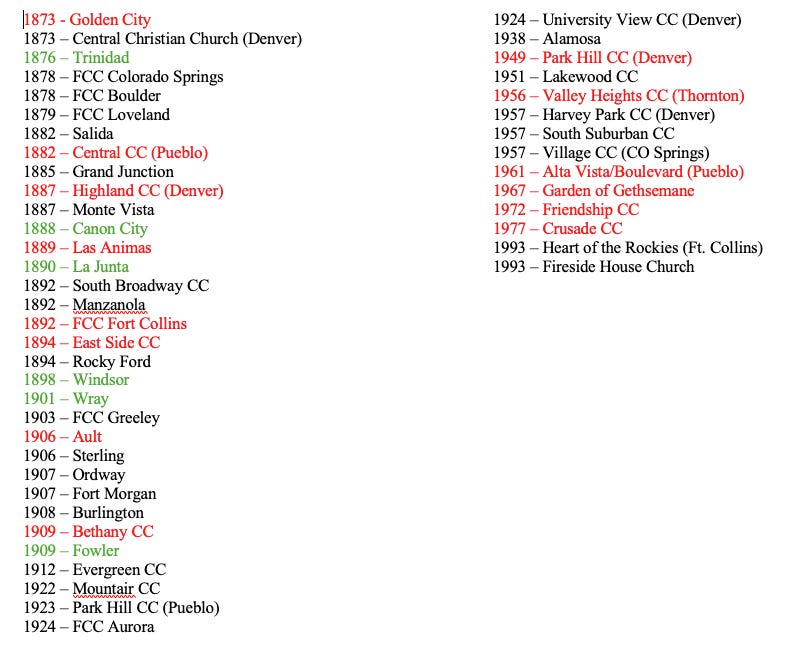
While this perspective contains a degree of truth, I felt compelled to dig deeper. Drawing on Bryant D. Badger’s History of the Christian Church (Disciples of Christ) in Colorado, I compiled a list of church starts up to 1993 and, with the help of ChatGPT, sought to analyze what this history might reveal about patterns of growth in our denomination. The insights from this data tell a far more nuanced story, one that challenges the notion of simply attributing growth to cultural trends.
Insights from Colorado’s Church History
The history of Christian Church (Disciples of Christ) congregations in Colorado reveals several key trends. By examining the list of church starts, we can discern distinct patterns of growth, cultural shifts, and denominational dynamics.
Periods of Growth
The Late 19th Century (1870s–1890s): During the early days of Colorado’s statehood, there was a significant wave of church planting. Churches like Golden City Christian Church (1873) and Trinidad Christian Church (1876) were established as communities grew and developed. This era reflects the religious expansion that often accompanied settlement in the American West.
The Interwar Period (1920s–1930s): After World War I, growth slowed but continued steadily. Notable churches such as Mountair Christian Church (1922) and Park Hill Christian Church in Pueblo (1923) emerged during this period, aligning with population shifts and regional development.
The Post-WWII Boom (1950s): The 1950s stand out as the most prolific decade for church planting in Colorado, mirroring national trends. Suburbanization and the post-war population boom contributed to the establishment of churches like Lakewood Christian Church (1951) and Valley Heights Christian Church in Thornton (1956). This era’s growth highlights the intersection of cultural factors and denominational efforts.
Decline in Church Planting
The momentum of earlier decades gave way to a noticeable decline in church starts by the late 20th century. After the 1970s, new church plants became rare, with only two churches—Heart of the Rockies (Fort Collins) and Fireside House Church—established in the 1990s. This decline reflects broader societal changes, including decreasing religious affiliation and shifting attitudes toward organized religion.
Closures and Departures
The list also reveals a sobering reality: many churches have closed or left the denomination. These closures, alongside departures marked in green font, underscore the challenges of sustaining vibrant congregations in an increasingly secular cultural landscape.
Challenging Simplistic Narratives
To suggest that all the church growth in Colorado occurred solely during the post-WWII boom oversimplifies the story. Yes, the suburbanization of the 1950s is evident in church starts in places like Thornton and Lakewood. However, the late 19th century and interwar period also saw significant church planting efforts, demonstrating that growth has occurred in various contexts and eras.
What I find particularly discouraging is the resignation among some Mainline Protestant leaders—a sense that revival is beyond reach. This outlook seems particularly dissonant given the origins of the Christian Church (Disciples of Christ), a movement born from the fires of revival. While it’s true that cultural alignment with church attendance played a role in past growth, it feels overly cynical—and even anachronistic—to dismiss the possibility that God was at work in these churches.
A Call to Pray for Revival
As we reflect on the history of our denomination in Colorado, I believe we are called not to resign ourselves to decline but to pray boldly for revival. If God could work through believers to establish vibrant congregations in the past, I firmly believe God can do so again.
Let us not be defined by the closures and challenges but inspired by the legacy of those who planted seeds of faith in earlier generations. Together, as Mainline Protestants and Disciples of Christ, may we pray for a renewed movement of the Spirit—one that leads to new and revived churches, carrying forward the story of Jesus in our communities.
In my own prayers I use the word resurrection rather than revival — an entirely new form of church, barely recognizable as its old self.