


What are the ingredients of a dynamic, healthy, and growing church?
For the last 20+ years, especially in evangelical circles, the focus has been on modern, dynamic worship music, compelling preaching, quality children’s ministry, all neatly wrapped in church building that looks more like a Walmart than a sacred site.
But, what if we have that backwards?
What if these elements are not the cause of a health, growing church but rather the results of one?
In his book, The Next Evangelicalism: Freeing the Church from Western Cultural Captivity, author Soong-Chan Rah makes an intriguing assertion based on his analysis of Acts 2, recognizing the existence of a Chiasm (also sometimes called chiasmus or a chiastic structure) within the text.
The Greek Chiasm
A Chiasm gets its name from the Greek letter Chi, which looks like our letter “X.”1 I remember learning about Chiasms way back in Bible college when I was studying NT Greek. On paper, a chiastic structure can be laid out like an outline, except in reverse, where the more important point is in the center, and the supporting points expand outward.
In his book, Rah lays it out like this:
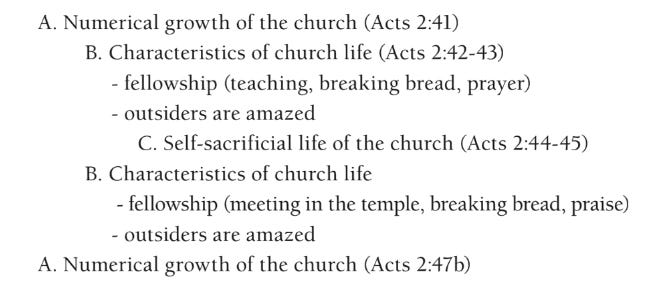
Again, in a chiasm, point “C” is the center or foundational point of this literary device.
So, this means that, rather than “numerical growth” being the key element—Rah is pointing out that Acts is making the opposite case—that “self-sacrificial” actions in the life of the church is essential. Meaning, numerical growth doesn’t come from dynamic worship music, compelling preaching, and quality children’s ministry, but rather the reverse. Self-sacrificial actions from the church lead to dynamic worship music, compelling preaching, and quality children’s ministry which will then result in numerical growth. So, its essential to see self-sacrificial actions not as a side-ministry of the church, but as the foundational building block of the church.
Donald McGavran and Megachurches
What’s most intriguing about Rah’s point here is that he lays this all out in his chapter on “The Church Growth Movement and Megachurches,” where he examines primary vs. secondary culture and the homogenous unit principle from Donald McGavran. Rah writes, “the key error in the church growth theory is that secondary measurements, such as numerical growth, were used as a central value, rather than attempting to understand the primary cultural dynamics hat were at work.”2 Ultimately, Rah is less interested in critiquing McGavran than he is those who seem to have essentially misappropriated his work for a very different context (the US). More, Rah sees the importance of both primary and secondary cultures as leading to the rapid growth of ancient Christianity. He writes, “The point of intersection between primary and secondary culture is approximately the time frame of the advent of the New Testament church.”3
But, back to the point at hand; self-sacrificial service, I’ll call it “ministry” from here on out (spoiler alert) is essential to church growth. Rah says, “So instead of seeing evangelism and church growth as the effect of the cause of a verbal proclamation and the preaching of the gospel by Peter, should we instead see evangelism and church grown as a product of the demonstration of the gospel in the self-sacrificial living [ministry] of the church?”4
Here is where I come back to Andrew Root (of course)…
Andrew Root is insistent throughout his Ministry In a Secular Age (MSA) series that ministry is a primary means of encountering God because God is inherently a minister. In Faith Formation in a Secular Age and The Pastor in a Secular Age, Root talks about acts of ministry and sharing about those acts of ministry as being essential avenues of encountering the Divine. In the latter, he writes, that “To teach people to pray is to call them into ministry; it is to pray together in and through acts of ministry.”5 In the former he says, “without the dynamic of the receiving and giving of ministry, the church is absent Jesus Christ.”6
So, this all leads me to practically wonder, what would this model of church look like? After all, in the megachurch model is something like 3-4 worship songs, announcements, message, and closing song, all in a darkened room, looking forward the whole time, with maybe a chance to “turn around and say hello to your neighbor.” Maybe. The whole thing is set up to be about getting—not giving. He writes, “elements of the worship service… become reduced to a form of therapy that places the individual at the center.”7
Rah even dramatizes this reality in an opening vignette of the book, imaging a married mother attending her usual church one Sunday, yet secretly hoping for an extra special encounter to fill the void she’s feeling (hint—that void is ministry). She’s been programmed to assume that she’ll come to church and get what she needs. That’s not necessarily wrong, for even in Root and Rah’s line of thinking, there is an element of receiving of ministry. Yet, in the megachurch model that Rah critiques, its only about getting, not giving. And, that’s not quite enough. For, as Root so provocatively declares, “Salvation is to receive and give God’s ministry.”8
Towards a new model of church
With all this in mind, I’m wondering if we need to sort of “flip” or “reverse” the model of what church has traditionally been, at least in predominantly white-American Christianity since the mid-20th century. Rather than acts of service (ministry) being secondary elements of the gathered community (think weekend service projects or special service days), what if ministry and service was the primary gathering model?
Specifically, what if a Sunday/weekend church-going experience looked something like this: gather together for service/ministry projects, then re-gather for a time of prayer, worship, and testimony (sharing about our experience during the service). Because of time constraints, this all might not be possible every single Sunday. So, maybe one Sunday is service, then on another Sunday, folks gather for the prayer, worship, and testimony part. Or, maybe folks commit 1-2 Sundays a month and dedicate 3-4 hours to this entire encounter (I think its unrealistic to expect people to commit any more than that).
In the first two books of the MSA, Root talks about the importance of acts of ministry as elements of faith formation and experiencing God. In Faith Formation in a Secular Age, Root writes about what he calls an “x,y,z” formula, basically where people do acts of ministry then share with others about their experience. In The Pastor in a Secular Age, Root is more explicit, positing that pastors should strive to encourage and enable testimony, as through such stories, people encounter God in their own stories and the stories of another.
So here’s one last somewhat radical idea. What if a month of “church” was structured like this?
Week 1: Ministry/Service Projects
Week 2: Worship & Testimony
Week 3: Worship & Prayer
Week 4: Preaching & Prayer
Then the cycle repeats itself.
Ministry must be central
I suggest it in this order based on the insights of Rah’s Chiasm and Root’s theology; that ministry is central. Week two then becomes about sharing our stories and how we encountered God through our ministry to people and praising God for it. Week three is more worship and then also praying for those we have ministered to in the past and also for those we will minister to in the future (or for opportunities to minister again). Finally, week four is about exhortation and prayer—think like a coach giving a motivational speech before a game (after all, serving others isn’t particularly “fun” or always enjoyable, so sometimes people may need to be reminded of why we do it). Then we move right back into ministry and service.
In reality, in our modern world, not everyone will participate every week, likely most will only get 1-2 weekends. But, I can imagine there being enough “residual” impact where even if folks aren’t participating in the week one service project, they’re hearing the stories on week two, or they’re praying with others on week three, or they’re hearing why they should serve on week four. So, they are essentially being formed around ministry. And, again to Rah’s point, ministry then becomes the center of the church—and maybe even creates the church dynamism everyone seeks.
Rah makes the case in his book that churches do not need to replicate megachurch models to become dynamic, healthy, growing churches. Churches need to center themselves on serving. Root says a very similar thing himself. “The church does not need more innovators. It needs more ministers. It needs more people who participate in the ministry of God.”9
Here’s to ministry.
Deeper Christian. "Bible Chiasms: Explanation and Examples." Accessed January 15, 2024. https://deeperchristian.com/bible-chiasms-explanation-and-examples/.
Rah, The Next Evangelicalism, 102.
Rah, The Next Evangelicalism, 105.
Rah, The Next Evangelicalism, 107.
Root, The Pastor in a Secular Age, 277.
Root, Faith Formation in a Secular Age, 201.
Rah, The Next Evangelicalism, 36.
Root, The Pastor in a Secular Age, 223.
Root, The Church After Innovation, 222.
This is great! Rah’s book has sat on my shelf for a while (I loved his Prophetic Lament) so will need to pick this one up.
I like your proposal for making ministry more central to the life of the church.
Allow me to offer an additional option from the church I attend, which has been working well in our specific context, and that’s to better utilize church resources Monday-Saturday. Our church building hosts 20+ recovery groups (AA, NA, etc) during the course of the week, as well as renting out office spaces to a number of faith based and secular non profits that work in our community (a counseling service, big brothers big sisters, tutoring, housing coordinator, etc). We have two free community meals a week (Sunday breakfast and Wednesday dinner) for anyone to come and eat together, with childcare provided at the Wed. one. Church staff and members are present and actively involved in all of these activities.
I could go on and on, but the sum result is that we have way more people, both churched and unchurched, being connected with Monday-Saturday than we do on Sunday morning. Some of these people end up getting plugged into a small group or coming to a Sunday worship service, but many never do. But the result is that our whole congregation feels much more on mission and involved with ministry, and is regularly running shoulders with people that are on the margins.
Obviously we’re not perfect and it’s not really a replicable model for everywhere (it’s taken decades to build these relationships and trust in the community), but for me it does feel a bit like I imagine the Acts 4 church might have felt like.
Anyway, thanks for your time and for writing! God bless.