


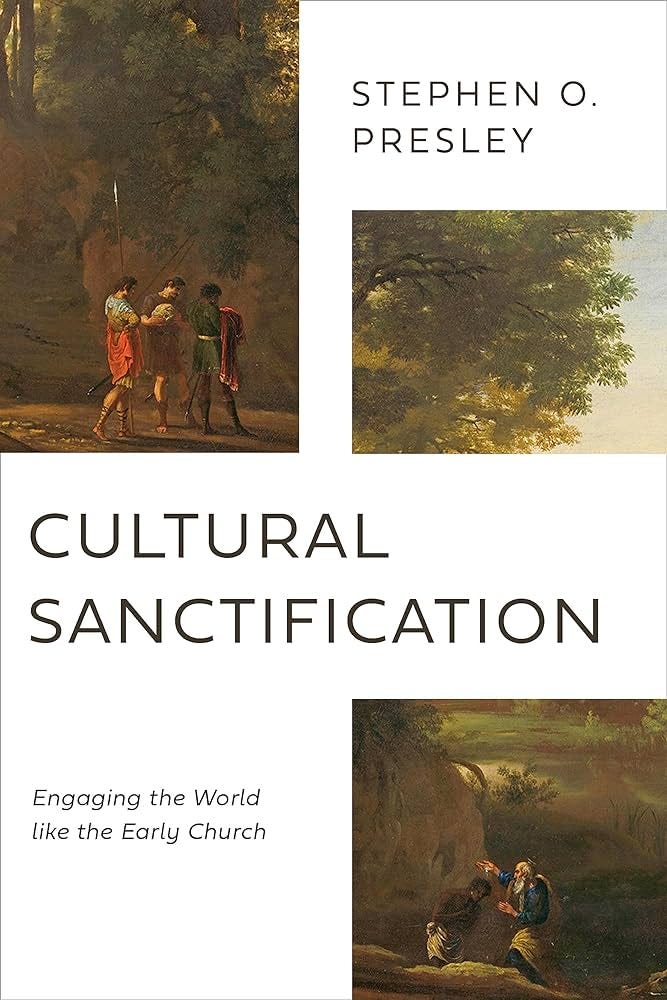
Writing anything on Christian Nationalism seems to be the quickest way to get published these days.1 So, I was somewhat surprised when I received the book Cultural Sanctification: Engaging the World Like the Early Church by Stephen O. Presley from Eerdmans Publishing. I don’t know much about Presley, and can only make assumptions about his worldview from his bio (he teaches at The Southern Baptist Seminary), but having little knowledge about him or his perspectives probably served me well as I entered the book with few preconceptions. What I found was an intelligent, thoughtful, and nuanced approach for Christians engaging with broader society.
In truth, this is a book that has few “hot takes,” which sort of makes me wonder if it will actually sell. Few and far between are the sort of radical, far right or far left takes that seem to be all the rage these days (meaning either a call for CN or yet another dystopian warning book by those on the left). Presley’s most controversial take, at least in my opinion, is what follows:
He writes, “We are now in a postmodern world where Christianity is rejected as morally bankrupt (and most of the time still intellectually suspect). In other words, Christianity is not sidelined anymore because it is religious but because its moral claims frequently run contrary to new expressions of social progress and moral diversity.”2 Obviously, reading between the lines, one can surmise what he might be talking about. Yet, he leaves it open to interpretation, which I think in the context of the book, fits. He writes later, “the early church never prescribed specific cultural scenarios to explain virtuous living. It expected believers to cultivate virtue and then learn the art of expressing that virtue in any situation.”3
The locus (at least as I see it) of Presely’s book centers around this claim:
“If we are living in a world of modern paganism, perhaps we should go back to the earliest centuries and examine the lives of the Christians who thrived in the age Caesars.”4
With that in mind, in his chapter on “Active Citizenship,” Presley suggests five actions Christians should pursue in accordance with Scripture and the testimony/example of early Christians.
Honor Civil Authorities
Pray for Civil Authorities
Pay Taxes
Defend Religious Liberty
Promote Virtue
As should be obvious, these are quite reasonable and fair, points that folks on the religious right and left would do well to consider—the right may bristle at the thoughts of paying taxes and the left might resist the idea of honoring civil authorities, especially in the age of Trumpism. But what seems especially important to me is his idea of promoting virtue. As a self-described virtue ethicist, I lament that virtue ethics seem to have gone by the wayside in our society, replaced by an ethic of money and power.5 Presley argues for virtuous actions in this way:
“When Joseph or Daniel found themselves in a foreign land ruled by a pagan kind, they did not sit around complaining; they lived virtuously and worked within the structures of the civil authority to become leaders worthy of respect.6
Again, these are words that could be prudent to those on the right and the left (though those on the left would not like the “pagan” descriptor). Certainly, those on the far right seem to be working furiously to disrupt the structures of the civil authority. And, on the far left, there does seem to be more than a few sitting around and complaining. What if we acted virtuously, seeking to become leaders worthy of respect? Seems pretty reasonable to me.
Yet, this reasonableness, this balanced, nuanced approach is why this book won’t win any accolades in this day and age, yet it is still a thoughtful, respectful, important addition to the question of social and political engagement for Christians as we approach the quarter mark of the 21st century. I might disagree with some of Presley’s specific views on moral and cultural matters, but where I can agree is that (we) Christians should approach such matters with high-character, virtuous living. Such, in my mind, might even build a foundation from which some common ground might be established and built upon.
Setting aside whether CN is being overblown and whether progressive Christians might be overlooking their own CN—see Ryan Burge’s Substack Ryan Burge
Presley, Cultural Sanctification, 5.
Presley, Cultural Sanctification, 48.
Presley, Cultural Sanctification, 12.
See my previous post here:
Presley, Cultural Sanctification, 63.