


TL;DR: This is a book I admired more than I liked. The authors make a compelling case for "effective altruism"—using evidence and careful reasoning to maximize the good we do in the world. My critique isn't of their heart or intentions, but of their assumptions about human nature. The book often feels disconnected from how ordinary people actually make decisions, especially around generosity. Most people give because they are moved by a need, not because they've calculated the highest possible return on investment. While the book challenged me to think more carefully about impact, I ultimately found its vision admirable, ambitious, and largely unrealistic.
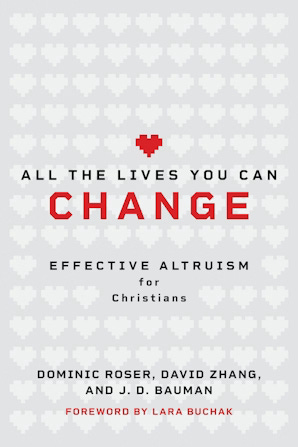
This is a book I REALLY wanted to like.
The authors—Dominic Roser, David Zhang, and J.D. Bauman—are clearly intelligent, thoughtful, and deeply committed to making the world a better place. I even had a brief phone conversation with Bauman a while back when he was pitching the book for the Future Christian podcast and came away with a positive impression.
Which makes it all the more uncomfortable that the further I got into the book, the less I found myself agreeing with it.1
Honestly, I’m not even sure how to approach this review. I don’t usually write straight reviews. I tend to engage books in conversation rather than simply evaluate them. But publishers send me books all the time (and please don’t stop), and I feel the least I can do is write something up—even when I don’t particularly like the book.
And unfortunately, I didn’t.
Let me also say this from the outset: the authors are likely smarter and better educated than me. They have advanced degrees, impressive credentials, and are far more accomplished in their respective fields than I am. They also seem to genuinely care about philanthropy and making the world a better place.
My problem with the book is not its morality.
It’s the anthropology.
The authors seem to assume human beings are far more rational, disciplined, and calculating than they actually are.
The Good Place Problem
Several things came to mind as I read.
Years ago, I knew a young man who was experimenting with one of those bizarre sleep-hacking systems. He slept for thirty minutes every few hours or something equally ridiculous.
I remember telling him: that’s great while you’re twenty-two and single.
But what happens when you’re in a real relationship and your spouse wants to go to bed together? What are you going to say?
“Sorry, it’s not time for my sleep cycle.”
Of course not.
You’re going to crawl into bed beside the person you love.
Life has a way of disrupting elegant theories.
I was also reminded of one of my favorite television shows, The Good Place. In the “IHOP” episode, the characters argue that modern life has become so morally complicated that even buying a tomato or eating a chicken sandwich involves countless ethical considerations that no ordinary person can reasonably navigate.
(I had to link the YouTube of the clip because I enjoyed this episode sooooo much!).2
That’s exactly what I kept thinking while reading this book.
And then there is a phrase from Donald Miller’s StoryBrand framework that has stuck with me for years:
Complexity confuses.
Human beings generally want to thrive or survive, he says.
Most people are not running cost-benefit analyses every time they buy groceries, volunteer, or make a charitable contribution.
They’re trying to get through the day.
Effective Altruism
The authors are writing from the perspective of what is often called “effective altruism.”
They summarize the movement with four core ideas:
Altruism. Doing good should be a significant part of ordinary life.
Impartiality. Everyone matters equally, regardless of geography or proximity.
Consequentialism. We should focus on what actually produces the greatest good.
Careful thinking. We should use evidence, reason, and research to determine what works.
None of those ideas are inherently problematic.
In fact, most of them are very admirable.
The challenge is that I think they often feel quite disconnected from how actual people make decisions.
The authors write:
“Evidence shows that, just like when choosing between charitable interventions, we tend to favor causes that we have heard of, which are closer to home, or which tug at our heartstrings, rather than those that have the biggest impact.” (65)
The implication is that this tendency is a problem.
The truth is that this is how most people operate.
We see a need, it moves us, and we respond.
That doesn’t strike me as a bug in the system. It strikes me as part of what makes us human.
The Fundraising Problem
Perhaps this is where my (albeit limited) experience in fundraising shapes my perspective.
The authors write:
“And in our time and age, taking a step back before blessing others—in order to choose the most effective avenues for transforming our resources into blessing—is one of the most explosively loving things we can do.” (55)
Sure, Maybe.
But here’s the reality.
In fundraising, you generally want to activate donors while they’re warm.
When someone feels moved to give, encouraging them to step back, conduct extensive research, compare outcomes, evaluate competing organizations, and calculate return on investment may work for a small subset of donors.
Most people will simply get distracted and move on.
And I didn’t like how the authors tend to downplay the emotional rewards of giving, as though logic and measurable outcomes should be the primary drivers.
People give for different reasons.
Some want maximum impact,
Others want to support something close to home,
Others want to support a cause that reflects their values.
A good fundraiser understands this and speaks to the motivations of the donor. Again, this is all pretty basic fundraising 101.3
Where the Book Lost Me
The authors write:
“Ethical consumption rarely avoids harm.” (172)
I understand the point they’re making, or do I? Statements like this left me more confused than inspired.
Should I stop trying?
Should I try harder?
Should I conduct more research?
Should I feel guilty?
The book often left me feeling as though the answer was simply more calculation.
More evaluation.
More analysis.
More optimization.
Again, I admire the impulse—I just don’t think it’s realistic.
At one point the authors discuss individuals who make dramatic sacrifices in order to maximize their giving. One example involves someone living in their car in order to donate more money.
That’s admirable.
It’s also not scalable.
Nor is it a realistic model for most people.
Which brings me back to the young man with the strange sleep schedule.
Some ideas work beautifully in theory. Real life has a way of complicating them.4
Admirable but Unconvincing
To be fair, the authors themselves acknowledge the difficulty.
They write:
“It’s easy to diagnose current systems as unjust. It’s harder to accompany such vague diagnoses with concrete action steps, particularly if these steps are to avoid grave risks of their own.” (169)
I agree completely.
What I’m less sure about is whether the book always recognizes that same challenge within its own proposals.
And as much as I wince writing a negative review, knowing my own book will be out in a few months and undoubtedly ripe for critique, here we are.5
In the end, I found myself admiring this book more than I liked it.
I really do admire the authors’ commitment to generosity, their desire to alleviate suffering, and their conviction that our resources should be used thoughtfully and effectively.
I think I even agree with much of what they are trying to accomplish.
What I struggle with is whether their vision is realistic for most human beings.
Perhaps that’s where age, experience, ministry, fundraising, and ordinary life have made me more skeptical.
Most people are not maximizing machines.
They are busy, distracted, emotional, relational creatures trying to do some good in a complicated world.
Still, I appreciate the authors’ challenge. Even if I remain unconvinced by effective altruism as a movement, I found myself repeatedly pushed to think more carefully about generosity, impact, and what it means to love our neighbor well.
And that’s probably worth something.
After all, as the authors themselves write:
“Jesus opens our eyes to see a million deaths as a million tragedies, and a million lives as a million individuals each uniquely loved by God. Love thy neighbor means love thy statistic.” (5)
That’s a beautiful sentiment.
And perhaps we need more young, idealistic, world-changing people willing to say it out loud.
During the call I literally told Bauman something to the effect of “I should be pitching myself you you!”
Maya Rudolph’s line “Your big revelation is ‘life is complicated!?’ …That’s a divorced woman’s throw pillow” LOL! — Also notice what she says, “do the research and buy another tomato.”
It strikes me that these guys would absolutely CRUSH it as part of a robust development team on a thriving nonprofit on the data analysis side.
Being tired as I am writing this doesn’t like help either—my own “sleep system” wasn’t great last night.
SHAMELESS PLUG - https://churchpublishing.org/products/9781640659988-the-church-as-community-hub
Thanks for this. There are a lot of EA people in SF and in Anthropic and in my congregation. This would be a good book to explore.
I find myself a bit torn. I share your anthropology, but perhaps disagree that it means we shouldn't aspire for better. I think Jesus called us to things that didn't come naturally to us. Also we learn to do things that don't come naturally all the time, such as advanced math (and all the calculations they employ.)
In some ways, EA is just asking us to be as prudent and rational with our philanthropy as we have long said we need to be with our use of church funds/stewardship. Imagine what would happen if a leader just spent church money the way they felt inclined to in the moment, rather than trying to be rational/prudent about it!
Some more discussion of this review in the Christians and Effective Altruism FB group!
https://www.facebook.com/groups/eaforchristians/posts/28327297523572120/?comment_id=28355556207412918¬if_id=1787304119535497¬if_t=group_comment