


TL;DR:
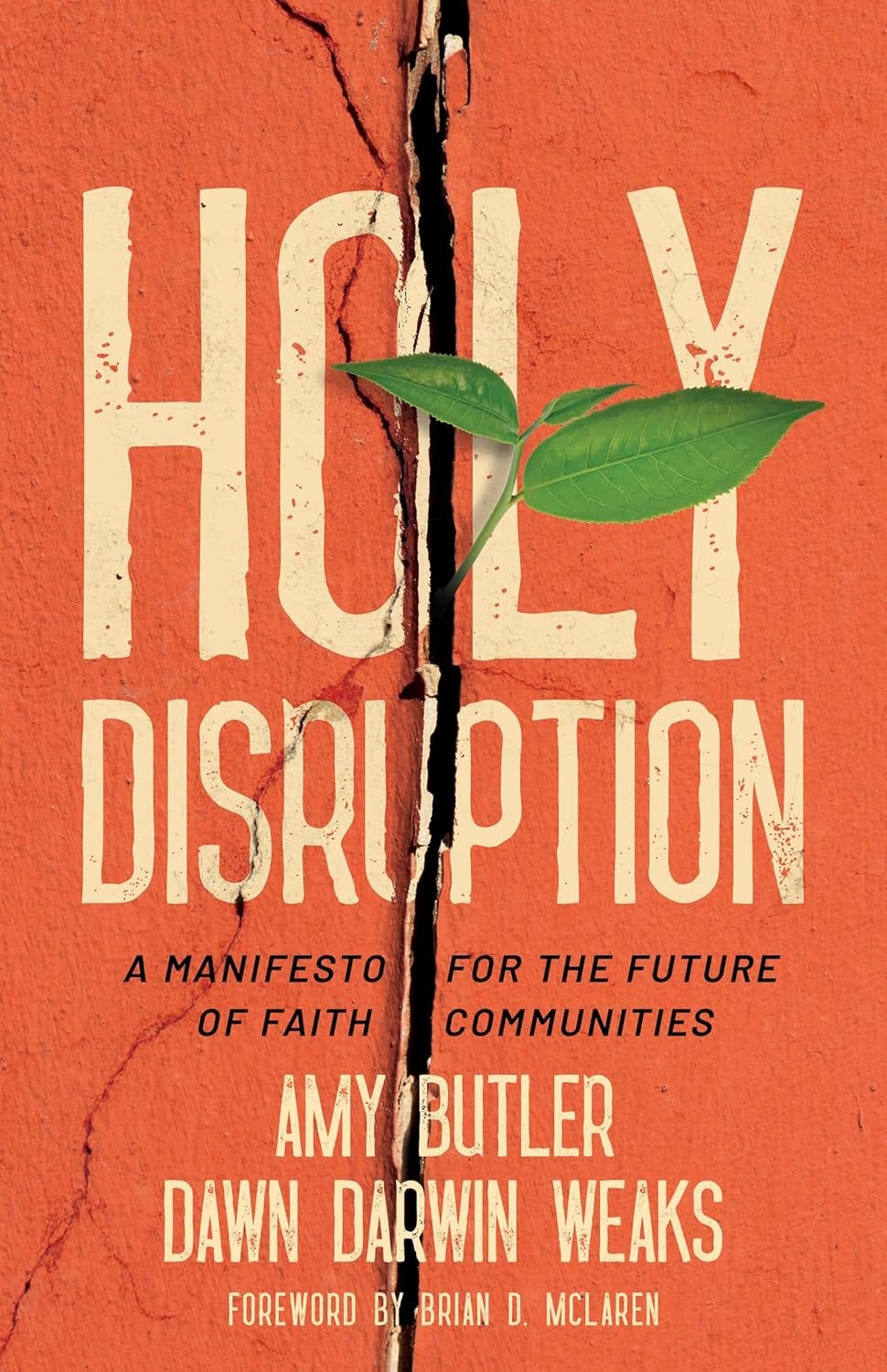
Holy Disruption by Amy Butler and Dawn Darwin Weaks has been praised—even by Walter Brueggemann—for its prophetic call to reimagine the church. I respect the authors and share their conviction that change is necessary. But in my reading, the book repeatedly collapses church into social entrepreneurship and too often sounds like a marketing piece for Invested Faith, Butler’s nonprofit. Drawing on Bonhoeffer, Protestant tradition, and my own training in social entrepreneurship, I argue that church is more than activism or innovation. It is Word and Sacrament, a Spirit-formed community of disciples centered on Christ’s death and resurrection. On this point, I must disagree.
Introduction
In one of the last books he endorsed before his death, Walter Brueggemann praised Holy Disruption by Amy Butler and Dawn Darwin Weaks in glowing terms. He called it “brave, bold,” urging the church to interrupt “business as usual” with proclamation and enactment of God’s reign. “Our thanks to Amy and Dawn for their prophetic perspective!” he concluded.1
Who am I to disagree with the iconic Walter Brueggemann? And yet—I must.
I write this not as an outsider to the conversation, but as someone deeply familiar with the very framework that animates much of Butler and Weaks’ argument. I studied social entrepreneurship in graduate school, participated in a year-long social entrepreneurship cohort, and continue to frame my own LLC work within that model. I believe in the promise of social entrepreneurship; it is innovative, practical, and often transformative. But in this book, Butler and Weaks repeatedly collapse the life of the church into the work of social entrepreneurs. And here is where I part ways with them: social entrepreneurship is not Church.
Invested Faith and the Push to Divest
At its core, Holy Disruption suggests—sometimes subtly, sometimes not—that churches should divest themselves of their buildings and assets, directing those funds instead toward Invested Faith, a nonprofit Butler leads. Consider the language:
“Maybe it’s repurposing an old building. Maybe it’s releasing it to use the assets to fund innovative ministry elsewhere. … Imagine what would happen if you put the seed of your church building and other assets into the fiercely hopeful hands of the Holy Spirit and see what She does with it” (44). Later, they add “Many of the funds Invested Faith channels to new and innovative ideas come from traditional churches to reached completion…” (91).
To be clear, the authors likely mean the Holy Spirit here, but the phrasing is uncomfortably close to suggesting that churches entrust their assets to Butler’s nonprofit. Elsewhere they write, “What a gift our robust religious institutions of the twentieth century have given us: the foundation of considerable assets by which we can seed the world with goodness” (28), followed by a description of Invested Faith’s work (29). The reader is also told that “Pastor Amy founded Invested Faith to identify, resource, and connect those who are… creating ‘church’ in unconventional places and unconventional ways…” (91) and that their goal “is to help those of us in traditional church spaces, distracted by decline and fear, to find the courage to use our assets to come alongside Invested Faith Fellows and other holy disruptors” (93). At times the book sounds more like a marketing packet than a manuscript.
What Is (and Is Not) Church
My deeper concern is theological. The book repeatedly reduces church to social entrepreneurship. Fellows funded by Invested Faith are described as “doing exactly what Jesus both did and taught” (8). But this collapses Jesus’ ministry into “helping people,” leaving out crucifixion, death, and resurrection—hardly marginal details. Social entrepreneurship may be worthwhile, but it is not church. And conflating the two, as Holy Disruption often does, risks reducing Christianity to little more than doing good in the world, rather than forming communities of worship and discipleship. The church does not exist to simply “seed the world with goodness.” Jesus told his disciples to go make other disciples.
The wider Christian tradition reminds us that the church is something far deeper. In his book Types of Ecclesiology, author David Emerton cites Dietrich Bonhoeffer, who insisted “that the church is not, and must never be treated by theologians as if it were, in Küng's words, "a free association of like-minded religious people," or, in Bonhoeffer's own words, a community of "pious people" or religiously and ethically motivated "kindred spirits," such that what the church is might be seen to be derived from, or produced by, its individual members and their socio-ecclesial acts (138). Instead, the church is an event of the Spirit’s act, “a community of hearts turned outwards”—the community God gives in redeeming grace to be the one “community of salvation” (144). Indeed, Emerton, citing Bonhoeffer, is clear that the church is the church only when it acts for others. For him, such action includes active love for one’s neighbor, intercessory prayer, and the mutual forgiveness of sins (135).
But the Protestant tradition has long had another way of defining what makes a church—Word and Sacrament, as Ryan Panzer notes in his book The Holy and the Hybrid, where he wrestled with how to do church in a virtual context and states that “the grace of God encountered first through Word and Sacrament” (7). What constitutes a Christian faith community then? Butler and Weaks acknowledge that “Traditional Protestant Christian denominations have determined that a church exists wherever word (the proclamation of scripture) and sacrament (the rituals like baptism and communion) are practiced in community,” but wonder, “Is this a robust enough understanding of church?” (Butler and Weaks 84). Butler and Weaks seem to suggest the answer is no. I would argue, emphatically, that it should be yes.
And their redefinition of church stretches even further: “Can an urban farm in downtown St. Louis hold the seeds of a faith community? We say yes. Even if the people who run it aren’t ministers and don’t hold formal services? We say yes” (88). Here again I strongly disagree. An urban farm may be good and necessary work, but without word, sacrament, and a gathered community in Christ, it is not church.
This is also where the book begins to sound more like an advertisement for Invested Faith itself: “Pastor Amy founded Invested Faith to identify, resource, and connect those who are… creating 'church' in unconventional places and unconventional ways, pushing… traditional church people to stretch our imaginations about how church happens and where and in what ways we can show up to support it. Many of the funds Invested Faith channels to new and innovative ideas have come from traditional churches who reached completion but who long for a legacy that lives beyond their institutional life” (Butler and Weaks).
Theological Overreach and Rhetoric
The authors even claim: “We think it’s time to name our insistence on church and institution as we know it as sin. Idolatry, even” (4). I think that goes too far. Yes, church forms must change. I’ve written elsewhere, drawing on Ted Smith and Dwight Zscheile, about the decline of voluntary association models. But to call commitment to gathered worship and discipleship “idolatry” is a theological overreach.
This trend is common in progressive Christian circles: replacing pastors with activists, congregations with nonprofit projects, discipleship with “doing good.” The book warns against limiting faith community to stained glass and pews, calling such limits “a blatant sin” (57). That sounds inspiring—until you realize the practical implication: close your church, sell your building, and give the proceeds to Invested Faith. The spiritualized language adds weight to what is essentially an organizational fundraising appeal. And that’s something I’ve noticed before—in my review of Circle of Hope, I pointed out how personal conflicts were always communicated not as “you upset me” but as “you’ve violated the Bible.” Framing everything in theological absolutes heightens the rhetoric but also raises the stakes in ways I find unhelpful here as well.
Following the Money
Curious about the organization behind the book, I went digging into Invested Faith’s IRS filings. The most recent return I could initially find was the 2022 postcard 990—filed by nonprofits with gross receipts under $50,000—which revealed very little, as expected. ProPublica’s Nonprofit Explorer, however, makes the 2023 Form 990 available, showing that Amy Butler received a salary of $84,000 and the board chair $1,500. In that year, Invested Faith reported $478,941 in contributions and grants (almost certainly all contributions), spent $248,597 on program services out of $314,703 in total expenses, and closed the year with $164,238 in net assets.
The organization’s own 2024 annual report, available on Invested Faith’s website, adds further detail: a $1 million three-year pledge from St. Peter’s UCC (Ferguson, MO), 20 new fellowships awarded, and $110,000 disbursed in grants. A total of 41 Fellows participated in its programs, with 62% of funding coming from churches and total income of $805,540.
To be clear, I don’t begrudge Butler or any nonprofit leader receiving a salary—staff are often both the largest expense and the primary drivers of mission. And in fairness, this same dynamic exists in churches: pastors preach about giving to the church, and those gifts both sustain the ministry and pay their salaries. The difference here is the way Holy Disruption frames its appeal. The language of prophecy and Spirit-led disruption positions Invested Faith not simply as one ministry among others but as the vehicle for the church’s future. That overlap doesn’t make the work illegitimate, but it does make the rhetoric feel uncomfortably self-serving.
Questions of Mission and Incentive
Notably, Invested Faith’s own reporting indicates that only 78% of its Fellows identify as Christian. That is not inherently a problem—churches have always supported causes and initiatives beyond their own walls, many of which are not explicitly Christian. But when paired with the rhetoric of Holy Disruption, which frames these projects as the very definition of discipleship, the dissonance is hard to miss.
I am also reminded of a recent post I read by Jeff Gill about how external organizations often want access to a church’s members and especially to its donors. The goal is not necessarily the health or sustainability of the congregation itself, but rather to “develop” those donors for other causes. Reading Holy Disruption, I can’t help but wonder if something similar is happening here. Is it too far a stretch to suggest that Invested Faith has a built-in incentive, to use an economics term, to encourage churches to close their doors so that their assets can be redirected into its own programs?
This is what makes the book feel so uncomfortable to me. The religiously coded language—invocations of the Spirit, calls to disruption, appeals to prophetic courage—masks what sometimes sounds like a fairly straightforward fundraising agenda. Churches are not simply pools of assets to be liquidated for “innovation.” They are communities of Word and Sacrament, discipleship and prayer. When the call to close congregations is coupled with an invitation to give the proceeds to Invested Faith, it’s hard not to see a conflict of interest.
Church Assets and Legacy
I also take issue with the push for closing churches to give assets to nonprofits rather than new churches. Nonprofits have multiple funding streams; churches do not. While it may be appropriate for a closing church to give part of its assets to community partners, I believe churches should prioritize starting and reviving more churches. I’m told that the UMC Book of Discipline mandates this, which also makes assertions in this book troubling, as they argue that denominational norms are holding us back (again, I don’t necessarily disagree), but it strikes me that it’s not hard AT ALL to set up a designated fund within a church denominational structure that can and will support a very specific cause. This summer I just talked to the president of the foundation for my own denomination. Anyone who follows my stuff knows I’m RARELY shilling for denominational structures, but this is again why this book feels so off-putting to me, with the implicit message of “don’t trust your own organizational structures, but Invested Faith.”
Yes, church wealth can be entangled with injustice—anyone who’s read Killers of the Flower Moon while driving past huge, old churches in downtown Tulsa, OK will realize at least some of that grandiose might have come at the expense of oil wealth taken from Indigenous populations. But I believe God redeems ill-gotten gain, and that church funds are best invested in forming communities of worship and discipleship. Sure, it may be after prayer and discernment that a congregation decides to give some of their funds to local causes or organizations as a response to recent or historical injustice, and I celebrate this. But, it seems like there is this mood within Progressive Christianity to assume that retaining any amount of margin or assets for future endeavors is wrong.
A Foolish Act of Hope
Since writing the above, I’ve begun reading Forming Communities of Hope in the Great Unraveling by Alan Roxburgh and Roy Searle. Reflecting on Jeremiah, they highlight how God instructs the prophet to do a foolish thing: purchase a worthless piece of land in a time of crisis (Jer. 32). “Who buys a worthless piece of land when everything is so dark?” they ask. Their conclusion: “Hope is not to be found in the usual places, with the usual people, using the usual methods” (44).
That image has stayed with me. It makes me wonder if the faithful act in our time might not be selling off property, but rather holding onto it in hope—trusting that God can fill these buildings again. For seventy-five years, Roxburgh and Searle argue, North American “Euro-tribal” churches have lived by a story of control, management, and predictability. Selling underutilized buildings fits neatly into that story. Jeremiah, however, offers a different witness: a story where hope looks foolish, and faith means planting seeds in places others deem barren.
Conclusion
Ultimately, Holy Disruption left me startled and disappointed. I’ve interviewed both Butler and Weaks on my podcast, and I respect them personally. They are thoughtful leaders. But in this book, I believe they confuse social entrepreneurship for church, fundraising for prophecy, and activism for discipleship. And on those points, I must disagree. While not always the case, I believe that holding onto church buildings—even when it seems counterintuitive—can in fact be a faithful act of hope, trusting that God may yet fill them again.
Works Cited
David Emerton. Types of Ecclesiology, Baker Academic, 2024.
Butler, Amy, and Dawn Darwin Weaks. Holy Disruption: A Manifesto for the Future of Faith Communities. Chalice Press, 2025.
Ryan Panzer, The Holy and the Hybrid: Navigating the Church's Digital Reformation, Fortress Press, 2022.
Roxburgh, Alan J., and Roy Searle. Forming Communities of Hope in the Great Unraveling, Wipf and Stock, 2025.
I must also confess I find the use of the plural pronoun “our” confusing…
A home run. I think this is why we don't hear our new church ministry talk about planting new churches.
Guilty as cited; my thoughts on the whole activist model as it interacts with the congregational model (which may not be as dead as some suppose, but there's a lot of motivated reasoning out there) shows up as I concluded my thoughts about our recent Memphis General Assembly, and beyond Memphis:
https://knapsack.substack.com/p/general-assembly-2025-tentative-conclusions
https://knapsack.substack.com/p/beyond-memphis