


TL;DR:
There’s consistent data showing higher reported well-being among conservatives, with factors like church attendance playing a role. Instead of explaining it away, we should ask what these patterns reveal about formation, community, and how we pursue human flourishing.
The Data—and the Reaction
In recent years, data has circulated showing that conservatives tend to be happier and more content in life than liberals/progressives.1 At this point, that’s become common enough that it hardly needs citation.
What’s been more surprising is the reaction to it.
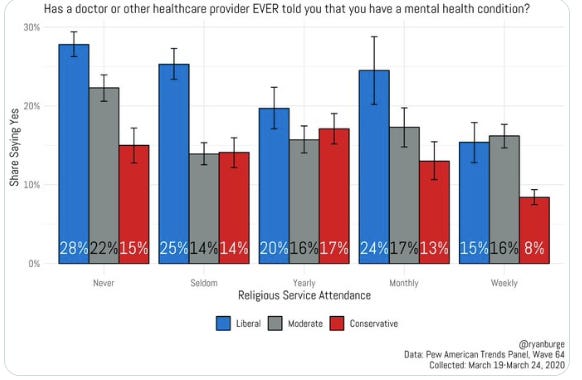
A few weeks ago, I shared some data from Ryan Burge showing that church attendance correlates with better mental health. I was struck by how quickly people tried to push back on it—even dismiss it outright. As I texted a friend, it’s surprising how many “we believe in science” progressives struggle to accept findings that don’t align with their assumptions.
And yet, even among self-identified liberals, those who attend church weekly are far less likely to report a mental health condition.
Trying to Explain It Away
So I started digging further.
I came across a research article2 attempting to explain the gap. It suggests the difference may be due to “Conservatives’ greater levels of justifications for and acceptance of the current state of the world (e.g. inequality)” serving as a pacifying factor, or even “due to stigma” around reporting mental health struggles.
The study goes on to say:
“One explanation for this ideological gap in mental health could stem from differing ideological justifications for the state of the world. Conservatism is a system-justifying ideology that seeks to rationalize the existing political, economic, and social order.”
I’m not a conservative, but it’s not hard to see why claims like that contribute to skepticism toward academia—especially when they read less like neutral analysis and more like heavy-handed interpretation.
After all, the entire Make America Great Again movement is built on the assumption that the current political, economic, and social order was not working. So the idea that conservatism simply “rationalizes” the status quo feels incomplete at best.
To its credit, the study does acknowledge:
“We cannot rule out the possibility that there is a real gap between mental health and overall mood ratings among conservatives but no such gap among liberals.”
And even more directly:
“Since 1972, conservatives have consistently reported greater levels of happiness compared to liberals.”
But then it pivots, suggesting that “liberals lack an ideological rationalization which frames inequality in a positive or neutral light,” and again that “Conservatives’ greater levels of justifications for and acceptance of the current state of the world serve as a pacifying factor for their own mental state.”
Those conclusions read less like neutral findings and more like interpretive framing.
What the Data Actually Shows
What seems more straightforward is correlation.
“Conservatism is positively correlated with a number of traits that are traditionally associated with better mental health and well-being, such as religious faith, patriotism, marriage, higher incomes, and old age.”
“It is also true that conservatives in the United States are more likely to be religious than liberals. Thus, at least some portion of the ideological mental health gap may actually be caused by religiosity.”
In other words, church attendance is associated with positive outcomes—not universally, not in every case, but often enough to take seriously.
The study itself acknowledges these realities. Conservative Americans are “more likely to get (and stay) married, more likely to be financially secure, and tend to be older”—all factors tied to improved mental health.
Conversely, “liberal Americans are younger, less likely to be religious, more likely to be members of socially ostracized groups, and less likely to marry. Liberals are also more engaged in politics, participate more, and more likely to find meaning in political activism, but involvement in politics appears to have a negative impact on well-being” (my emphasis).3
That last line is particularly striking.
Even after attempting to control for these variables, the study still concedes that “even controlling for a wide variety of alternative factors the ideological mental health gap still persists.”
The Real Question
Which raises a different question.
Why is this particular conclusion so difficult to accept?
Why are so many progressives—especially progressive Christians—so eager to downplay or explain away the apparent benefits of church?
Seeking prayer, community, and support within a church isn’t a replacement for medical care—but it is a meaningful form of social and spiritual support. As a hospital chaplain, I regularly encourage people to draw on those kinds of resources.
Some of the alternative explanations offered from the study feel less convincing. For example:
“conservatives…may inflate their own mental health ratings to avoid confronting a negative image of themselves.”
But isn’t part of mental health the ability to cope, to reframe, to maintain resilience in the face of difficulty?
Similarly, the attempt to argue that liberals are “actually” happier includes this line:
“Liberals may be more likely to demonstrate signs of happiness: liberal politicians expressed more positive emotional language as well as smiled more intensely and genuinely, and liberal Twitter users were more likely to tweet out positive words and messages than conservatives on Twitter.”
Those words actually made it into an academic paper. That kind of reasoning doesn’t clarify much.
Formation Beneath the Surface
More broadly, I do wonder about the formation happening beneath all of this.
In recent years, parts of progressivism have leaned heavily into emphasizing injustice, marginalization, and structural critique. There is real importance in naming those realities.
But there is also a difference between acknowledging suffering and organizing one’s entire outlook around it.
At times, it can feel like we are encouraging people not just to recognize hardship, but to remain within it—to interpret their lives primarily through that lens.
The study itself hints at this dynamic when it notes that liberals are more politically engaged, more active, and more invested—while also acknowledging that such engagement “appears to have a negative impact on well-being.”
There may be something there.
A constant “hermeneutic of suspicion” doesn’t just analyze systems—it can begin to shape how a person experiences the world, often in ways that cultivate mistrust and resentment.4
A More Personal Question
Which brings me to a more personal question.
When so many people—especially liberal Christians—question the value of church attendance, are they evaluating it clearly? Or are they, like all of us at times, influenced by the assumptions of their broader ideological environment?
More and more, it seems like many of us—across the political spectrum—are susceptible to a kind of ideological capture. A reluctance to seriously consider that our own frameworks might be incomplete or even wrong.
That dynamic is not limited to one side. It’s part of the broader moment we’re living in.
Looking in the Mirror
There are, of course, real concerns worth naming.
Data shows that increased church attendance can correlate with stronger political conservatism. More, churches are increasingly becoming the domain of the well and educated upper-class financially.
Those are not small issues.
But for me, those concerns don’t negate the data—they invite deeper reflection.
They push me not to dismiss the mirror, but to look into it more honestly.
The Question We Have to Face
This isn’t about defending one ideology over another.
It’s about asking a harder question:
What is actually helping people flourish?
And are we willing to follow the answer—even when it challenges what we want to be true?
I will use these terms interchangeably even if I recognize they are technically not the same, as Burge’s data seems to combine them.
https://pmc.ncbi.nlm.nih.gov/articles/PMC12043138/
It would be interesting to see if in 10 years there is a similar mental-health impact amongst young MAGA-acolytes.
Personally speaking, I found my mental health improve when I stopped assuming people were out to get me. Again, as mental health experts would say, focus on what one can control rather than what one cannot.
My faint parallel to what you describe here: I was a student assistant minister in a campus ministry, a student associate pastor in seminary, then have had four ministry positions with "letters of call" along with a period in there as an unpaid staffer (long story), and now have been the long-term supply pastor for a small mainline church not of my tradition. Point being: that's seven locations, six if you discount a campus ministry, across three states, in urban to county seat to rural locations. Okay. In four settings, I tried to do a study of C.S. Lewis's "The Screwtape Letters" -- EVERY time, it did not work. The language, the verbiage was simply off-putting to the people, and these were folks who "self selected" for a study. After a few weeks, the more outspoken would just say "I can't follow this at all" and quickly the group would petition for a shift.
I did have a bit more luck in three settings with Gene Peterson's "A Long Obedience in the Same Direction" which was largely built on Psalms (the psalms of ascent, 120-134), but there was a general running commentary of "what's he trying to say?" about Peterson's chapters, and two of the three were very nearly derailed on the same grounds as I describe with "Screwtape." And I was an early part of Gay Reese's "Unbinding the Gospel" book & sequels, and "The Bethany Project" which evolved into the still extant "Bethany Fellows" program. But one BIG problem with the Unbinding project was that it was difficult beyond words to get people to actually read the chapters, and do the exercises. And this was back in the 1990s, early-early 2000s.
When I've posted in Disciples ministry groups about these issues, I get a torrent of posts from people who insist, and I do not doubt them, that in THEIR congregation there's a small but mighty cohort who read books, discuss them intently, and share insights thereby gained. More interestingly, there are always a few people who say they have had similar experiences: they share this directly to me, in messages or emails, not in comments on the post. Because they know what the reaction will be.
It is surely possible I have just lost at the lottery, as many do. Perhaps I have served by dumb luck or blind misfortune only congregations which were post-literate -- it's not that each did not have a critical mass of professionals (teachers, nurses, lawyers, principals, mid-level managers) or had no post-secondary degrees in the membership and leadership, because they all did -- and there are many Disciples of Christ congregations out there which find books and reading for discussion to be spiritually enlivening, I just didn't end up at any of them. It's possible.
More likely, I think, is that it's not common, but it's very discomforting to seminary trained ministers to concede that in general, our congregations don't love literature, let alone talking about it. There's a huge carve-out for Bible stuff, but by extension, do we really read our Bibles, or consult them for confirmation of the concepts and images we bring to the page? Do we discuss biblical passages or narratives, or glance over them, and talk loudly about what we have been trained to think they address? My experience, again, is that it is pulling teeth without novocaine to get a heterogenous church group to really delve into a scriptural text.
But my point, which I claimed to have, is that there's a parallel here to me, at any rate, in how my colleagues tend to reject this as a general description of our churches or our congregants. Our people love books, love reading, love discussion groups. And any attempt to push back on that has gotten me a fair amount of tsouris, again from fellow ministers. Not so, not so! And I generally sigh quietly, and let everyone else go on about their last five or six successful reading groups. Yet still I wonder...
Thanks for this post.
I see two issues. One is the correlation between well-being and worldview (including on religious matters). The other is the rejection of results that don't fit with one's own opinions.
This confirmation bias happens on many issues across various spectra of opinion. It's troubling when the most highly credentialed fail to let contradictory evidence open their minds. This goes to the heart of what critical thinking and education are supposed to be about. Most troubling, such a bias makes it hard to correct possibly dangerous errors.
This is all the more reason to have diversity of opinion in processes of decision-making. Although this lets a degree of error through the door, the alternative blocks unpopular truth from having a hearing.