


TL;DR/Executive Summary
Church planting in Wyoming’s frontier days shows that survival depends less on charisma and more on four things: external realities, denominational support, serious funding, and a gospel-driven calling. The Hannans’ story in Cheyenne proves that with partnership, resources, and focus, a church can endure even in the hardest seasons.
“History does not repeat itself, but it sure does rhyme.”
The well-known quote "Those who forget history are doomed to repeat it" comes from the lesser-known American philosopher George Santayana. A more recent twist I've heard, and perhaps a truer one, is that "history does not repeat itself, but it sure does rhyme."
This is part of why I value reading history, and why I was drawn to pick up a couple of books by the late Rev. Dr. Bryant D. Badger—a Disciples historian and minister whose work offers rich insight into the struggles and hopes of frontier ministry. I first encountered Badger’s work through his History of the Christian Church in Colorado (1873–1997) and, a couple years later, found myself returning with gratitude to his voice (See my engagement with his Colorado book below).
I feel a kinship to Badger—not just through geography or denominational heritage, but through spirit. On the few occasions I've run into his daughter at denominational events, I’ve been compelled to ask more about the man. In his obituary, he was remembered as someone "passionate about reading."
That resonates deeply with me. I, too, have always read widely and often randomly, which is exactly how I rediscovered Badger’s legacy. Engaging his work is like being part of a quiet, ongoing conversation across time.
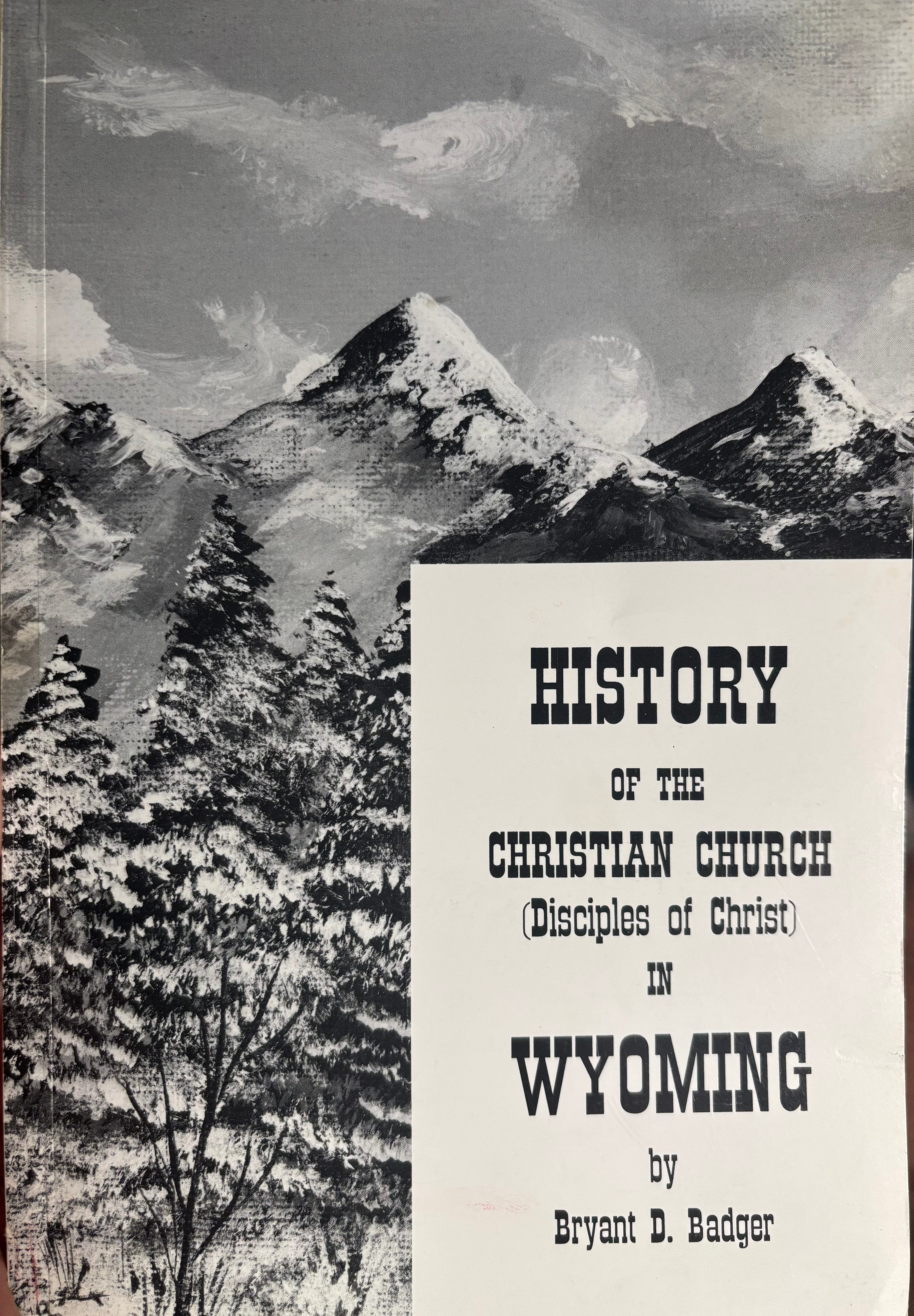
Approaching his History of the Christian Church in Wyoming (1996) with a church-planting lens, I was eager to see what insights his careful chronicling might offer for today’s leaders and planters.
Lessons from the Field
Church planting has never been easy. But in a place like Wyoming—marked by geographic isolation, economic hardship, and spiritual ruggedness—the work of starting and sustaining Christian communities has been particularly grueling. And yet, through the dry wind and lean years, some churches have endured. Their stories, especially that of First Christian Church in Cheyenne, offer both a cautionary tale and a hopeful witness.
In 1925, Charles and Martha Ann Hannan arrived in Cheyenne, Wyoming. They weren’t paid. They weren’t sent. They came on vacation and decided to stay. Paying their own expenses, they conducted a survey of the area, resigned from their prior church, and moved to Cheyenne by October 1. With little more than faith and a vision, they nailed a sign to their rented house that read: “Christian Church Parsonage.”
Both Hannans were ordained ministers. They worked as a team, and their ministry was remarkable for its generosity and scope. By 1927, the fledgling church had a local budget of $3,000 and gave an additional $3,600 toward missions—a staggering sum for the time. The pastor’s salary was subsidized by the United Society, an early example of denominational support that kept the mission alive.
But the Great Depression hit hard. By 1933, the church was considering closing its doors and sending the keys back to the American Christian Missionary Society. With no money for salaries or bills, only denominational aid and a few debt concessions kept the doors open. The church survived—and still exists today.
When Churches Close, It’s Not Always About Leadership
The North Casper congregation, after eight years and three pastors, voted in 1927 to cease worship and return to the First Christian Church of Casper. Its mission status was absorbed, and its legacy slowly faded. A new church in Gillette was explored but never launched due to economic instability. Even churches with bold starts from the state to the south, like the Friendship Church in Aurora, CO, closed just a few years later. Another ill-fated and poorly named attempt, Crusade Christian Church in Greeley, didn't last long.
Meanwhile, many other church plants across the region came and went—not necessarily because of poor leadership or lack of commitment, but due to the boom-and-bust cycles that define much of Wyoming's economic history. As Badger hints at, external realities often play a more significant role in a church’s longevity than the talent or faithfulness of its leaders. Just as COVID-19 disrupted church life globally, churches in Wyoming were frequently shaped by waves of economic uncertainty, population shifts, and industry changes that were beyond their control.

Denominational Support and Dollars
One clear takeaway from the Cheyenne story is this: "denominational" support made the difference. During the darkest days of the Great Depression, when the church considered closing its doors, financial assistance from the American Christian Missionary Society helped keep the lights on and the ministry alive. Without that external support, the church may not have survived.
Rev. Aikens' words from nearly a century ago still ring true: “We need money.” Adjusted for inflation, the $22,579.57 invested in thirty Colorado congregations between 1897 and 1920 would be equivalent to over $740,000 today. Similarly, the Cheyenne church received a local budget of $3,000 and gave $3,600 to missions in 1927, with the pastor's salary supported by denominational aid. In today’s dollars, that $6,600 total commitment is roughly equivalent to over $115,000. These figures are proof that serious church planting requires serious funding.
The Power of Team-Based, Gospel-Driven Ministry
Charles and Martha Ann Hannan exemplify what we might today call the “parachute” method of church planting—arriving in a new city with no external team, no guaranteed funding, and no built-in support structure. Yet, remarkably, they succeeded. Both were ordained, and they worked in close partnership, modeling a team-based approach to ministry that was likely rare in their era and still instructive today. Their unified vision, shared leadership, and deep commitment to the community laid a strong foundation for the church’s survival and longevity.
Four Big Takeaways for Today
So, in these key themes—external socio-economic realities, denominational support, financial investment, and a gospel-centered calling—we find enduring truths of church planting. These factors, more than the charisma of a single leader or the size of a launch team, often determine whether a church thrives, struggles, or disappears from the map.
Yet we cannot overlook one more essential ingredient: a sense of calling and a passion for the gospel. As the Hannans, Rev. Stout, and others demonstrated, church planting is ultimately a spiritual endeavor rooted in the conviction that the good news is worth sharing and communities are worth building. Even in the face of scarcity or setbacks, that gospel-driven calling is what moves leaders to plant, stay, and serve.

The west is no doubt a unique and difficult religious landscape. It’s surprising how much it costs to plant a church, even when on a shoe string. But I agree with your closing statement, and believe that when God is with us He alone can make it work; He alone can open the doors needed to make it thrive. Being almost to the start of year three, and with no denominational support, I can agree that this is the hardest, most humbling thing ever, and the closest I’ve ever felt to God.