


TL;DR:
I picked up Doing Well by Doing Good expecting significant overlap with my own interests in church-based enterprise and social entrepreneurship. While the book offers some genuinely helpful case studies and practical insights, I found its treatment of Business as Mission (BAM) surprisingly inaccurate and deeply suspicious of explicit Christian witness. The biggest divide between Barnicle and myself seems less about practice and more about theology—whether the gospel is something to be proclaimed alongside economic work or something that should remain largely implicit.
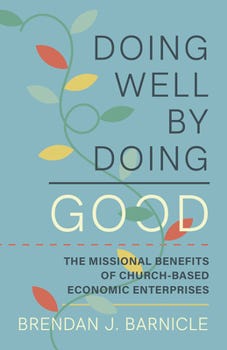
I was excited when I first saw the title Doing Well by Doing Good: The Missional Benefits of Church Based Economic Enterprises by Brendan J. Barnicle.
As I’ve mentioned before, I have a book coming out on a somewhat similar topic, so whenever I encounter overlapping ideas or themes, I take it as a sign that I’m probably onto something worth exploring.
That being said, it became apparent very early on that Barnicle and I approach this topic from vastly different perspectives.
My Background with Business as Mission
For starters, I completed an MBA with a nonprofit emphasis at Hope International University, where I studied social enterprise and Business as Mission (BAM).
Which is why I found Barnicle’s treatment of BAM so perplexing.
At one point he writes:
“Both the prosperity gospel and the BAM initiatives endorse profit and wealth as evidence of God’s favor. They see the Mission of God as Business as Mission” (18).
Now certainly, I can imagine some contexts where BAM entrepreneurs may over-spiritualize business success. And historically, BAM did emerge largely in cross-cultural missionary settings focused on Unreached People Groups.1
But Barnicle’s broader characterization simply doesn’t align with either the movement’s stated goals or the way BAM is commonly understood.
What BAM Actually Is
For example, Barnicle later argues:
“BAM advocates reject any activities that are not directly related to the business or to their mission, which is largely defined as converting people to their form of Christianity. They are exclusively focused on a coupling of business and mission as a way to faithfully follow the gospels. They overlook or undervalue other aspects of Christian faith, mission, and discipleship” (23).
Frankly, I don’t know how someone familiar with the broader BAM movement could write that.
Doing some very basic searches on Business as Mission, I quickly found definitions like:
“Discover the power of business to respond to the world’s most pressing needs — for God’s glory, the gospel and the common good.”2
Or:
“Business as Mission is the creation and growth of for-profit, sustainable companies that are intentional about Kingdom of God purposes. Business as mission (BAM) addresses the economic, social, environmental, and spiritual needs of unreached peoples and vulnerable communities.”3
Or again:
“Business as Mission involves ‘the whole church taking the whole gospel to the whole world.’”4
None of those definitions remotely resemble Barnicle’s portrayal.
Even more confounding is his assertion that BAM is somehow the “logical extension of the prosperity gospel” (22).
Honestly, I’m not even sure where to begin with that claim because it feels so disconnected from the actual theology and practice of most BAM practitioners.5
A Deep Suspicion of the Church
What also struck me throughout the book was a deep suspicion—not just of capitalism or business—but seemingly of the church itself.
Barnicle argues that even if churches launch businesses or economic enterprises, they ultimately must relinquish meaningful control or else:
“they would likely perpetuate the past oppressive colonial roles of Christian churches” (52).
He goes on to acknowledge that:
“it cannot be guaranteed that the enterprise will not make poor choices” (52).
And later repeats:
“Churches may not be able to prevent businesses that they help launch from exploiting others. Churches may try to provide oversight and regulations, but such an approach risks perpetuating the past oppressive roles of Christian churches” (103).
Reading those sections, I found myself wondering:
Does Barnicle actually believe the church has anything uniquely good to offer economic life?
Or is the church primarily a liability to be managed and restrained?
That question became even harder to ignore when he later suggests that leaders of gospel-based enterprises “must not proselytize [or] sermonize” (149).
At that point, it becomes easier to understand why he dislikes BAM.
But it also raises a deeper question for me:
What exactly is the gospel in Barnicle’s framework?
Because throughout the book, there were moments where it felt less like Christianity was being presented as good news about Jesus and more like a generalized vision of human flourishing with Christian language attached to it.
And perhaps that, more than anything else, is where our approaches fundamentally diverge.
Where I Do Agree
That being said, I don’t want to suggest the book has no value. In fact, the latter portions of the book contain several strong case studies and practical insights worth paying attention to.
Barnicle repeatedly emphasizes things like:
“the primary focus must be missional, not financial”
“A clergyperson does not need a business background or entrepreneurial experience”
and that leaders “need to be committed for the long term.”
He also rightly insists that faith and mission must remain central to any church-based economic enterprise.
On those points, I actually found substantial agreement.
Which is part of what made the beginning of the book feel so perplexing to me.
Because ultimately, many of the practical outcomes Barnicle advocates for are not radically different from what many within the BAM movement itself are trying to accomplish: sustainable enterprises rooted in Christian mission, serving both communities and the common good.
Where we seem to diverge is less on practice and more on theology—namely, whether explicit Christian witness and proclamation are liabilities to be restrained or essential parts of the mission itself.
And for me, that distinction matters quite a bit.
https://thirdpathinitiative.com/tag/10-40-window/
https://businessasmission.com/
https://businessasmission.com/start/
https://www.dbu.edu/business-as-mission/what-is-bam.html
https://www.bam360.org/business-as-mission/
It feels like many in the progressive halls of the church are more like functional deists than actually Christians.
Your article is my first exposure to BAM. To me, it sounds like a somewhat Christian evangelicalized form of what I have always called Socially Responsible Capitalism. Am I off-base?