


In today's political and religious landscape, the lines between faith and politics are increasingly blurred. As I listened to a recent episode of Rainer on Leadership, featuring sociologist Ryan Burge, I was struck by how deeply these dynamics influence not just the Southern Baptist Convention (SBC), but American Christianity as a whole. The September 20 episode, titled “What happened to all the white Evangelical Democrats,” delved into these themes, raising important questions about the shifting nature of Evangelicalism and the consequences for the wider Christian church. Below, I unpack some of the key takeaways from the episode and explore their broader implications for Mainline Protestantism and Progressive Christianity.
The Southern Strategy and the Divide Between Evangelicals and Fundamentalists
One of the most striking moments in the episode was Burge's candid discussion of the "Southern Strategy" and its impact on American Evangelicalism. He didn’t shy away from referencing Lee Atwater, who famously orchestrated this political strategy to secure conservative voters by appealing to racial anxieties. This strategy had a lasting effect, intertwining politics and faith in a way that continues to shape the SBC and American Evangelicalism today.
Sam Rainer's distinction between fundamentalists and Evangelicals was another noteworthy moment. As he and Burge discussed, the Southern Baptist Convention is increasingly being pulled toward fundamentalism, despite the attempts of many, like the Rainers, to differentiate themselves. This tension between the desire for societal impact and the pull toward purity is a significant issue within the SBC—and one that echoes in broader conversations about faith and politics.
The Evangelistic Challenge: Separation vs. Engagement
Burge's first major sociological observation centered on the challenge fundamentalism faces in evangelism. By separating itself from society in a pursuit of purity, fundamentalism can often abandon efforts to evangelize or engage with the world. Burge argued that for evangelism to succeed, Christians must offer something distinct from the surrounding culture—something compelling enough to draw people in. His critique of the Christian Right suggested that, in many cases, politics have become a substitute for this distinction, with allegiance to political ideologies overtaking commitment to religious transformation.
This brings to light a deeper issue: when faith becomes synonymous with politics, the unique, transformative power of the Christian message risks being lost. Evangelicalism's increasing alignment with the political Right has, in some cases, made it indistinguishable from broader conservative movements, which weakens the church's ability to serve as a distinct and transformative presence in society.
Horseshoe Theory and the Religious Triangle
Burge’s introduction of "Horseshoe Theory" offered an insightful lens through which to view the political and religious spectrum. Rather than seeing the Left and Right as diametrically opposed, horseshoe theory posits that they are actually closer than they seem, with both sides operating from a similar space but toward different ends. Burge used this concept to explain how the political Right and Left, despite their differences, often rely on similar methods of identity formation and societal critique.
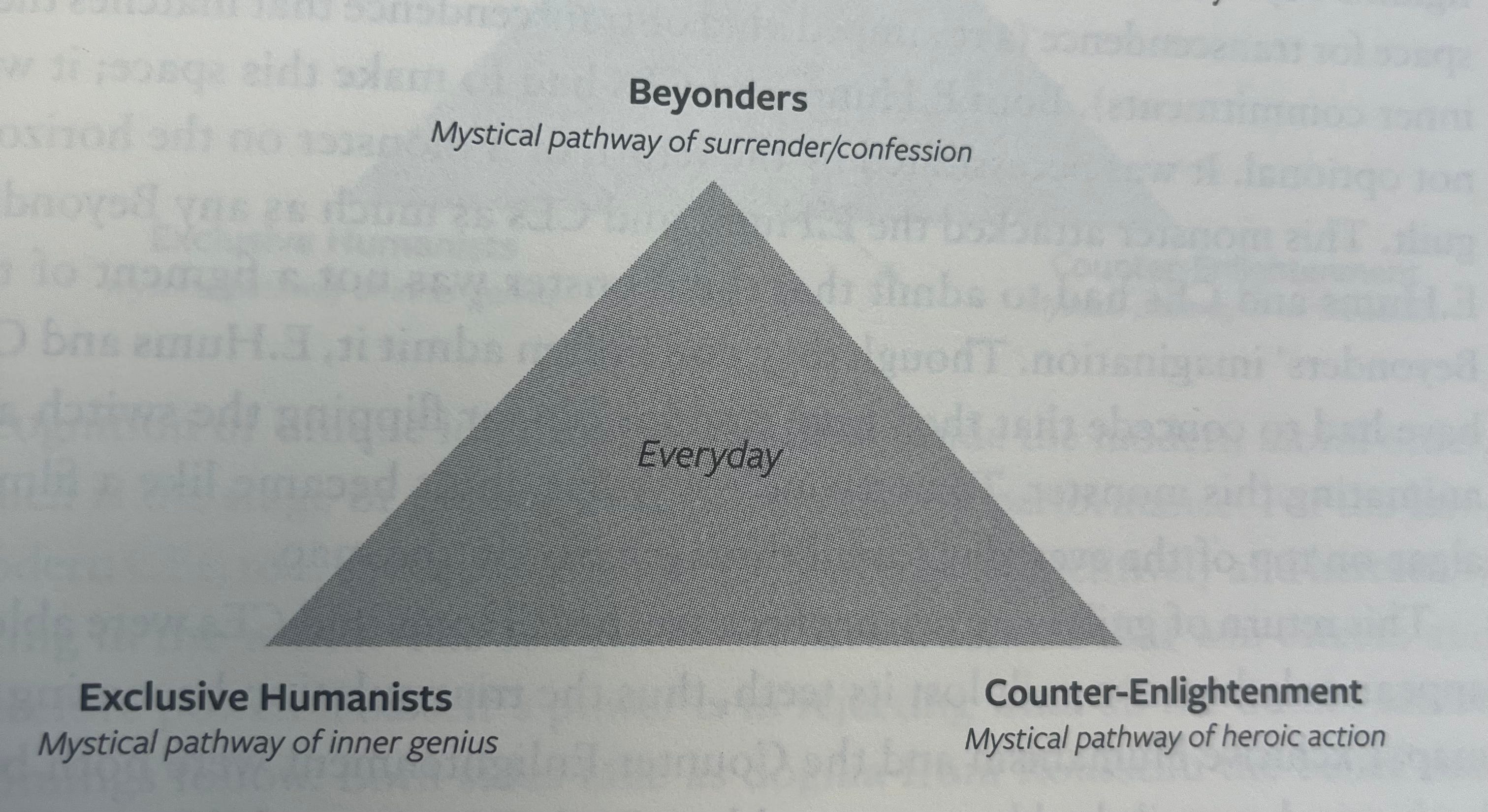
This theory immediately reminded me of Andrew Root’s triangle concept from his book Church in the Age of Secular Mysticism. Root’s triangle posits that those on the Right (Counter-Enlightenment) believe in transformation through heroic action, while those on the Left (Exclusive Humanists) see transformation coming from inner genius. Though Burge’s framework is political and Root’s is religious, both speak to the same dynamic: the belief that societal change ultimately depends on individual or collective human effort.
What This Means for Mainline Protestantism
For Mainline Protestantism, particularly its Progressive wing, these discussions hold critical implications. As Burge pointed out, successful evangelism requires being distinct from the broader society. Yet, much of Progressive Christianity has aligned itself so closely with social justice initiatives that it risks becoming indistinguishable from secular NGOs. While justice is undeniably important, reducing the church to a vehicle for human activism alone overlooks the unique hope that Christianity offers—that transformation is not solely dependent on our efforts.
As I see it, this is where Mainline Protestantism can—and must—reclaim its role. By offering a vision of transformation that is not merely about human action but about divine intervention and grace, the church can present something compellingly different from the surrounding culture. The hope of the Gospel lies in the belief that we are not alone in our efforts for justice, and that God is an active participant in transforming our world.
Toward a More Distinctive and Hopeful Future
Perhaps the most important takeaway from both Burge’s insights and Root’s framework is the reminder that both the political Left and Right—whether in their secular or religious expressions—are often playing by the same rules. They both rely on human action as the ultimate means of transformation. Yet, for the church to offer something truly different, we must break free from these binaries. Progressive Christianity, in particular, needs to resist the urge to disdainfully judge those on the Right and instead focus on offering a compelling alternative that centers on divine hope, grace, and transformation.
In conclusion, listening to this episode of Rainer on Leadership reminded me of the challenges and opportunities facing the modern church. Burge’s critique of fundamentalism and the Christian Right, combined with Root’s exploration of secularism and religious transformation, provides a roadmap for how we might move forward. By reclaiming the unique hope of the Gospel and emphasizing a message of divine, not merely human, transformation, Mainline Protestantism has the potential to chart a path that is truly different—and desperately needed in today’s world.
Related posts:


