


TL;DR:
Anger and outrage in the face of injustice are understandable—and often necessary—but when hatred becomes the driving force, it destroys imagination, creativity, and ultimately the soul of those who carry it. Drawing on Howard Thurman and the witness of the Black Church, this piece argues that resistance must be rooted in lament, love of enemy, and spiritual discipline, refusing dehumanization even while pursuing justice with clarity and courage.
Author’s Note:
I write this with humility and some fear. The injustices of this moment are real and severe, and I do not claim moral certainty. I may be wrong in my reading here. What follows is not meant to soften outrage or excuse harm, but to wrestle—faithfully and imperfectly—with how Christians respond to evil without letting it deform us.
I’ve written in the past about the necessity of a moral ecology—a moral foundation rooted in Christianity.
I’ve also written about the Black Church, particularly its leadership during the Civil Rights Movement, as a model worth recovering today: deeply rooted in Scripture, spiritually grounded, morally serious, and unflinchingly committed to justice.
At the same time, I’ve expressed concern about grounding the actions of the American church primarily in secular theories—especially those that reduce moral life to a struggle for power. When power becomes the dominant explanatory frame, dehumanization can never be far behind.
This is why I get nervous when I see or hear slogans like “f*ck ICE.”

I understand the outrage. I share much of it. I don’t question the anger that arises when injustice is blatant and lives are lost. A Substack reader commented that initial outbursts of “f*ck ICE” is understandable. I agree. Another suggested that such language is meant systemically—“f*ck the system,” not individual people. Fine, perhaps.
But I’m not convinced our moral imaginations—or our nervous systems—actually make that distinction in practice.
When people chant “f*ck ICE” in the streets, or when videos circulate online with those words emblazoned across them, the message does not land as a nuanced critique of systems of power. It lands as an expression of hatred—often directed, explicitly or implicitly, toward human beings.
I do believe in lament. I’ve written previously about lament as a necessary Christian practice—one that refuses denial and resists injustice. And I can imagine how such chants might function, at least initially, as a form of raw lament.
But I grow uneasy when those chants become repetitive, habitual, and central—because I also know how human beings work.
There is a reason Jesus tells us to love our enemies and pray for those who persecute us—not because injustice is excused, but because hatred corrodes the soul of the one who carries it.
What I’m ultimately grieving here is not simply a breakdown in tone or strategy, but the eclipse of Christian moral formation itself. In many spaces—both secular and religious—the grammar that once shaped Christian resistance has been replaced by a framework almost entirely concerned with power, struggle, and domination. That framework can name injustice, but I’m unconvinced that it can reliably form people to resist injustice without becoming distorted by it. Part of why I continue to point back to the Black Church and its leadership during the Civil Rights Movement is not nostalgia, but grief: a recognition that America has largely lost a shared moral ecology capable of sustaining costly, disciplined, non-dehumanizing resistance.
As Ross Douthat warned of several years ago, if many are alarmed by the excesses of the Christian right, they should be equally—if not more—concerned about what emerges when moral restraint, transcendence, and formation disappear altogether. We are clearly seeing that a politics untethered from any thick moral or spiritual tradition does not become gentler; it becomes rawer, crueler, and more efficient in its capacity to harm.
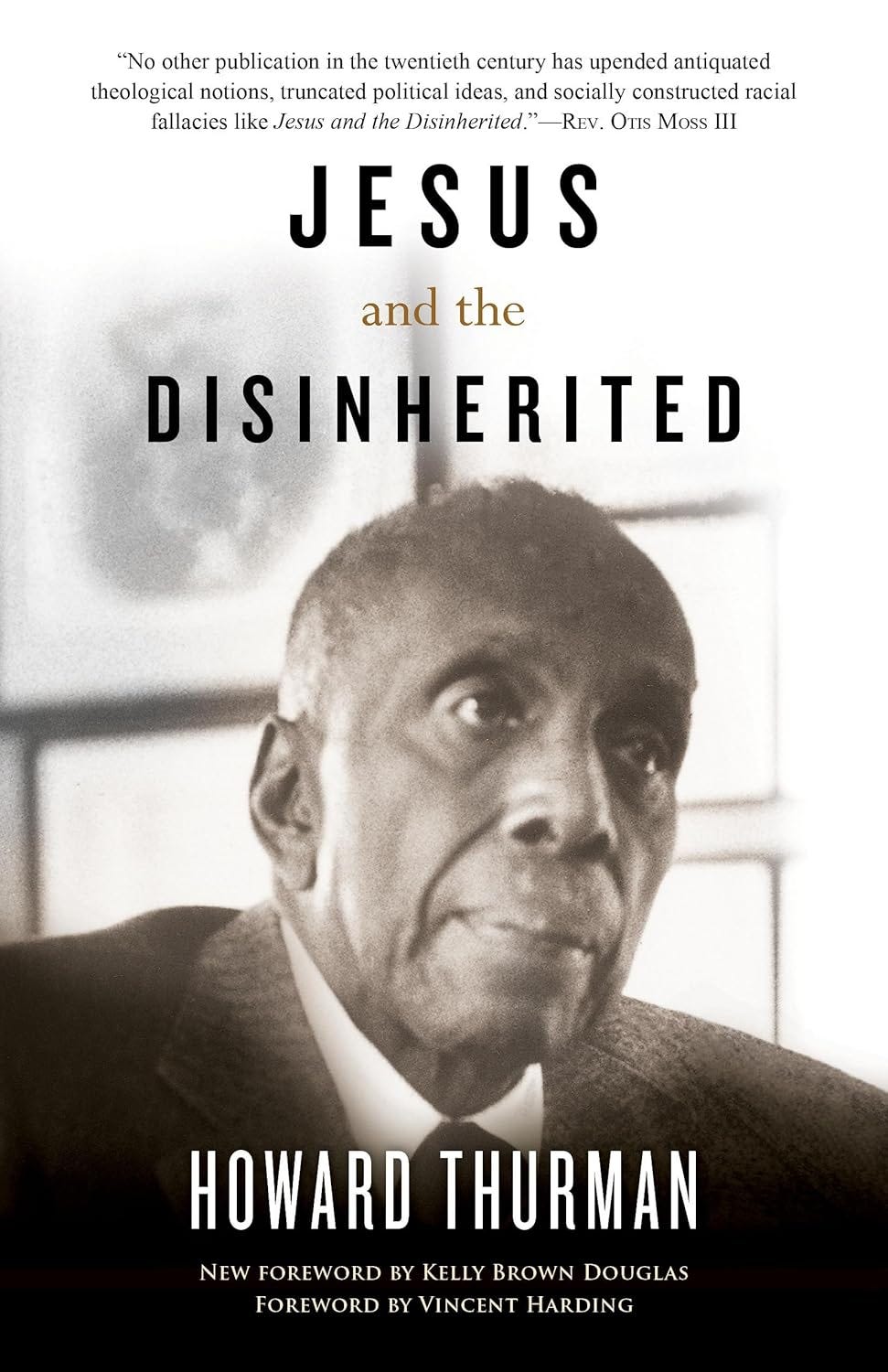
And again, this is why I found myself returning to the wisdom of the Black Church and to a few books pulled from my shelf: Why We Can’t Wait by Martin Luther King Jr., Hope and History by Vincent Harding, and Jesus and the Disinherited by Howard Thurman.
Thurman’s reflections on hatred are especially clarifying. It’s important to say at the outset that—assuming I am reading correctly—he is not writing to excuse oppression, nor to shield oppressors from accountability. He is writing to those who are disinherited—to those whose lives are constrained, threatened, or crushed by unjust systems.
“Hate,” Thurman writes, “is another of the hounds of hell that dog the footsteps of the disinherited” (74).
One of Thurman’s most piercing and prescient insights is that hatred can masquerade as moral clarity. It can offer what he calls “a dimension of self-realization,” where “the illusion of righteousness is easy to create” (82). Over time, hatred becomes “a device by which an individual seeks to protect himself against moral disintegration” (83). In other words, hatred does not simply react to injustice—it can become the moral framework through which a person understands the world.
And this is where Thurman’s warning becomes especially relevant for our moment.
We see this all around us. When hatred becomes the motivating force—as it has for many in our current administration—creativity dies, imagination collapses, and cruelty hardens into policy. Thurman names this dynamic with chilling clarity, warning that hatred “tends to dry up the springs of creative thought in the life of the hater” (88). Hatred does not simply oppose injustice; it corrodes the inner life, narrowing vision and foreclosing the possibility of newness.
What Thurman is diagnosing is not partisan—it is human.
And it is here that I want to make a contemporary observation of my own. When anger and vitriol become the primary animating energy on the left—even when that anger is understandable or morally justified—the danger Thurman names still applies. As he cautions, once hatred takes hold, “resourcefulness becomes completely focused on the negative aspects of the environment” (88). The imagination contracts. Creativity gives way to reaction. Resistance becomes defined more by what it opposes than by the life it seeks to bring into being.
This is why Thurman insists that hatred ultimately produces death, not life. “Hatred bears deadly and bitter fruit,” he writes. “It is blind and nondiscriminating…once the hatred is released, it cannot be confined to the offenders alone” (86). It spreads. It metastasizes. And eventually, it consumes even those who believe they are wielding it justly.
This is precisely why Martin Luther King Jr. could say, without sentimentality, “Hate cannot drive out hate; only love can do that.” And why Thurman insists that Jesus rejected hatred not as weakness, but as faithfulness:
“Jesus rejected hatred because he saw that hatred meant death to the mind, death to the spirit, death to communion with his Father. He affirmed life; and hatred was the great denial” (88).
Jesus’ command in Matthew 5—to love enemies and pray for persecutors—is not naïve idealism. It is a refusal to let dehumanization become the engine of action.
None of this denies injustice. None of it excuses evil. I do not want to pretend that what our current administration and many ICE officers are doing is anything other than morally reprehensible. Anger and rage are sometimes appropriate. We should be angry when a mother is killed unnecessarily.
But the point I am trying to make—and perhaps I am wrong—is this: action rooted in hatred will not bring new life.
What I long for instead is a recovery of the moral and spiritual posture exemplified by the Black Church during the Civil Rights Movement—deeply grounded in Scripture, disciplined by prayer, committed to love of neighbor, and yet utterly uncompromising in its pursuit of justice.
Justice and accountability matter profoundly.
But so does the way we speak.
So does the way we imagine.
So does the kind of people we become along the way.
Hi. I agree with much of your analysis. I think a slight qualification is in order - not every protest or protestor is motivated by hate. That only seems true when watching the images that the news media selectively chooses for, I think, sensationalism purposes. I suggest it is important to note that there are multiple faith based national and local organizations that work from the perspective of love - Rev. Dr. William Barber & Moral Mondays, Rev. Dr. Paul Raushenbush & Interfaith Alliance. I presided over a vigil in my local community last Friday encouraging love over hate and standing silently with candles at the violent death of a human being. I encourage all to check out faithful movements based in love of neighbor while disavowing hate for hate. Thank you Loren.
I agree with your analysis of the corrosiveness of hate. It blinds and destroys the hater and pollutes anyone who comes close to it. Death in its very nature is unjust. No matter how one dies it cuts off their ability to pursue the good that we long for through life. Yet, we die….at times from natural aging and breakdown of our bodies or from accidents and often from our own irresponsible choices. The death of the ICE agent or the death of Renee Good are equally tragic. Where I disagree with your analysis is the assertion that her death was based on injustice and not on her blatant obstruction of justice. The apprehension of violent and illegal immigrants is just. Few consider the horrific injustice of the killing of someone out for a run in the park or the impact of dangerous drugs that end the lives of thousands each year. Where is the outrage for the women trafficked and abused? I am sorry that Good’s life was cut short. If it had not been much good might have come from a life well lived. I am also sorry that she chose to not peacefully stand up to her perception of injustice in the legal mandate given to ICE officers which led to her death.