


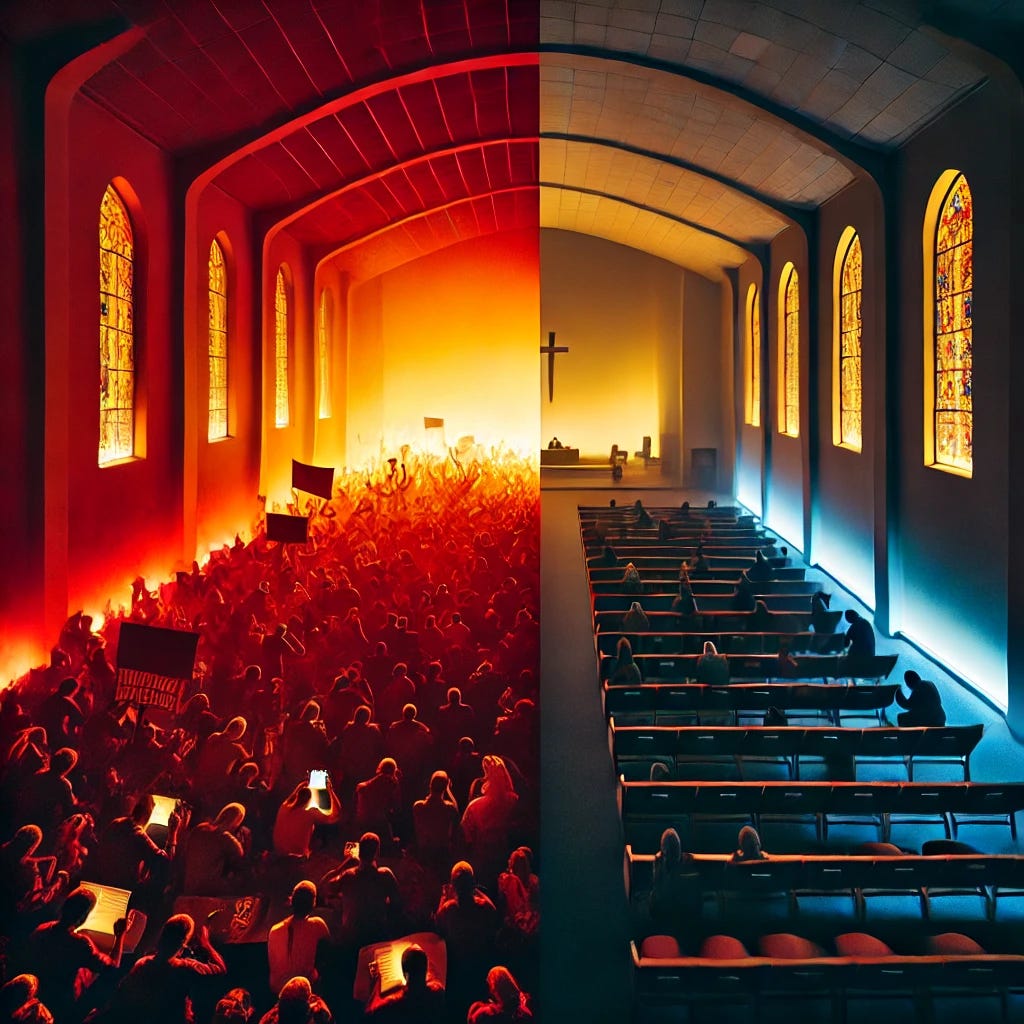
I was recently listening to an episode of Dennis Sanders’ podcast Church and Main in which he interviewed Ben Crosby. An important advocate for the Church in the Mainline context, Ben is one of the few Mainline leaders I know actively advocating for the church—not as an institution or voluntary association—but as the gathering community of Christ-followers, emphasizing the importance of worship and discipleship.
On my own podcast, Future Christian, my co-host Martha Tatarnic has an interview with Crosby coming up, but until then, I thought he had a lot of important things to say in this conversation with Dennis.
Church Is About Making Good, Moral People
One of the more striking insights from their conversation was how the church, at least in the Mainline tradition, has been reduced to producing “good, moral people.” Crosby, echoing Dennis’ observations, noted that many in the church have subtly accepted the idea that as long as we’re shaping people into ethical individuals—people who care for the poor, advocate for justice, and do the right thing—then the church is fulfilling its role.
As Dennis put it:
"Sometimes we have started to believe that the church is there to help us be good people. And if we end up with people who are good people who help the poor, well then, it’s worked."
Now, Church Is About Making Social Activists
Crosby builds on this point, noting that in many Mainline circles, the shift has gone further. It’s no longer just about forming moral people in a general sense, but about forming people who hold the correct social and political opinions. In some spaces, the church’s role has been reduced to a kind of progressive chaplaincy to broader cultural movements.
He argues that while social witness is a vital part of the church’s mission, it cannot replace the fundamental task of making disciples. The church must not only advocate for justice but also offer a compelling vision of Christian life—one centered on worship, discipleship, and evangelism.


Therefore, Church Is Unnecessary
The inevitable conclusion of this trajectory is that church itself is unnecessary. If being Christian is simply about holding the right values, why gather for worship? If church membership is indistinguishable from secular activism, why commit to a community of faith?
This is a concern I’ve explored in my own writing, particularly in “The Death Spiral of Progressive Christianity.” I’ve argued that progressive Christianity has often made itself redundant by downplaying the necessity of worship, discipleship, and evangelism. Instead, many progressive churches have leaned heavily into social activism, assuming that as long as they promote justice, they are fulfilling their mission. But when church becomes indistinguishable from a nonprofit, why should people bother attending?

Dennis referenced my post and also noted that we in the Mainline often critique the Evangelical “Jesus and me” theology, but in our own way, many progressives have embraced a similar individualism—believing that as long as they hold the right beliefs and do good in the world, church attendance and participation are optional. As I wrote in my Substack piece, the church’s primary role is not just to affirm people’s existing commitments, but to call them into deeper discipleship.
This ties directly into what I discussed in another Substack post, “Why Worship and Discipleship Must Come Before Activism.” The church must reclaim its focus on making disciples without neglecting its call to justice. Worship and discipleship are not in opposition to activism but rather form the foundation that makes our social engagement truly transformative. When we root our justice efforts in discipleship, they become an extension of our faith rather than a substitute for it.

Why This Matters
Crosby’s critique is not simply about numbers for numbers’ sake. He echoes the late Everett Lees, who once remarked:
"Each one of those numbers is somebody whose life has been changed and transformed through a relationship with Jesus Christ and the power of the Spirit."
The church is not merely a social club or a vehicle for activism; it is the body of Christ, called to proclaim the gospel and form people into disciples. If we lose sight of that, we risk losing the church itself.
If you’re someone who cares about the church, I encourage you to continue to follow this Substack, check out Ben Crosby, and of course, Dennis Sanders. Additionally, find my podcast Future Christian wherever you get your podcasts and stay tuned for Martha's upcoming episode with Ben Crosby.
Great commentary on us mainline folks and the dead end of theological progressivism.
I appreciate this kind of conversation, but I still don't think producing activists is at all really where mainline churches or even progressive mainline churches are. Yes, maybe some element - I certainly encourage folks to engage their voices for others, for justice. I know our general level leaders do engage their voice on a broader level. But I do think mainline churches need to articulate better that we want to be a community where you belong - which is where we sometimes focus all of our energy - but we also want people to grow, to become better human beings.
More so, I think some mainline churches have clusters of people who feel called to this work, but the majority of people who still stick around mainline churches tend to appreciate belonging to a community that is more moderate to progressive (in all of its definitions). Or they have deep family ties.
I'm from Oklahoma (originally). I imagine among Oklahoma Disciples of Christ congregations, less than 20% have any significant social justice engagement? Unless you are talking about feeding the poor and other direct aid kinds of things? Some might have a book club or group that discusses such issues. I could be wrong, of course.
And of course, justice work is about being a good person on a fundamental level.
Justice, for example, is about very basic things - honesty, fairness, listening, truth-telling, treating people with dignity, correcting something that is wrong, learning how to work with others. It's hard work, and yes, we should be humble that we may not have a big picture like God does, especially on a societal level. But sometimes it's just behaving individually and as a community in a way that we are taught in kindergarten (share, wait your turn, no touching, etc.).
I think the bigger question for mainline churches remains the "why" - why do we exist in this particular place and time, with our particular history, our focus, our music, our words, our particular devotion to the Holy. It may not be needed. Or it may be if we can rediscover it or discern it or reimagine it together with God's help.