I grew up in Christian Fundamentalism. I know firsthand the pull toward certainty, the comfort of clear lines, and the belief that questioning too much could unravel everything. In many ways, it makes sense—when faced with uncertainty, we naturally cling to something solid. But over time, I realized that faith is not about rigid certainty. It’s about trust. And trust requires nuance, complexity, and a willingness to hold tension.
In our current moment, I see this struggle play out on both sides. Many in conservative evangelical spaces, feeling threatened by cultural shifts, have leaned into Christian Nationalism (a form of fundamentalism), conflating faith with political power. Meanwhile, I fear some of the Progressive Christian left has swung in the opposite direction—fully embracing secular humanism and often abandoning Christian distinctiveness altogether. I've written about this elsewhere:
Beyond Left and Right: Rethinking the Theological Spectrum

My recent post on Progressive Christianity within the Mainline Church has gained a lot of attention, which has been interesting to watch. As expected, it has also sparked a mix of responses—some thoughtful, some critical. While negative comments on social media are never enjoyable…
Rev. Dr. Andrew Draper, my recent guest on the Future Christian Podcast, spoke powerfully to this tension. In our conversation, he noted:
"Deconstruction is necessary; it's always been a part of the work that the people of God have done... If we can't look critically at our own idols and the things that we have built up that are problematic in our own theological systems, then we're not participating in the history of faith in a thick sense."
At the same time, he warns against the extremes of either reaction:
"That's why it's so easy for Christian nationalism or secular humanism to be where people land when they start to be uncomfortable with walking in the path of uncertainty."
This resonates deeply with me. When we lose the ability to sit with tension, we end up choosing ideology over faith. But faith, real faith, has always been about trust—not in a political movement, not in human reason alone, but in Christ.
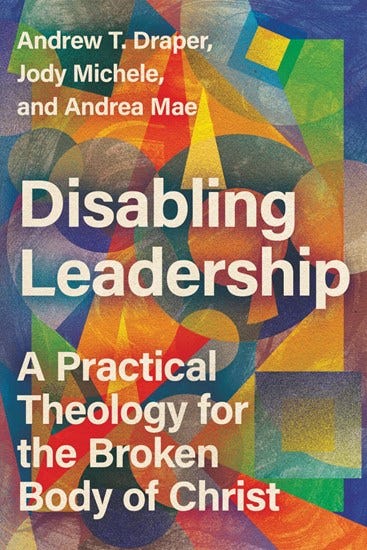
I invite you to explore this conversation further. You can listen to my full interview with Andrew Draper on the Future Christian Podcast and check out the book he co-wrote Disabling Leadership: A Practical Theology for the Broken Body of Christ to dig deeper into these themes. I really appreciated the wisdom and nuance he and his co-authors brought to the discussion.
What do you think? How do you navigate the pull between these two extremes? Let’s continue the conversation.