


"This is what they voted for!"
I've seen this response all over social media of late, blaming and shaming voters who cast their ballot for President Trump, most often from those considered experts or elites. While there are many unfair and unfounded assumptions within this statement, it hides a bigger problem—blame shifting. In many ways, I would argue that in many ways, the experts and elites have only themselves to blame.
I came across a recent article from The Conversation titled “How Populist Leaders Like Trump Use ‘Common Sense’ as an Ideological Weapon to Undermine Facts”, which explores how populist leaders exploit distrust in expertise by appealing to “common sense.” The piece argues that figures like Donald Trump frame expert knowledge as elitist, making complex policy debates seem like unnecessary overreach when “ordinary people” supposedly have all the answers. This rhetorical strategy, the article suggests, weakens institutional credibility and deepens societal polarization.
While the article makes a compelling case for how populist leaders exploit distrust in expertise, it led me to a more fundamental question: Why has this distrust become so pervasive in the first place? One of the noteworthy trends in the recent election is the shift in voting patterns. Data reveals that more blue-collar workers and people of color voted for Trump, whereas many traditionally elite Republican voters, such as Liz Cheney and her supporters, shifted toward the Democratic Party. More than any election in my adult life, this one highlighted a significant class divide—the elites versus the rest of us.
What exacerbates this divide is the pervasive sense of dread or impending disaster that elites have warned would occur, while many middle-class and blue-collar workers feel they are already in crisis. Worse, those same elites now blame these voters for the country's current state. In my view, experts and elites have done much of the damage to their own credibility. Over the past few decades, institutions have actively undermined themselves in at least three key ways:
1. Institutional Corruption and Cover-Ups
Perhaps the most obvious reason people no longer trust experts is the exposure of deep-seated corruption in major institutions. One of the most glaring examples is the Catholic Church’s widespread abuse scandal. For decades, church leadership not only failed to address rampant abuse but actively covered it up, protecting perpetrators while silencing victims. When such corruption is revealed, how can people be expected to trust religious or moral authorities?
The Catholic Church is far from the only institution guilty of self-sabotage. The Southern Baptist church sex scandal, the US government's handling of the Vietnam War, and numerous corporate and financial scandals have all played a role in eroding public trust.
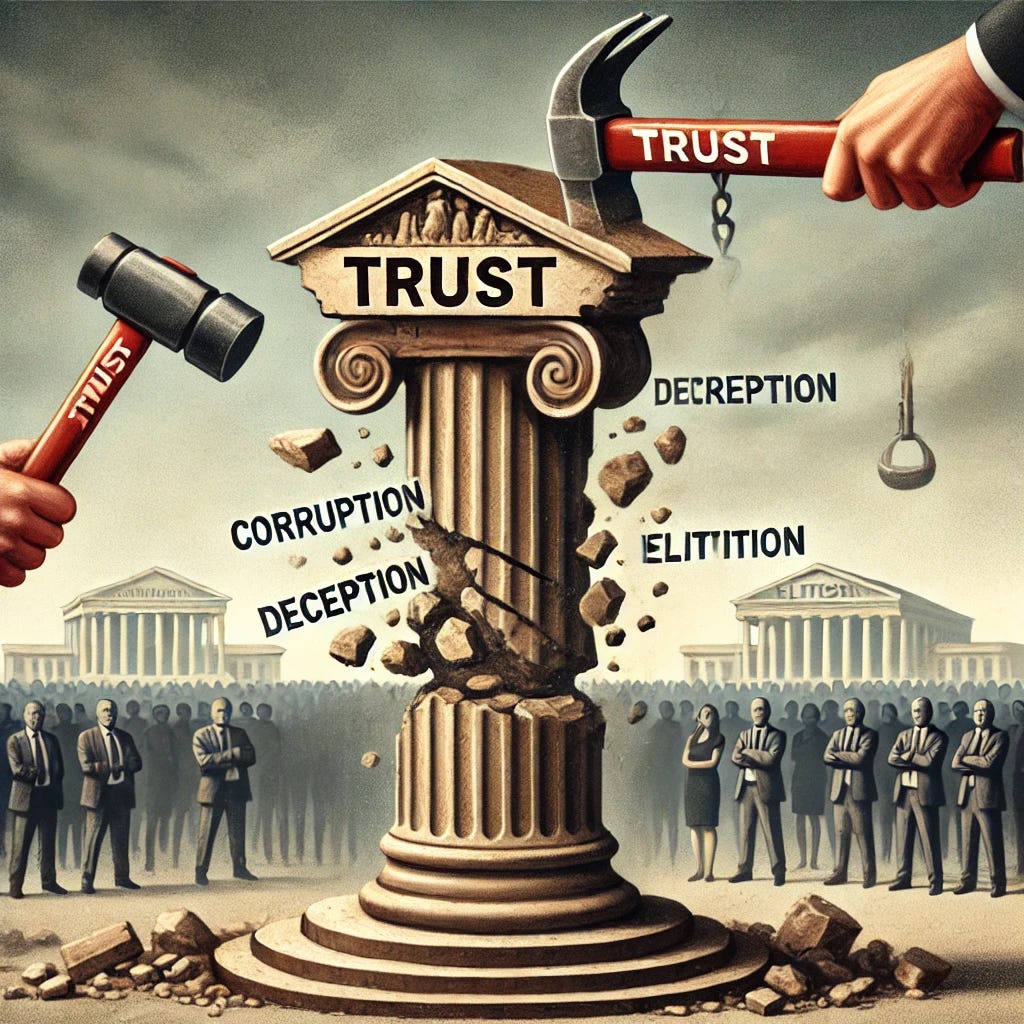
Trust in institutions has eroded not because populist leaders “weaponized” common sense but because those institutions gave people very good reasons to stop believing them. Leaders of institutions have chosen to protect the institution at all costs and, in doing so, have undermined public confidence.
2. The Rise of Deconstructionist Ideology
Another way elites have undermined themselves is through the widespread promotion of deconstructionist philosophy. Thinkers like Jacques Derrida, a major figure in postmodern thought, emphasized that language, meaning, and even “truth” itself are fluid and socially constructed. While these ideas have intellectual value, they have also contributed to a cultural shift where skepticism of authority is the default posture.
If all “truth” is subjective and socially constructed, why should anyone trust institutions that claim to be authoritative? If reality is shaped by language and power structures, as deconstructionist ideology suggests, then every institution is assumed to be a tool of oppression rather than a source of wisdom.
A simple example: It’s no secret that Mainline Protestant Churches have experienced massive decline over the last 50 years, due to factors such as societal change and declining birth rates. Yet, many Mainline leaders lament the church’s decline while simultaneously questioning the necessity of the church itself. This contradiction only fuels further disillusionment.
Ironically, many of the same academic and media elites who lament the rise of populist distrust are the very ones who spent decades undermining the concept of objective truth. When institutions dismiss truth as relative, they shouldn’t be surprised when the public stops taking them seriously.
3. Alienating the Working Class and Labeling Them as the Problem
Finally, elites have fueled distrust by ignoring or outright blaming the working class for their struggles. The decline of American manufacturing, the opioid crisis, wage stagnation, and the collapse of local economies have disproportionately affected working-class communities. While some elites have noticed the systemic nature of these problems, they have largely failed to offer concrete solutions that can help.
When working-class Americans voice frustration, they are frequently dismissed as racist, xenophobic, or backward. Rather than addressing legitimate economic concerns, many political and media figures have doubled down on cultural warfare, blaming the very people suffering from institutional failures.
Ryan Burge’s research on institutional trust helps explain the consequences of this alienation. His work shows that those who are disconnected from traditional institutions—churches, schools, government—are significantly more likely to embrace conspiracy theories. Why? Because when people feel abandoned by mainstream institutions, they turn to alternative explanations to make sense of the world.
This is not to say that conspiracy theories are justified, but that their rise is a symptom of something deeper. People do not embrace misinformation in a vacuum; they do so when mainstream narratives have failed them.
Personal Perspective: Straddling Two Worlds
I recognize that I, in some ways, fit into the category of an “elite.” With two master's degrees and experience in academia, I have benefited from the very institutions that many now distrust. At the same time, I also resonate deeply with working-class and blue-collar workers because I grew up working-class poor myself. I have seen firsthand the struggles of those who feel left behind, ignored, or outright blamed for societal problems. This background gives me a unique vantage point—I understand both the frustrations of those who have lost faith in institutions and the necessity of expertise and informed leadership.
Conclusion: The Experts Need to Look in the Mirror
Populist leaders may exploit distrust in experts, but they didn’t create it. Institutional corruption, ideological deconstruction, and the alienation of the working class have all contributed to the collapse of public trust. If elites want to restore credibility, they need to start by taking responsibility for the ways they have undermined themselves.
Rebuilding trust requires more than dismissing populism as an appeal to “common sense.” It requires accountability, intellectual humility, and a willingness to address the legitimate grievances that have driven people away from institutions in the first place.
Until that happens, the public will continue to seek alternatives—whether in the form of conspiracy theories, populist leaders, or outright disengagement. And elites will have no one to blame but themselves.
Works Cited
Burge, Ryan. The Nones: Where They Came From, Who They Are, and Where They Are Going. Fortress Press, 2021.
The Conversation. "How Populist Leaders Like Trump Use ‘Common Sense’ as an Ideological Weapon to Undermine Facts." 2024. https://theconversation.com/how-populist-leaders-like-trump-use-common-sense-as-an-ideological-weapon-to-undermine-facts-248608.
From a Presbyterian perspective this is largely spot-on. I found a disconnect between the educated clergy-person (me) and the people in the pew, especially when I served congregations with fewer educated/professional people. I would talk in sermons about Jesus' opposition to "the elite" of his day, meaning the wealthy, but sometimes people heard "elite" as referring to completely different people than I had in mind. (I also want to recommend the work of Peter Turchin who describes what we are currently going through as less elite vs. everyone else (as you indicate) and more insider elite vs. outsider elite, with the latter doing a better job of enlisting the working classes in their cause.). (Also Ezra Klein's podcast today about how liberals are both pro-government and also keep government from functioning, thus undermining their own agendas and making an opening for those who just want to tear government down.)
I have a different perspective. I'm a Lutheran and an attorney. I represented people in workers' compensation and Social Security disability cases. I liked my clients who were good people. Unfortunately few paid attention to politics and were not aware of how much they depended on a strong social safety net. Many bought into the Republican Party lie from Ronald Reagan to the Koch Brothers' backed candidates that there were a bunch of freeloaders on the disability programs for which they were seeking access. In fact they felt like those freeloaders were why it was so hard for them to get the benefits they deserved. Populism is based on resentment, and Republicans have been devilishly clever in turning that resentment on whomever is the current object of hate (gays under George W. Bush and transpeople under Trump) and electing Ivy League-educated politicians (e.g. Ted Cruz, J.D. Vance, Ron DeSantis, Donald Trump) to be the standard bearers of a false populism which enacts a Project 2025 agenda that benefits conservative elites and not average Americans. It's maddening.