


TL;DR / Executive Summary:
Social media algorithms reward outrage, not truth—fueling lazy, sensationalist takes, especially around Evangelicals and Christian Nationalism. Not all conservative efforts are dangerous, and Trump’s 2024 win wasn’t solely due to white Evangelicals. Both left and right often confuse politics for theology. The church must reclaim thoughtful, grace-filled dialogue rooted in faith—not algorithms.
Algorithms don’t reward truth.
Algorithms don’t reward truth or intellectual depth. They reward engagement. Whether something is accurate, nuanced, or thoughtful doesn’t matter; what matters is whether it provokes a reaction. As Scott Galloway said recently on Raging Moderates, social media companies have effectively become editors through their algorithms, elevating certain stories while evading accountability for the chaos those stories cause.
His co-host, Jessica Tarlov, put it more bluntly: Americans are becoming intellectually lazy. So lazy, she said, they won’t even take the time to Google a story before smashing “retweet.”
Let me say it this way: I’m sick and tired of the intellectual laziness of those who constantly decry Evangelicals and their influence on the 2024 election.
The Rise of Hot Takes and Rage-Bait
I’ve written previously about the rise of deconstructionist, anti-Evangelical voices on social media, largely fueled by hot takes and Evangelical-bashing rage-bait. I don’t know these creators personally, so maybe my assessment is wrong—or maybe I’m just jealous. But this trend represents something that’s become deeply frustrating about social media over the last ten years.
Since the collapse of Twitter, I’ve searched for a meaningful text-based platform. I tried Threads. I tried Bluesky. Neither hit the mark. Then I found Substack. At first, it seemed like a haven for thoughtful writing; a place where ideas could be explored with nuance and care, with Notes offering a way to share short reflections and interact meaningfully with other writers.
But that dream didn’t last long.
Once the presidential election cycle ramped up, my Substack feed began to look just like every other platform; reduced to hot takes on Christian Nationalism and Evangelical outrage bait. Maybe that’s just the algorithm feeding me what drives my engagement. But regardless, the pattern is clear: simplistic, reductionist, and intellectually lazy takes dominate the space—especially the Evangelical-bashing outrage bait.
Christian Nationalism: Real vs. Rhetorical
A major theme among these voices has been Christian Nationalism.
Let me be clear: I’m very wary of Christian Nationalism. Dominionism and “Seven Mountains” ideology are flat-out dangerous. But labeling every effort by conservatives to bring their values into public life as “Christian Nationalism” is just dishonest and lazy.
Take the Ten Commandments in schools. It’s silly and shortsighted, sure. But is it really Christian Nationalism? No—it’s cultural nostalgia. I’m not worried about children in public schools seeing the Ten Commandments on the walls; however I am worried about Stephen Wolfe’s vision coming to life.
When everything becomes “Christian Nationalism,” two things happen:
We create a false binary for Evangelicals—either stay silent or align with radicals.
We ignore that secular progressivism is also a belief system, one that also seeks to shape the public square.
As I recently posted on Notes:
“I know it’s far more popular to simply bash on Christian Nationalism, but we can’t protest CN and Project 2025 by saying, ‘Don’t impose your beliefs on others,’ and then turn around and try to impose our own. If we want our values to shape public life, we have to allow others the same opportunity.”
I think women should have pregnancy options, gay marriage should exist, and that trans persons should have some protections against abuse and discrimination. I come to these opinions based on my faith. Even still, I recognize that other people of faith have different opinions, and part of living in a liberal democracy means we have to compromise (And I mean “liberal democracy” in the sense of a system of government that combines majority rule with the protection of individual rights, the rule of law, and constitutional limits on power).
Trump’s 2024 Victory: Not Just About Evangelicals
The second intellectually lazy claim I want to push back on is the idea that Donald Trump’s victory is solely the result of white Evangelicals—and that those Evangelicals still enthusiastically support him.
That’s just flat-out inaccurate.
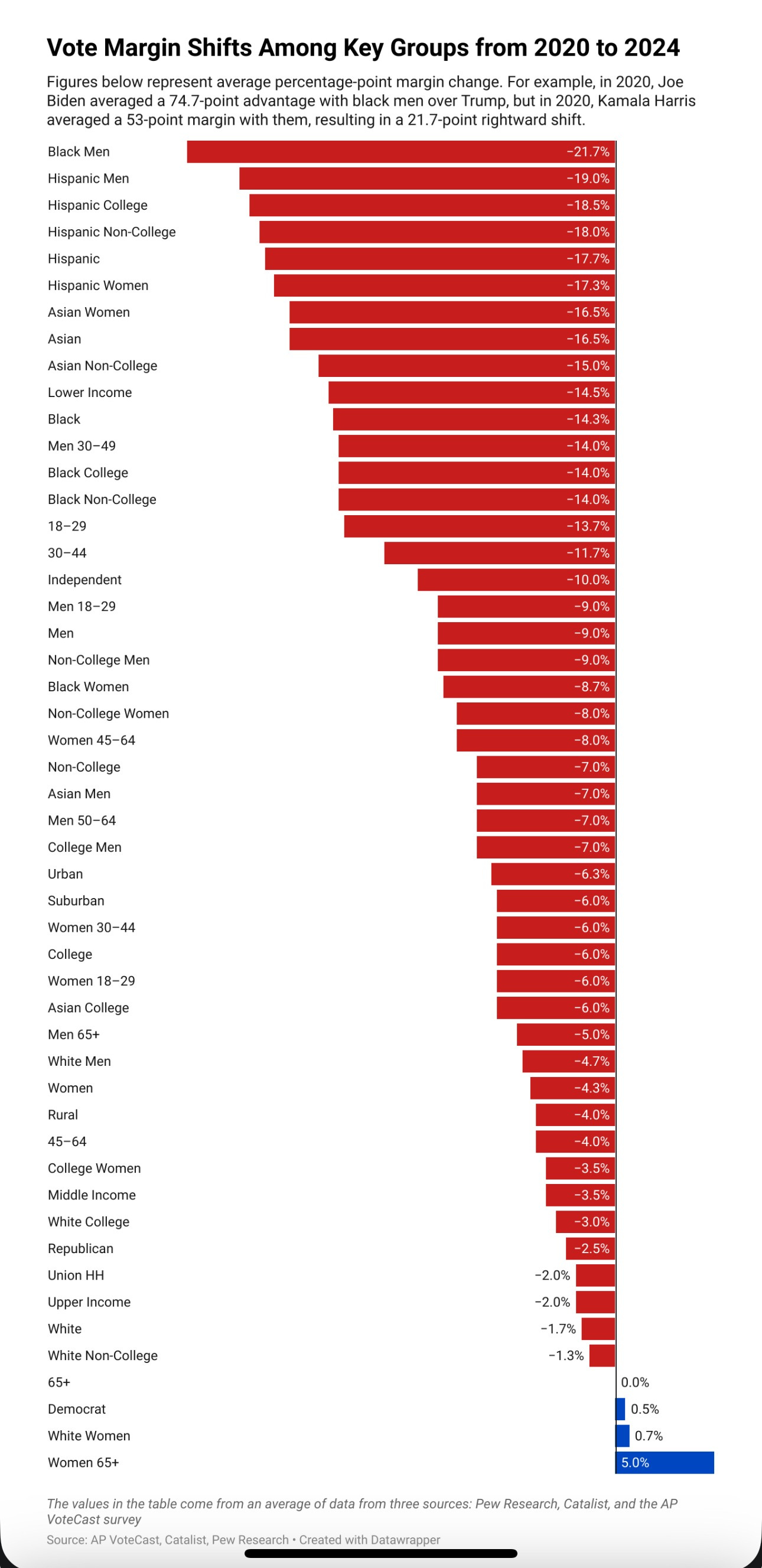
Trump made significant gains with people of color in 2024, including a 21.7-point rightward shift among Black men. He also improved among all Christian groups:
“Trump expanded his margins for Christians identifying as ‘Protestant or other Christian’ and Catholic. Of voters identifying that way, 63% went for Trump and 36% for Harris—up from 60% and 39% in 2020.
Catholic voters swung hard toward Trump, 58% to 40%, despite Harris being a Baptist. That’s a major shift from 2020 when Biden won Catholic voters 52% to 47%.”
Again the graphic above.
As to white Evangelicals, their shifts to Trump have been marginal—from 78% in 2016, to 81% in 2020, to 83% in 2024. No doubt, I wish it wasn’t that way, but it’s also important to note, as Ryan Burge has repeatedly emphasized, Evangelicalism is now more of a political marker than a theological one. Trumpism isn’t flowing out of Evangelical theology—it’s flowing from political identity. Plenty of Evangelical leaders have lamented this: biblical teaching no longer forms identity; political talking points do.
While the tacit approve Evangelicals have led to some deeply troubling actions by the Trump administration, especially around immigrants, these are not actions driven by theology. As Burge notes:
“I’m not convinced that religion is doing the lion’s share of the work in driving anti-immigrant attitudes—it’s almost certainly little more than political partisanship.”
The Left Has Its Own Form of Political Religion
And yet this is precisely what I see on the progressive left as well—especially among some prominent deconstructionist voices. I ultimately decided against naming names in this post, but I hope one can read between the lines. I don’t think their social media rage-takes are driven by deep conviction and theology—maybe I’m wrong.
Let me be clear: I’m not saying these folks aren’t Christians. But their public witness is primarily political, not theological. Their content flows first from political allegiances, not from a deep well of spiritual conviction.
And that’s the real problem.
When political ideology—right or left—becomes our primary interpretive lens, we lose our theological center. The church becomes a vehicle for partisan rage, and public discourse becomes a marketplace of tribal memes rather than moral clarity.
What I Long For
Maybe I’m too idealistic (I probably am), but I still believe platforms like Substack could be places for thoughtful, theological dialogue—for challenging but nuanced engagement. For those of us outside traditional institutions or social privilege, it’s a rare opportunity to be heard.
But more, I want a nation that truly lives into the ideas of the liberal democracy. But, for that to really happen,
We need truth.
We need discernment.
We need a little intellectual curiosity—and a whole lot more humility.
Sources (I know, what are those!?)
Ryan Burge, Does Religious Affiliation Make Someone More Anti-Immigrant? Graphs About Religion, June 24, 2024. https://www.graphsaboutreligion.com/p/does-religious-affiliation-make-someone
Ryan Burge, 2024 Election Post‑Mortem: Evangelicals. Graphs About Religion, April 21, 2025. https://www.graphsaboutreligion.com/p/2024-election-post-mortem-evangelicals
Paul D. Miller, The Wolfe in Sheep’s Clothing: How the Case for Christian Nationalism Leads Us Astray. North View Institute, April 10, 2024. https://northviewinstitute.org/the-wolfe-in-sheeps-clothing-how-the-case-for-christian-nationalism-leads-us-astray/
Ruy Teixeira, A Final Comprehensive Look at How the 2024 Election Was Won. The Liberal Patriot, July 3, 2024. https://www.liberalpatriot.com/p/a-final-comprehensive-look-at-how
Mark Wingfield, How Trump and Harris Fared with Faith Voters in 2024. Baptist News Global, July 9, 2024. https://baptistnews.com/article/how-trump-and-harris-fared-with-faith-voters-in-2024/
These are all such important points. Your righteousness is not a product of how much engagement your posts get. Posting hot takes is not “speaking truth to power” or being “prophetic.”
I remember reading a Facebook post with lots of engagement blaming churches “full of people who voted for this government” for the passage of the Big Beautiful Bill and the harm it would cause. In the poster’s telling, they were directly responsible for what followed. But I and many others had raised concerns with this progressive church leader about the direction of their church and had been ignored or even attacked.
https://open.substack.com/pub/ryanclarkself/p/with-allies-like-these-who-needs?r=7y31d&utm_medium=ios
This person didn’t seem interested in the harm their own church was causing—something directly under their control—but demanded conservative evangelicals be held to account for every action of the Trump administration.
If you only love “accountability” and “truth telling” and being “prophetic” when it’s directed at your political opponents, you don’t actually believe in any of those things.
Thanks again for the great post!
Every effort by conservatives to bring their values into the public square is not Christian Nationalism. I actually haven’t heard that much but maybe that’s just my algorithms. I also hate “both sides “ because maybe there are more than two “sides”?