


TL;DR: After reading Carolyn Chen’s book Work, Pray, Code, I’m convinced that just as Buddhism is not Buddhism without the Buddha, Christianity cannot be Christianity without a risen Christ.
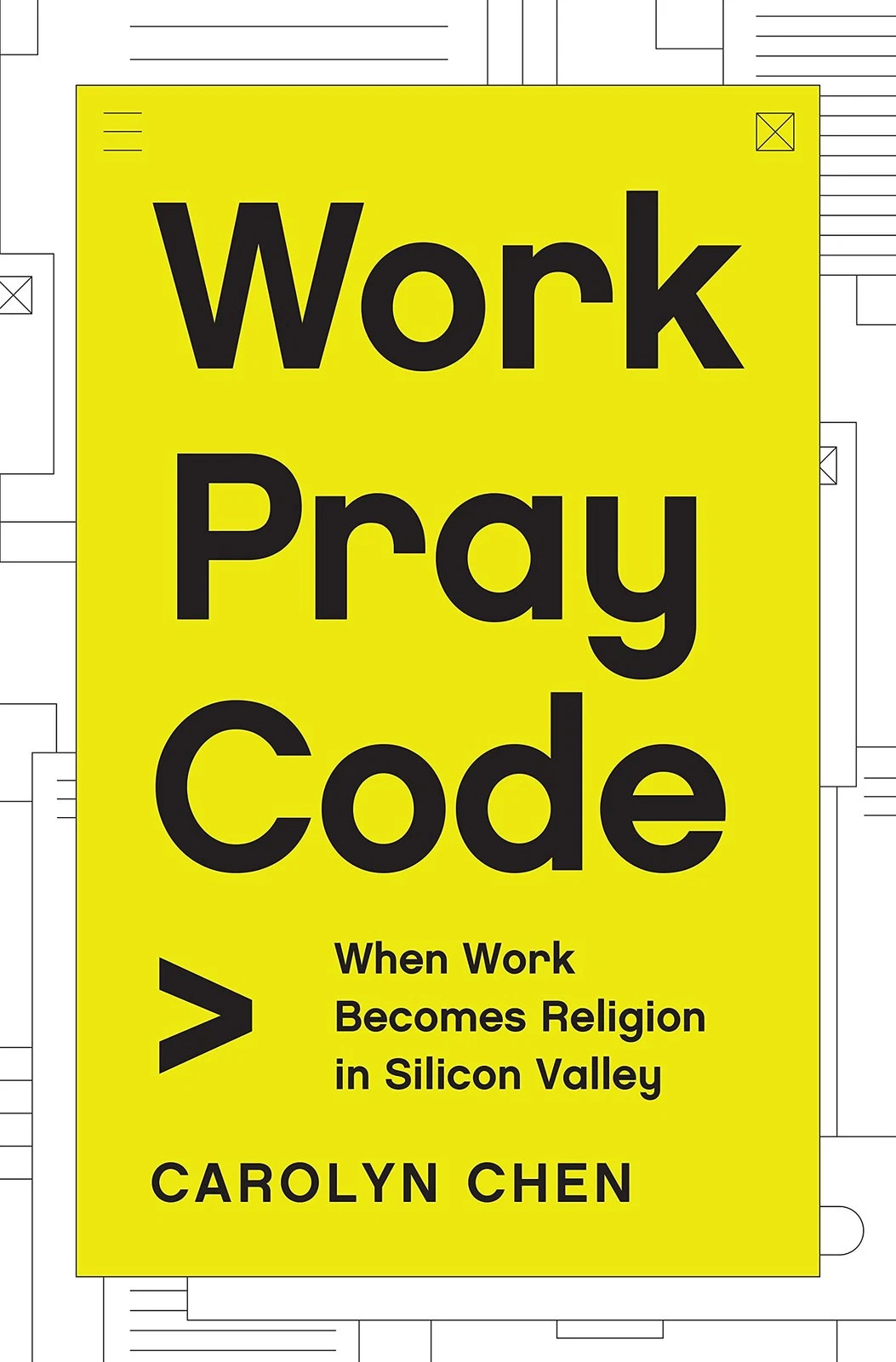
I just finished Carolyn Chen’s fascinating book Work, Pray, Code: When Work Becomes Religion in Silicon Valley.
It’s a compelling read, and I’d 10/10 recommend it.
I’m trying to get her on the podcast—so, Dr. Chen, if you’re reading this, or if you have connections to Dr. Chen, please let her know I want to talk with her!
The book is about how tech giants are becoming a religion in their own way, reshaping spirituality to serve their religion of peak productivity while stripping out elements of supernaturalism and broader community benefit. Reading the book, it’s quite clear Chen is a talented and brilliant sociologist of religion, and she left me with MUCH to think about—I made fifty-five highlights in my highlighter app!
But it’s her final chapter, titled “Killing the Buddha” and running about fifty pages, that really had my brain buzzing. And even within that one chapter, full of compelling insights and examples, there’s one idea I can’t stop thinking about.
Chen spends considerable time examining the curious place of Buddhism within Silicon Valley. Meditation and mindfulness are everywhere, but Buddhism as an actual religion is considerably harder to find.
At one point, Chen highlights a conference in which, as she describes it, there were literally monks in their full religious garb being put on display—but they were never asked to speak. Instead, it was white people on stage reducing the practices to how they could impact the bottom line and provide a return on investment.
Chen calls what has emerged “Whitened Buddhism”—Buddhism that has been stripped of much of its Asian heritage and religious particularity and repackaged into something more palatable to White, educated, secular Americans.
Meditation or mindfulness remains, but much of the religious world from which those practices emerged disappears. Chen adds that most Americans think of Buddhism in this desacralized way because this is the form we’ve been sold.
Why has this happened? Well, Chen puts the dynamic rather succinctly:
“To survive in Silicon Valley, religion must conform to the logic and culture of the tech industry.” (154)
That line got me thinking about progressive Christianity.
And before anyone gets mad at me, let me say immediately: this isn’t uniquely a progressive Christian problem. Conservative Christianity can—and frequently does—conform itself to the logic of its surrounding political and cultural world too. The resulting Christianity simply looks different.
But since I self-identify as someone on the Christian left and often critique forms of progressive Christianity, I want to focus this piece on the secularizing pressure exerted on progressive Christianity.
What happens when Christianity has to conform to the logic and culture of secular progressivism in order to remain culturally intelligible within progressive spaces?
The parts of Christianity that translate easily remain.
Justice, inclusion, equality, community, liberation; care for marginalized people.
All of these are authentically Christian concerns. The problem isn’t their presence.
The question is what happens to the parts of Christianity that don’t translate nearly as easily.
Miracles, sin, salvation, resurrection; the actual activity of the Holy Spirit.
Having just finished Eric Smith’s By What Power, that last point is especially worth emphasizing. As I argued in my review, Smith largely reduces the story of Acts to “humans doing stuff” (my words). The Holy Spirit is remarkably absent—and, to my recollection, not even mentioned in the book. Instead, Acts gets read primarily through the categories of political, social, and economic power.
But Christianity also makes the claim that Jesus Christ isn’t merely a particularly compelling moral teacher, but the resurrected Lord who is somehow actually alive and active in the world.
There can be a kind of cultural selection pressure: keep the parts of Christianity that fit comfortably within a secular moral framework and “demythologize,” reinterpret, or discard the parts that don’t.
And that makes me wonder if we need a provocative term analogous to Chen’s “Whitened Buddhism.”
I want to call it “atheistic Christianity.”
I don’t mean that the Christians I’m describing necessarily identify as atheists or explicitly deny God’s existence. Many obviously don’t.
Rather, I mean a form of Christianity whose understanding of the world seems to require no actual supernatural agency—a Christianity in which we can talk extensively about God while very little depends upon God actually doing anything.
Christianity Within the Immanent Frame
Of course, I’m reminded here of Andrew Root’s book Churches and the Crisis of Decline, in which Root notes that “Religion does not want a living God—who is alive in speaking both a yes and a no—it wants an object to use of its own individual meaning making.”
While the subject is different, the move is similar to what Chen identifies in Silicon Valley: the desire to turn the divine into an object of individual meaning-making.
And again, I’d emphasize this, as Chen does: Buddhism is not without supernatural claims!
But this is the danger of the immanent frame, as Root notes, borrowing from the work of Charles Taylor. Churches, institutions, or organizations that concede to the immanent frame “tend toward a theology without the church.”
Yet, working from the dialectical theology of Karl Barth, Root argues that “attending to a God who is God is impossible outside the church.”
Which, again, speaks to Chen’s broader point.
Chen describes sitting next to a Silicon Valley type who, after hearing a presentation on the “productivity benefits of meditation,” turned to her and said:
“wait…is Buddhism a religion?”
That’s sort of the whole problem.
Root writes that “The immanent frame declares that togetherness, religious literacy, and intellectual interests are in bounds and therefore coherent.”
Chen describes something remarkably similar. “Mindfulness” and “meditation,” for example, are welcome. Less welcome are moral, ethical, or supernatural claims that transcend the assumptions of the surrounding culture.
As Root says in regard to the same secularizing forces acting upon Christianity:
“Less accepted is the idea that the God of Israel who stands outside the universe could enter into it, judging and redeeming it from death for life.”
In the same way that Buddhism is not Buddhism without the Buddha, Christianity cannot be Christianity without a risen Christ.
Quite brilliantly, Chen asserts:
“How, when, where, and why you do something changes the meaning of it.”
And I think that’s exactly the point.
If God Didn’t Exist…
Which leads me to a question I find increasingly useful:
If God didn’t exist, how much about some versions of progressive Christianity—what I’m calling a kind of atheistic Christianity—would actually have to change?
Would its politics change?
Would its understanding of justice change?
Would its advocacy change?
If the answer is not very much, I think we have something worth examining.
And again, we could ask the very same questions of some versions of conservative Christianity.
Chen’s critique of Silicon Valley Buddhism isn’t that meditation is bad. It’s that practitioners of that religion have been transformed by the cultural institution receiving them. To become acceptable within that world, they have had to conform themselves to that world’s assumptions.
And I wonder if some forms of Christianity are experiencing something remarkably similar.
The question isn’t whether Christians should care about justice, inclusion, liberation, or any of these other concerns; of course we should.
The question is in which direction the formation is happening.
Is Christianity forming our understanding of justice, politics, and the world?
Or has the surrounding culture determined which parts of Christianity we’re still allowed to believe?
For Buddhist practitioners within Silicon Valley, Chen argues that their faith increasingly had to be watered down and desacralized to become acceptable within tech companies.
I increasingly fear that progressive Christianity, in its desire to be accepted within broader social justice spaces, is undergoing a similar process—watering down and desacralizing the faith until Christianity fits comfortably within a world that has little need for a living God.
On a somewhat related note, and this may be controversial. But I read this Atlantic article about the dangers of excessive Buddhist meditation and kept thinking that perhaps people are underestimating what spiritual doors can be opened through these practices. There’re more powerful than we realize! Gift link: https://www.theatlantic.com/ideas/2026/09/meditation-willoughby-britton-downsides/688474/?gift=aQqGgI6aZaxPOENLR2yl2rkRh-qaPA9c0MlTGDrHzP4
I think you're raising excellent points, but I chafe at the term "atheistic Christianity" for this. I get what you're going for, but it makes me think of the parable with the two sons, one who says he will do his father's will, and does not, and the other that says he will not, but he does. Atheists are very capable of out-Christianing Christians. Belief in God is not necessary to abide in God, because God is love, and all who abide in love, abide in God. You can strip off most of the trappings of Christianity, even Christ, and still abide in God. But you can't strip out love. And that's exactly what so many Christian churches and Silicon Valley have stripped out.