


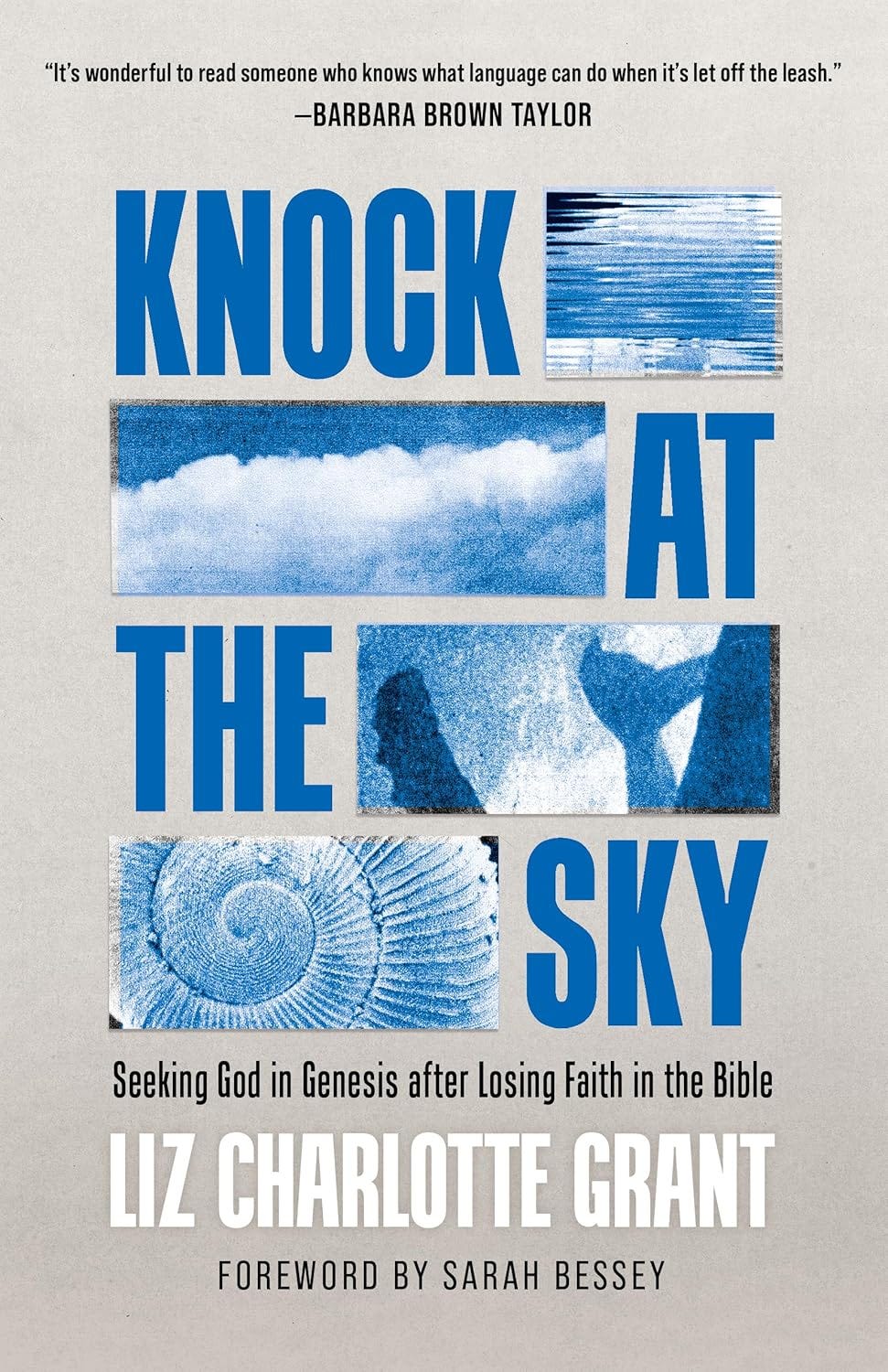
Sometimes there are books I don’t particularly resonate with or fully agree with, yet it’s obvious the author is both brilliant and deeply talented. That’s my experience of Liz Charlotte Grant’s Knock at the Sky. The book is so well-written—so artfully constructed—that it’s almost surprising to realize, if I understand correctly, that this is her first major publication.
Grant approaches the biblical book of Genesis with a kind of Midrashic lens, weaving together narrative, commentary, context, and imaginative expansion. While the style and theological direction didn’t always connect with me personally, I never found it a slog. Quite the opposite—her prose is sharp and compelling. I read a fair number of books, and based on this one, I doubt Knock at the Sky will be her last. I certainly hope not.
Though I’m not sure it would be officially classified this way, Grant’s work often struck me as a kind of commentary—and this makes sense if we read it through a Midrash framework. For instance, in one section (p. 132), she reflects on how historical criticism, shaped by Enlightenment ideals, seeks an “objective” meaning from the text. This, she suggests, may limit how we encounter Scripture’s complexity and mystery. It reminded me of what one of my seminary professors, Brandon Scott, once said: there’s no single right interpretation—but there are definitely some wrong ones.
As I reflected on the passages I had highlighted, it became clear that perhaps we should approach Knock at the Sky less as a devotional or commentary, and more as a work of theology—and Liz Charlotte Grant as a theologian in her own right. She writes,
“By listening, we meet the universe beyond ourselves. We also meet the universe within, who we actually are. And that quiet place of truth is also where we encounter God.”
This is not abstract spirituality—Grant grasps something essential about the Christian faith: sacrifice. She observes:
“The Bible assures us of only one certainty: the search for… God means loss in this life. Following God means sacrificing either ego—the need to be certain—or integrity—the truth that we rarely are.”
There’s theological richness throughout the book. She asks,
“Why can’t the force of gravity be both God’s active and contemporaneous work and an autonomous law of our natural order? Why can’t a thing have two causes, mystery and measure, a two-sided explanation?”
And again, leaning into that nuance, she writes:
“Theology offers us a two-sided concept of God that blends the lines between the material and the mystical… Sacraments are the holy objects that straddle the supernatural and material planes.”
But her depth isn’t just philosophical or abstract—it’s deeply human. In a culture that avoids suffering at all costs, she offers this timely and timeless wisdom (a quote that, I think she mentions originates with James Baldwin, but is no less true here):
“I do not mean to be sentimental about suffering—but people who cannot suffer can never grow up, can never discover who they are.”
Of course, there were parts of the book I disagreed with. For example:
“Even for devout Christians, we should be unnerved by a Divinity who can appear at whim, either externally or internally, and demand urgent compliance from us. As followers of the Bible’s Deity, we should ask hard questions about why biblical characters obeyed God.”
While I don’t share this concern, I find myself wanting to engage with Grant more deeply—not to argue, but to converse. Not because she’s an exvangelical hot-taker, but because she’s a careful thinker, and clearly a theologian.
And that’s what keeps me reading—because she also writes:
“In the end, what has sustained me in my reading is humility. Bible study, for me, means constant repentance. I see that I must constantly be willing to turn around, change my mind, admit that I’ve taken the wrong meaning from the text, and accept correction.”
There’s real spiritual maturity in that statement. And finally, in a moment that reminded me of the late Rachel Held Evans—beautiful, poetic, and disarming—she writes:
“We do not demand a flower explain itself. A flower is not a thesis statement. A flower is not even a question. A flower does not speak or lend itself to flattening on the page. Words will never capture the whole of the flower, even when the finest poet sets himself the task. Yet understanding can arrive as we sit in the presence of the blossom.”
That may be the most fitting metaphor for her book. Knock at the Sky is not a flower I’d plant in my own theological garden—but it is undoubtedly beautiful. And I hope she plants more like these.
Thank you for such a thoughtful review. I’m honored.