


Reflections on Church Metrics, Median Attendance, and Ministry Challenges
Recently, I listened to an episode of the Leading Ideas Podcast, featuring Doug Powe (incoming President of Phillips Seminary!) and Lovett Weems. Together, they discussed the future of the United Methodist Church (UMC) and the challenges facing Mainline Protestant denominations. One statistic shared by Weems stuck with me: in 2019, the median attendance in a UMC church was just 38 people. While the COVID-19 pandemic certainly worsened attendance trends, Weems emphasized that the decline in attendance preceded the pandemic and disaffiliation movements.
Hearing that number was startling. The median attendance of 38 means half of UMC congregations had fewer than 38 attendees on a Sunday. Similar trends appear in other Mainline denominations. The Presbyterian Church (USA) reported a median attendance of 35 in 2021, while the Episcopal Church and the United Church of Christ (UCC) reported medians of 50 before the pandemic. These numbers are sobering and highlight the ongoing struggles of declining participation across the Mainline Protestant tradition.
Understanding Metrics: Mean vs. Median
As a former church planter, I find these metrics fascinating. The distinction between mean (average) and median is important here. The mean is calculated by summing all values and dividing by the total number, but it can be skewed by outliers. For example, a handful of megachurches could inflate the mean attendance, making it less representative of the “typical” church. The median, on the other hand, is the middle value in the dataset and is unaffected by extreme outliers. In the context of church attendance, the median provides a clearer picture of the reality most congregations face.
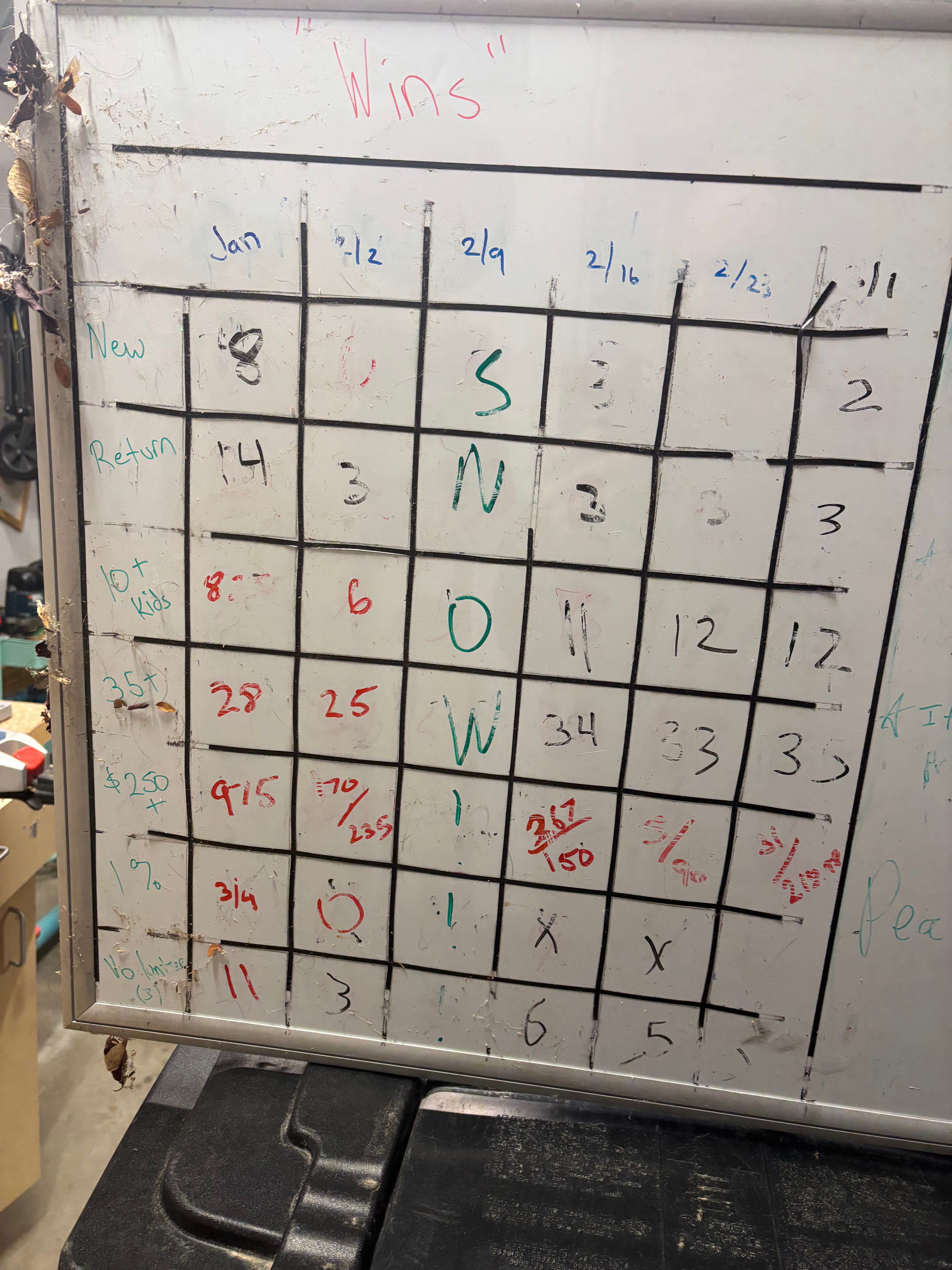
These metrics brought me back to my own experience leading a new church start. In my garage, I still have a whiteboard from that time, where I tracked attendance, visitors, and other metrics week by week. Even now, it’s a poignant reminder of the hopes, challenges, and heartbreak that came with starting a church from scratch.
A Snapshot of Success: Metrics from My Church Plant
Looking at the numbers on that whiteboard, I’m reminded of how much we accomplished in those early months of 2020, even in the face of challenges. I developed specific metrics to measure our progress, including first-time and returning visitors, total attendance, children’s attendance, giving, and volunteer engagement. For us, success meant having at least one new visitor each week, consistent returning visitors, 35 or more in total attendance, 10 or more kids, and $250 or more in giving.
Despite the cold, snowy Colorado winter that led us to cancel a Sunday due to snow, we came close to or exceeded these benchmarks several times. In February and early March, we averaged 32 attendees per Sunday, including over 10 kids. We welcomed eight first-time visitors in January alone, with more in March. Volunteers stepped up every week to help, even if giving was still a significant challenge.
These metrics clearly show that, by many measures, we were a successful church plant—certainly within the median range of Mainline Protestant churches.
Easter on the Hill: A Bittersweet Day
I’d been working hard preparing for what would be our first real in-person gathering since the advent of the pandemic. We decided to meet on a hill in a park near my house—a spot with a stunning view of the mountains, a truly glorious setting for Easter Sunday. I remember that morning vividly. I wasn’t sure what to expect. It had been so long since our community had gathered in person, and I had no idea who would show up—or who wouldn’t.
To my surprise and joy, 30 people showed up that day, many of whom I hadn’t seen in over a year. There was an excitement in the air, a palpable optimism about being back together. As I greeted people and as I preached, I could feel their energy and enthusiasm—hopeful for what was next and grateful to be reunited as a church family. Yet, as fulfilling as it was to see everyone again, I knew in the back of my mind there was no future.
What made it all the more challenging was my wife’s work schedule. As an ER nurse, she had worked the night before and was scheduled to work again that night. That left me leading in-person worship for the first time in over a year, in an unfamiliar location, on the biggest church day of the year—all while watching my two young kids.


I can still see myself standing there, giving my sermon as passionately as I could. My 3-year-old son kept running over from the playground to ask me questions mid-sermon, which added a layer of humor and distraction. But his interruptions weren’t the most challenging part of that day.
Earlier that week, on Monday, my boss and church planting coach had called me to deliver difficult news: it was time to shut down the church. In hindsight, I regret agreeing with him, but like many pastors during that time, I was exhausted—physically, emotionally, and spiritually.
At home, I was juggling life with two young kids, one of whom I was trying to guide through online schooling during the pandemic. My wife, meanwhile, was on the front lines of the COVID-19 crisis, working long and grueling shifts in the ER. When my boss suggested ending the church plant, I simply didn’t have the energy to fight back.
For reasons I still don’t fully understand, I found myself reading a resignation letter to denominational figures weeks later, bearing all the blame for what had happened. It felt profoundly unfair—blaming myself for something so far beyond my control: a global pandemic, toxic and dysfunctional leadership from my boss, and circumstances no one could have anticipated.
Moving Forward: A Testament to Faithfulness
Reflecting on my time as a church planter, I realize now that success isn’t always about numbers or outcomes—it’s about faithfulness. Despite the immense challenges we faced, I gave my all to that church plant. I worked tirelessly to create a space where people could connect, grow, and experience God’s love. Every sermon, every event, every metric I tracked was a reflection of my commitment to the mission and the people I served.
We were building something meaningful. Week by week, we saw new faces, welcomed returning visitors, and created a vibrant environment where over 10 kids gathered each Sunday. Those numbers weren’t just statistics—they represented lives touched by our ministry. We didn’t just survive in the face of impossible odds; we thrived in ways that many churches, even established ones, could only dream of.
I’ve carried a lot of regret and disappointment over how things ended, but I’m trying (emphasis added) to reframe that story. I was faithful to the work I was called to, even in the midst of a global pandemic, personal exhaustion, and systemic challenges. I poured my heart and soul into that church, and for that, I am proud.
The whiteboard in my garage, covered in spiderwebs and sawdust, is a reminder not of failure but of faithfulness. It represents a season where I gave everything I had to serve God and others. And in that, I see success—not because of the numbers or the outcome, but because I showed up, I stayed faithful, and I gave my all.
This is a great and very relatable story. As a church planter myself, I remember the days of just hoping someone, anyone, would show up. We determined early on that if it were my family plus one, we would have church. And we tested that theory a couple of times in the first year. Fortunately, ten years hence, we have a thriving, if small, church. But I remember those first days like they were yesterday.