


TL;DR
In a culture built around “doing what feels good,” it’s easy to mistake vibes for virtue. Drawing on parenting, civil rights history, and Christian moral thought, this post argues that real moral formation rarely feels good—and that sacrifice, not pleasure, is what actually shapes character.
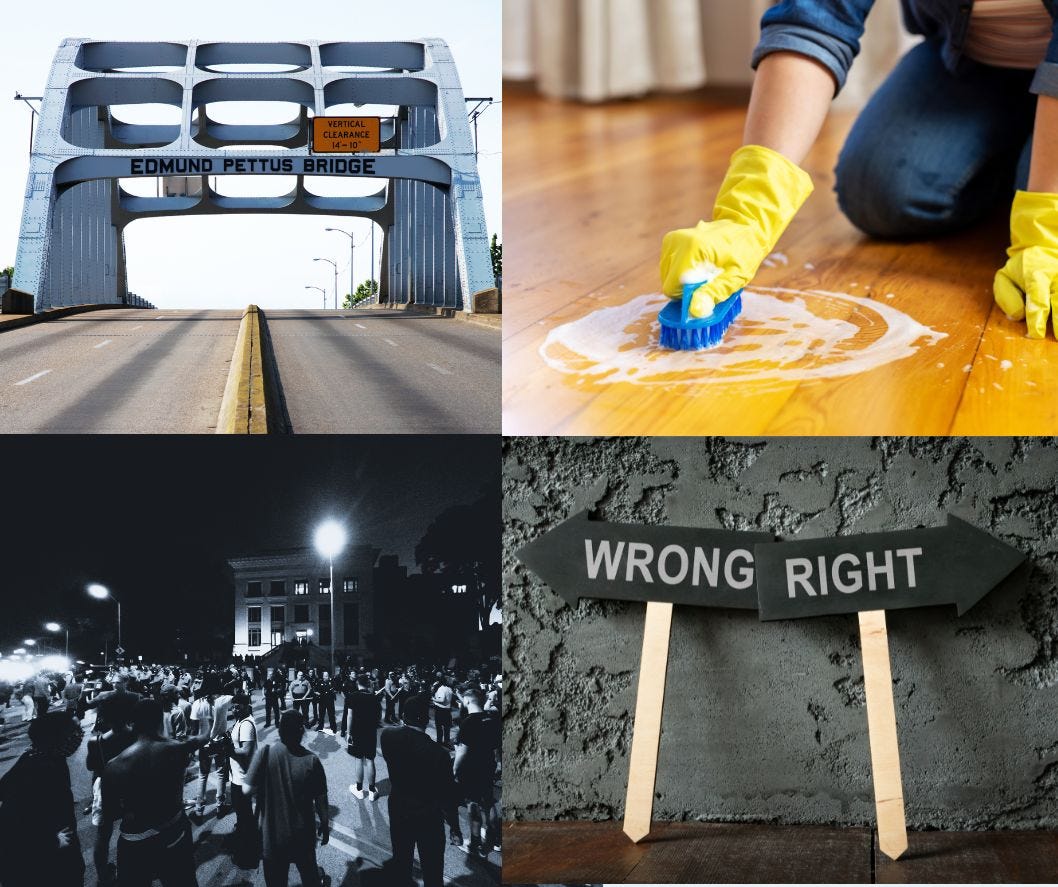
I started writing this Substack draft only to be interrupted by the reminder that I needed to go upstairs and clean up my son’s puke from the night before. He’d picked up some kind of stomach ailment on Christmas Eve—read: more puke—and even though it’s been about a week, apparently his stomach still wasn’t recovered enough to handle the pizza we bought with the gift cards tucked into the kids’ stockings.
It was not what you would call pleasant.
Or enjoyable.
Or feel-good in any sense.
The vibes, as they might say, were not good.
The Cult of Good Vibes
Also this past week, actress Jameela Jamil made waves on this platform with a post explaining why she dislikes kids. She wrote:
“I dislike children, I know that’s taboo, but I find them fucking annoying and very loud. The constant stream of snot freaks me out.”
As for what prompted the post, she explained:
“I’m turning 40 in two months. I am without child. I am by choice, without child. I am asked a minimum of once a week why I don’t want children, and I am maybe writing this just to text it to people rather than having to exhaust myself any longer.”
It’s no secret that Western society is facing something of a demographic cliff, as more individuals and couples choose not to have children. I don’t intend this to be a diatribe against women in general, nor a screed in favor of more traditional gender roles. But what Jamil’s post does exemplify—quite clearly—is how, in our modern cultural imagination, children are often seen less as a blessing and more as a liability.
There are, of course, very legitimate reasons for this. Rising costs—healthcare, childcare, housing, food, and eventually college—make the prospect of raising children feel economically impossible for many would-be parents.
I also want to say this plainly: not every woman or couple must have children, and not wanting children does not automatically make someone selfish or self-centered. Jamil herself names real concerns—the instability of the world, climate change, war, abuse. Those fears are not imaginary.
And yet, I find it telling that she opens her post by saying:
“I am aware that everything I’m about to say is an indictment on my character but fuck it.”
Why Vibes Can’t Form Character
In this post, I want to explore how much of the resistance to having children—and, more broadly, resistance to costly commitments—stems from a cultural assumption that life is about positive vibes and doing what feels good. Following up on my recent writing about moral ecology and moral imagination, I want to argue that vibes and feeling-good are profoundly inadequate foundations for forming people of moral character.
In a previous post, I wrote that anger and vitriol cannot sustain moral action:
“Reaction can feel satisfying in the moment, but it doesn’t actually form character. And when the emotional energy runs out—or the vibes shift—it leaves very little behind to sustain people.”

To review: in How to Reach the West, Tim Keller argues that character isn’t taught in a classroom but lived in community. He suggests that a moral ecology answers five basic questions:
Why be good?
What specifically is good?
What is not good?
Who is good? (moral imagination)
How can we be good in daily life?
Justin Giboney, in Don’t Let Nobody Turn You Around, defines moral imagination this way:
“Moral imagination is the ability to see not simply what has been historically, what is in the present moment, or what’s likely to be in the future. It’s the ability to see what ought to be and what will be based on God’s capacity, character, and promises” (156).
Put simply:
Moral ecology answers what should be.
Moral imagination asks what could be.
Moral Ecology and Moral Imagination
Our current cultural moment, however, tends to answer questions of good and bad almost entirely through feelings and vibes. I don’t think it’s an exaggeration to say that “if it feels good, do it” has become the default moral framework of our time.
On the surface, that logic sounds obvious—even humane. But it starts to crack under pressure.
Try saying in public, “endlessly chasing personal pleasure is both morally insufficient and socially destructive,” and see how that goes.
We’ve become such a pleasure-seeking, happiness-chasing society that even suggesting limits sounds backwards, even dangerous. Many of us suffer from a kind of main-character syndrome—assuming life revolves around us, or at least should.
Which brings me back to kids.
And puke.
Cleaning up my kid’s puke was not fun.
There were no positive vibes.
None.
And yet, this is perhaps the most important thing parenting has taught me:
Life is not about me.
Equally important is this: many of the most formative moments in parenting do not feel good. Dirty diapers. Middle-of-the-night wakeups. Worrying about development, health, friendships, failure. All of it is tedious, exhausting, and often gross.
And yet—precisely because these moments demand sacrifice—they lead to moments of deep moral clarity and fulfillment.
Parents don’t get constant rewards.
They get fleeting ones.
A small victory.
A smile.
A moment of growth.
And somehow, that’s enough.
Parenting, in this sense, is moral formation.
When Doing the Right Thing Doesn’t Feel Good
This is why Giboney’s reflections on the Black church tradition resonate so deeply with me. He highlights how African American Christians sustained movements for justice that did not feel good, did not generate positive vibes, and offered little immediate payoff. They endured suffering in hope of future redemption.
I’m reminded here of the Civil Rights movement—and of figures like John Lewis, who endured brutal violence crossing the Edmund Pettus Bridge on Bloody Sunday. Long marches. Late meetings. Beatings. Jail.
No dopamine hits.
No vibes.
Just a deeply rooted moral ecology that knew what was right—and trusted that goodness itself was worth the cost.
I recently saw a Substack post—can’t remember the title exactly—lamenting that “no one wants to do the hard work of going to meetings.” And honestly, I get it. Meetings are boring. Inefficient. Time-consuming. They require patience, listening, and sitting with people you disagree with or find irritating (dare I say, like kids).
Many meetings should be better run.
But the core point still stands: the meetings that actually matter rarely feel good.
And it’s no accident that they’re often dominated by older generations—people formed by a moral ecology that assumed change requires sacrifice. Many younger folks, by contrast, have been shaped by the logic that if it doesn’t feel good, it’s not worth doing.
Beyond Vibes
I’ll close with this.
I remember the surge of positive energy in the summer of ’24 when Kamala Harris stepped in for Biden. Dread turned into optimism. Then came the social media celebration around Tim Walz’s “big-dad energy.” Bluesky was awash in good vibes. Hope. Enthusiasm.
And yet, nothing fundamental had changed on the ground. The economy was souring. Cultural backlash was building.
And I can’t help but wonder: beyond vibing online, how many people actually did the hard work of talking to a swing voter?
I understand that in a pluralistic society, Christianity cannot function as THE shared moral foundation. Attempts to declare the U.S. a “Christian nation” are both laughable and corrupt.
But we do need some kind of moral framework—some shared story capable of forming people for costly action.
Again, part of the challenge of the all the cultural-deconstruction over the past decade is that America has been stripped of a moral framework. While it’s absolutely understandable that many of these stories were rooted in myth, historical inaccuracies, and sometimes absolute oppression, I do think they did, to some extent, define what it meant to “be a good American.”
And as a Christian, I think Christians—especially those of us on the Christian left—need to be far more explicit and confident about the moral foundation of our faith.
Not as vibes.
Not as aesthetics.
Not as feel-good energy.
Because in the end, doing the right thing rarely feels good.
Especially when there’s puke involved.
Do you have a link to that keller book? I don't seem to be able to find it but i like this track as a theme for lent...