



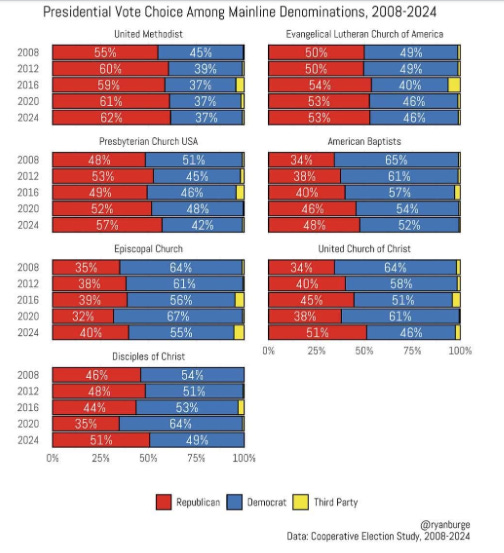
New data from religious sociologist Ryan Burge is sending a ripple of confusion and frustration through many mainline clergy circles, as evident in countless social media posts and comment threads. The recent stats show that a significant number of churchgoing Christians—yes, even in “moderate” or “progressive” congregations—voted for Donald Trump in 2024. For some, this was received like a betrayal. The response? Shock. Lament. Even a dose of public shaming.
But here’s the thing: I just don’t believe we’re secretly harboring a bunch of closeted Christian Nationalists in our pews. I think that’s a mistaken—and frankly unhelpful—assumption.
As Dennis Sanders wisely said:
“No, we aren’t a bunch of closeted Christian Nationalists. People within and outside the denomination think we’re raging progressives, and in reality, that’s just the pastors and denominational leaders. Folks voted for Trump for all kinds of reasons: inflation, immigration, concerns about Harris, or just thinking he’d govern like he did the first term.”
That may be hard for some clergy to hear, especially if we imagine our congregations as ideological extensions of ourselves. But the truth is more complicated—and more human. People make voting decisions through a tangled mix of fear, habit, conviction, identity, and perceived self-interest. It’s not always about theology or ideology. And it’s certainly not always about Christian Nationalism.
There’s also something of the Law of the Hammer going on here. Abraham Maslow once wrote:
“I suppose it is tempting, if the only tool you have is a hammer, to treat everything as if it were a nail.”
Many pastors, so deeply immersed in the fight against Christian Nationalism or right-wing extremism, have come to see every action or opinion through that lens. They assume that any decision not framed as outright resistance must be tacit support. But that’s a product of their bubble—a cognitive bias that flattens complex realities into binary choices. The nuance of why someone voted the way they did gets lost in a fog of suspicion and moral urgency.
Not everything is a nail. And not every Trump vote is a theological declaration.
Let me be clear: I’m not thrilled that so many Christians backed Trump again. But I also don’t know what good comes from shaming or mourning their votes in public. If our posture toward those who differ from us politically is outrage and lament, rather than curiosity and compassion, then we’ve already lost the plot.
Pastors need to take an honest, humble posture and ask: why would someone in my church vote this way? Not to win an argument, or prove them wrong, or offer them a better theological explanation—but to really understand. What fear, concern, longing, or frustration are they carrying? What are they seeing—or not seeing—from the church? That kind of curiosity might not just lead to pastoral clarity, but spiritual connection.
Dennis offered another insight worth sitting with: North Dakota used to have two Democrats as Senators, now it’s a pretty red state. People grumble about this, but no one asks why this state went from having Democrats representing them to becoming a strong GOP state. Dems used to have Senate seats and governors in Iowa, Nebraska, South Dakota—places where there are still plenty of mainline churches. Not anymore. Why?
Too often, the answer is assumed: They must just hate non-white people.
That’s not reflection. That’s dismissal. And it’s killing our ability to pastor people honestly, or understand the cultural and political shifts reshaping our communities. To be sure, no doubt some Trump voters do. But to assume that of everyone? I don’t think that’s fair nor accurate.
What if we started with less assuming and more listening? What if we allowed space for people to wrestle with complex realities without demanding purity or ideological conformity? What if we took seriously the challenge of discipleship—not as a synonym for progressive values, but as a deeper invitation to follow Jesus in costly and transformative ways?
It’s telling, really: Many pastors seem more alarmed by Burge’s recent voting data than they ever were by his earlier findings about the collapse of mainline church attendance. Maybe it’s easier to rage at a ballot than to wrestle with our own decline.
There are a significant number of people who voted for Obama and Trump, mainly because they wanted someone -- anyone -- from outside the System to shake it up. Historian Peter Turchin talks about the current struggle between 2 elites, the insiders and the outsiders, and how they each try and enlist the lower classes. I am trying to say that your point is well taken, that this isn't simply the hateful racist nationalists against us good guys. We are failing to see how the establishment has failed so many people that they started looking elsewhere. (A point Ezra Klein makes in his new book, Abundance.) A lot of people voted against Biden and for whomever was on the other ballot line, who happened to be Trump. As much as I despise Trump, many see him as an anti-establishment figure. (Not really paying much attention perhaps to what he is actually for.)
If you cannot listen to people who vote differently than you, as a genuinely interested neighbor, long enough to find out what issues or situations motivated them to do so, then how on earth can you counsel them spiritually? Accusing people of sins you don’t know they committed, and then refusing to absolve them, to boot, is abuse of the office.