


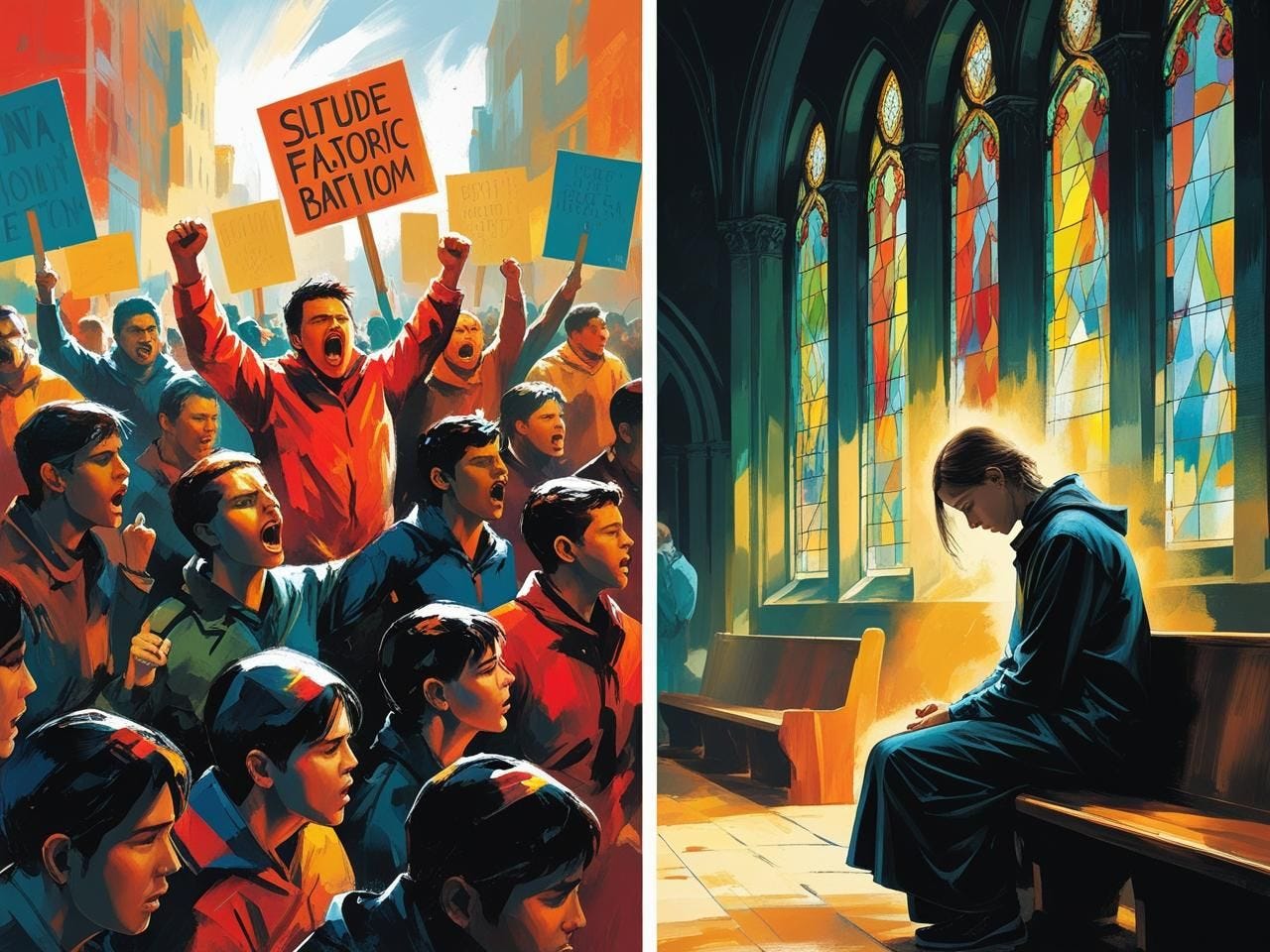
Recently on the Future Christian Podcast, I had a conversation with Dr. May Young, author of Walking with God Through the Valley: Recovering the Purpose of Biblical Lament. As we explored the role of lament in the Christian life—especially in response to pain, injustice, and violence—I was reminded of another powerful conversation I’d had some time ago with Dorcas Cheng-Tozun, author of Social Justice for the Sensitive: How to Change the World in Quiet Ways.
Both women challenged my assumptions about what faithful protest looks like. And together, they helped me see something I’ve been slowly coming to believe: anger isn’t the only way to protest. And honestly, it may not even be the most faithful one.
Lament as Protest, Not Performance
As I shared with Dorcas during our interview, I once brought my young kids to a protest. The goal was good—I wanted them to see what it looked like to show up for justice. But as the chanting grew louder and more confrontational, and as tensions flared between protest leaders and property representatives, something in me pulled back. I remember thinking, this could go sideways fast. It didn’t feel like the right place—not for me, and definitely not for my kids.
Dorcas resonated with that story. As a self-described sensitive soul and introvert, she shared how traditional activism—loud, urgent, aggressive—often felt overwhelming and alienating. “We can’t just be shouting at each other,” she told me. “That only gets us so far.” In her book, she contrasts two archetypes of leadership: the “warrior king,” who acts quickly and commands loudly, and the “priestly advisor,” who discerns slowly and leads relationally. Her invitation is to expand our imagination of activism to include gentler, quieter, yet still faithful forms of engagement.
May Young brought a complementary insight from the world of biblical theology. “Sometimes lament is the only and most appropriate response to evil,” she said. Lament is not weakness or passivity. It’s not merely sadness. It’s a holy act—a way of naming what is broken while placing our hope in the God who heals. Lament doesn’t numb the pain. It honors it, and it directs it to God.
Where Dorcas challenged the emotional cost of anger, May revealed its spiritual limits. “Anger might be where we start,” she said, “but it cannot be our long-term fuel.” Left unchecked, anger consumes. It narrows our vision, divides our communities, and blinds us to the humanity of others. When our outrage becomes our identity, we risk becoming the very thing we protest.
Resistance Isn’t Enough
What if the church took its cues not from the language of resistance, but from the language of lament?
I know resistance has become a rallying cry in many corners of our political and religious lives. And I understand the impulse. Especially now.
When legislation is passed that allocates $45 billion in funding toward militarized enforcement—empowering ICE with sweeping power, enabling the construction of detention centers that feel like an eerie mix of concentration camps and internment camps—it’s hard not to scream. These policies are not just misguided; they’re dehumanizing. They echo some of the worst horrors of our past. They are cruel, and they are evil.
And yet—as necessary as resistance may feel, I believe it’s ultimately insufficient.
Resistance might disrupt, but it doesn’t redeem. It names what’s wrong, but rarely shows us what’s right. It rises in urgency, but often burns out in exhaustion. In a moment as frightening as this—when fear and force are the coin of the realm—we need more than opposition.
We need holy grief.
We need sacred imagination.
We need lament.
The Prophetic Power of Lament
Lament doesn’t simply react—it responds. It doesn’t only cry out in pain—it clings to a deeper promise. It dares to believe that what is evil will not last forever, and that what is good—what is of God—will endure.
Lament says, “This is not how it’s supposed to be.”
But it also whispers, “This is how the world could be.”
It is prayer and protest in one. It holds the world’s grief without surrendering to it. And in doing so, it models the very thing the Church is called to be: not a megaphone for the culture wars, but a sanctuary for the brokenhearted. A people who cry out to God—not in self-righteous fury, but in deep trust that He is still at work.
In my conversations with Dorcas and May, I saw that lament is not inaction. It’s not simply a “thoughts and prayers.” It’s not a cop-out. It’s a different kind of protest—one that begins with grief, but refuses to give up on hope.
And I wonder: what if we stopped trying to “resist” everything and started learning how to lament?
Because I’m convinced more than ever—especially in moments like this—that what we need is not just louder voices.
We need deeper ones.
If this reflection speaks to you, consider sharing it—or better yet, praying through a psalm of lament today. May our protests be shaped not only by what we oppose, but by the hopeful future we long for—and by the God who is already making all things new.
Thanks for this excellent analysis. This is a conversation that, among us Christians, we must continue and even amplify. But allow me a couple of thoughts—not as disagreements so much as a conversation among friends. First, there could be a problem setting up a choice between lament and resistance. You are not exactly suggesting this, because you still seem to think resistance has its place. Personally, I think lament is a form of resistance—just not, as you say, a loud or angry version. In 2014 I wrote a published article under the title “Blessed Are Those Who Mourn: Depression as Political Resistance.” (I am a minister who is also a psychotherapist, and for 23 years also an academic.) But recognizing lament, or depression, as a form of resistance is not very effective for social change (rather than only individual sustenance) unless it occurs in community, unless it becomes “organized,” as activists might say. I think this is where your argument becomes critically important. I suspect that the authors you cite would also suggest that lament shared in community is the operative force, or power.
Second, I agree that resistance that is expressed as anger, or even limited forms of violence, is dangerous. But I am
not an absolutist on this. It is clear, in the Gospels, that Jesus ministry was one of non-violence. After all, he exhorts us to “love our enemies,” and to “turn the other cheek.” But Jesus was not an absolutist on this either. The Gospels also say he cleansed the temple grounds of “the money changers” on the Sabbath. They even go into detail, noting that he braided cords as a tool to force them out. He either beat some of them, or threatened to do so. In effect, this was an act of limited violence. It certainly was no Sermon on the Mount. And, to your point, some New Testament scholars have insisted that this act was the final straw that resulted in Jesus’ arrest and crucifixion. In brief, while I also embrace non-violent resistance, this Gospel story gives me pause.
A great commentary on what's necessary at this point. "Resistance"– force being met by counter-force– always seems so inadequate, not to mention unimaginative and coercive. As if that's sufficient to achieve the change that's actually needed. Lament is rooted in what the change needs to look like in order for it to be the "right" change.