


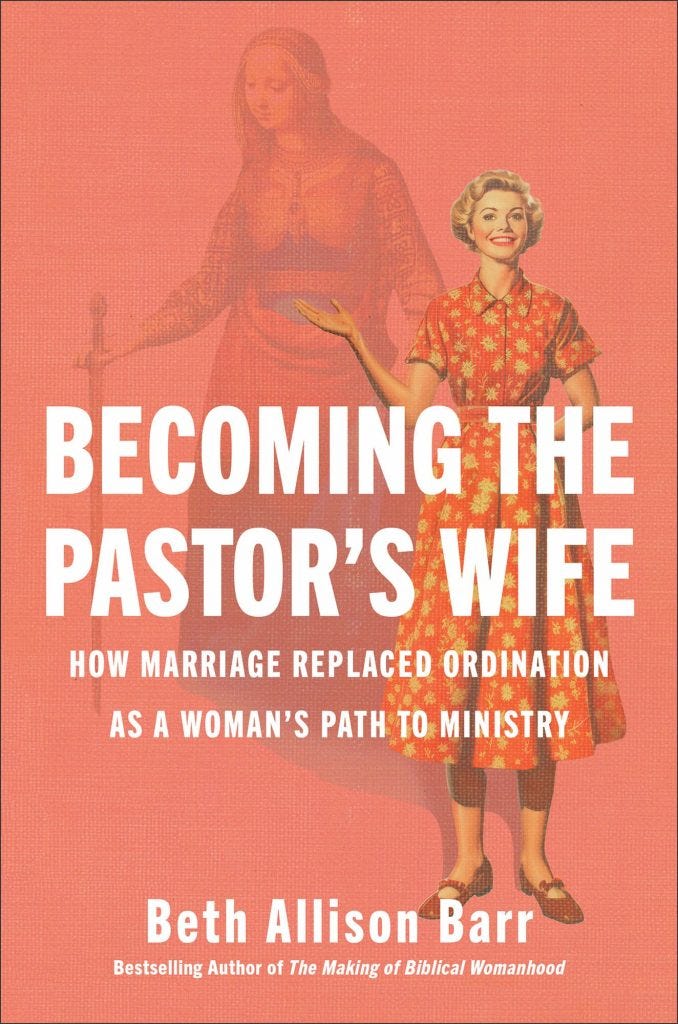
What does it mean when the most acceptable form of women’s ministry in some churches is simply being the pastor’s wife? In this post, I reflect on Beth Allison Barr’s new book and the real-world implications—both subtle and systemic—of that answer. Spoiler: ideas have consequences.
I’m obsessed with implications. It’s why I spend so much time on this blog talking about what I see as the problematic implications of Progressive Christian theology. It stems from my Strengthsfinder Strategic® strength, which drives my interest in implications.
From Strengthsfinder:
“You create alternative ways to proceed. Faced with any given scenario, you can quickly spot the relevant patterns and issues.”
“You quickly weigh alternative paths and determine the best one… anticipate, play out different scenarios, and plan ahead.”
The idea of implications hit me again while reading Beth Allison Barr’s Becoming the Pastor’s Wife.
Tracing the Role of the Pastor’s Wife
In the book, Barr tells the story of her journey alongside her husband in ministry while exploring how the role of “pastor’s wife” became the primary—if not only—viable path for women in conservative evangelical churches, especially within the Southern Baptist Convention.
Where I Don’t Fully Agree
While I didn’t resonate with everything Barr wrote—for instance, I do think the pastor’s family and/or spouse will bear an extra load and responsibility in church life—I think that’s just part of the reality. It’s hard for a pastor to urge people to commit to a church if the pastor’s own family isn’t visibly invested.
That’s something I think Mainline churches often miss. There’s usually little expectation—or even invitation—for a pastor’s spouse or family to participate in church life. But people want to know you’re all in—and that includes your family. It’s not unlike small businesses that describe themselves as “family-owned and operated”—that kind of shared investment builds trust and connection.
Unpaid Labor and Shared Calling
Barr also laments the “unpaid labor” expected of many pastors’ spouses, which I understand. At the same time, I’ve heard from the wives of male pastors I know—folks who lean more conservative—who regularly use “we” language when talking about church ministry. They see it as a shared endeavor. And these couples don’t come across as patriarchal or complementarian. If anything, they seem pretty egalitarian. So I do think there’s a way for a spouse to contribute meaningfully—even sacrificially—without being exploited.
The Bigger Implication
Still, Barr’s main point stuck with me: what are the implications of seeing women only as “pastor’s wives”? That’s not just about workload—it’s about theology and identity. One of the pastors and wives I’m thinking of serves in a tradition that does ordain women—which Barr points out has become a flashpoint in some circles, seen as a “slippery slope” (3). I don’t think that’s the case. But I agree with her broader conclusion:
“Rendering women as subordinate, in both marriage and ministry, rendered women’s voices, contributions, and value as less than those of men” (160).
She connects this directly to harm. Reflecting on the story of a pastor’s wife who endured years of abuse and betrayal with no options for escape, Barr writes:
“What does this story of a pastor’s wife abused by her husband have to do with the rejection of women’s ordination? Think about it. Both reflect what happens when male power is privileged at the cost of women” (179).
And then she drives it home:
“For more than five decades, conservative evangelical theology has been teaching an increasingly restrictive gender hierarchy that privileges male power and authority while subordinating and marginalizing women. The sex abuse scandals that are currently plaguing the SBC are not anomalous; rather, they are the product of a systemic culture teaching that women are worth less than men” (180).
Why It Matters
Ideas have consequences. Theologies have implications. And I appreciate Barr for naming them so clearly. I recommend Becoming the Pastor’s Wife for anyone curious about how theology shapes real lives—especially the lives of women.