


TL;DR/ Executive Summary:
In a culture flooded with anxiety, we often rush to oversimplify complex issues into black-and-white moral judgments. Drawing from Family Systems Theory, this post argues that our craving for moral clarity is often more about managing fear than seeking truth. Real leadership means knowing when to raise urgency and when to reduce it—what Jack Shitama calls being a “transformer” of emotional energy. This isn’t a rejection of moral clarity, but a call for virtue ethics: truth that holds complexity, wisdom, and character together.
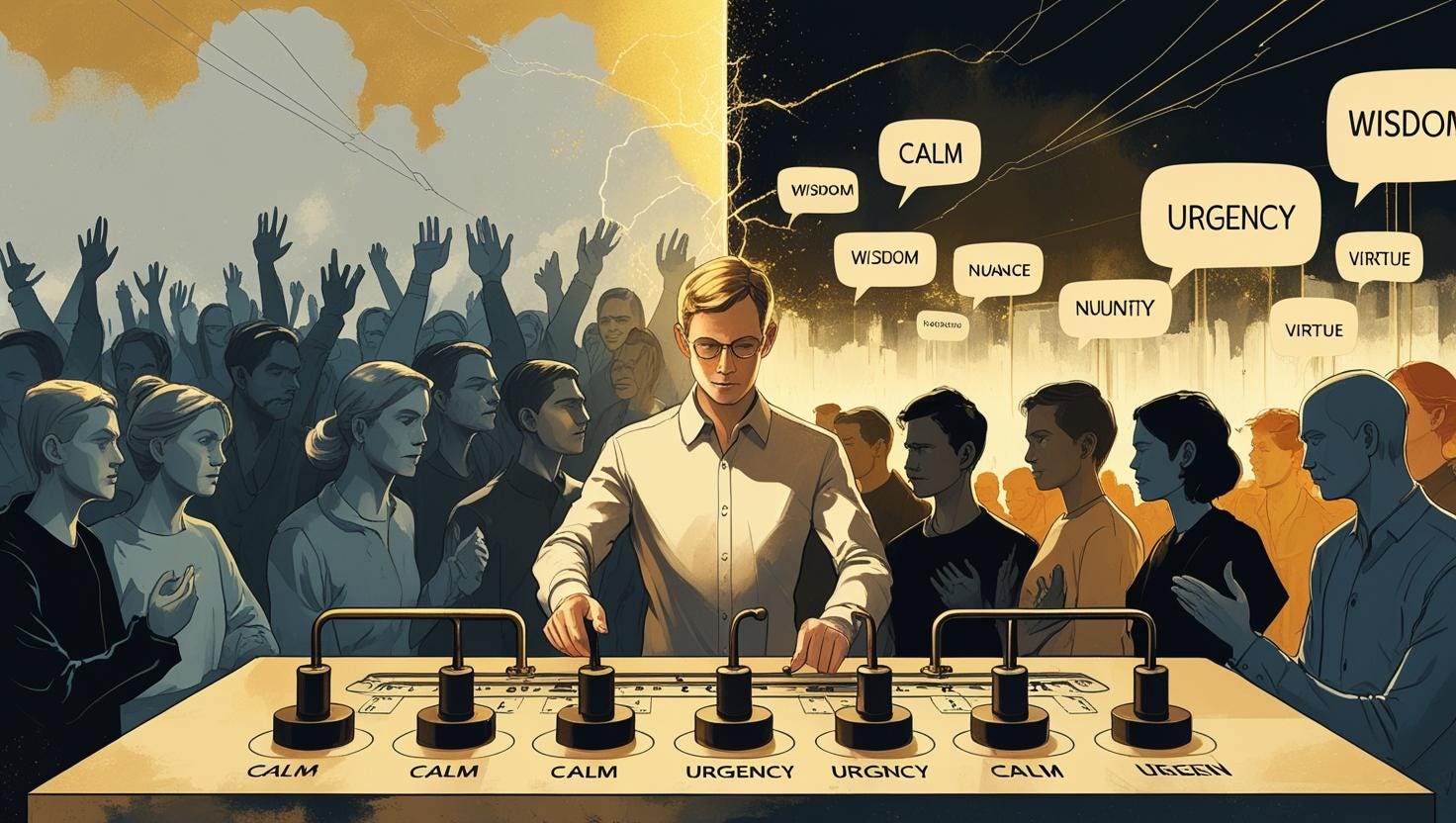
In Family Systems Theory, anxiety isn’t just a feeling—it’s a force. It spreads, it escalates, and it shapes the behavior of entire groups. In anxious systems (or societies), people gravitate toward certainty not because it’s true, but because it’s soothing. Moral clarity, even when oversimplified or inaccurate, becomes a coping mechanism.
That’s what I see playing out in so many of today’s public controversies.
The Certainty Illusion
Take the recent news about CBS and Stephen Colbert. Is this the silencing of liberal voices, or just late-night TV evolving in a streaming era? Depends who you ask—and their answer likely reflects their emotional need for certainty more than any serious analysis.
Or consider the WNBA pay debate. Is it pure sexism, or the natural economics of a growing league? The truth is probably both. But social media and cable news thrive on either/or answers, not both/and tensions.
Even the NPR funding conversation is laced with anxiety. Is it a vital public service or a liberal echo chamber? Is this about bias or budgets? These are complex questions. But in anxious systems, complexity feels threatening. So we rush toward clarity—even if it’s false.
When Certainty Becomes a Weapon
There’s another cost to this compulsive certainty: it alienates. When we treat every issue as morally obvious, we make it nearly impossible for those who are undecided—or even slightly questioning—to stay in conversation. There’s no room for doubt, no space for nuance, no grace for process. You're either fully in, or you're suspect.
In that environment, good-faith disagreement is confused with bad character. Curiosity looks like compromise. Asking questions is mistaken for being part of the problem. So people stay silent—or walk away.
And here's why that matters: in high-anxiety environments, belief isn’t just about ideas anymore—it’s about group cohesion and fitting in. As David Zahl writes:
“If we are leaning on a specific cause or ideology for social acceptance, then the most accepted will be those who espouse their views the loudest. Belovedness will be bestowed in proportion to the strength of our commitments. In such environments, hesitation and doubt become grounds for rejection, which incentivizes entrenchment, escalation, and even radicalization.”
— David Zahl, The Big Relief
It should also be said that in midst of our “attention economy,” it pays to speak loudly or forcefully, which creates perverse incentives. The social media algorithms rewards engagement, and nothing seems to drive engagement more than outrage. Everyone needs to be freaking out about something online in order to gain attention. Therefore, we on the consuming end feel the constantly escalated tension because things indeed are always ratched up by one person or another to gain clicks and views.
Not All Clarity Is Bad
Let me be clear: some things do offer absolute moral clarity. There are moments in life and history when the right thing to do is unmistakable. The civil rights movement offered a clarity grounded not in emotional reactivity but in moral vision, patient suffering, and long obedience. When we call something “wrong,” we don’t need to hedge. And when we name injustice, we should do so plainly.
But even moral absolutes can have complexity in how they’re applied. Take “Thou shall not kill.” A clear command. And yet most traditions make ethical space for situations like self-defense, just war, or protecting the vulnerable. That doesn't mean the commandment is relative or optional—it means that applying moral truth in real life often demands wisdom, not just slogans.
This isn’t an argument for moral relativism. It’s an argument for virtue ethics—the belief that there is always a right and just path, but discerning it often requires maturity, courage, and careful attention to context. It’s about formation, not just rules; character, not just clarity.
The overuse of moral certainty—in every headline, every controversy, every tweet—cheapens its power. It turns what should be a moment of ethical conviction into a mood of self-righteousness. And it leaves us unprepared for the real work of moral discernment: listening, learning, wrestling, holding tension.
What Healthy Systems (and Leaders) Can Do
Whether in families, churches, or societies; what Family Systems Theory reminds us is that healthy systems are marked by leaders who can tolerate ambiguity. Healthy leaders can hold the tension without needing to resolve it immediately. They can resist emotional reactivity and stay grounded in purpose rather than panic.
In one episode of his podcast The Non-Anxious Leader, Jack Shitama uses a helpful metaphor: leaders should act like electrical transformers. Just as the power grid relies on step-up transformers to move energy long distances and step-down transformers to safely reduce voltage for home use, society needs leaders who can convert emotional energy into something useful and sustainable.
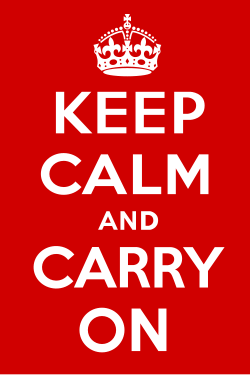
Sometimes, people need to be told: “Stand up. This matters.” Other times, they need to hear: “Calm down. We’ll get through this.” For instance, Dr. Martin Luther King Jr. essentially told Americans—especially white Americans—stand up, this matters. Whereas in the midst of what was surely a serious crisis in WWII, the British government told people to “Keep Calm and Carry On.”
Emotional intelligence means knowing which kind of energy transformation is needed—and when. Or, as Jack Shitama would say, we need leaders who will take principles stands.
Too many leaders today, however, have defaulted to one setting: full voltage, all the time. Instead of regulating anxiety, they reflect it. Or worse, they exploit it. They don’t calm the crowd or challenge it—they just tell people to keep freaking out.
We need something different. We need leaders, thinkers, and citizens who are willing to say, “This is complicated,” not as a cop-out, but as a commitment to doing the hard work of discernment. We need people who know when to raise the stakes—and when to lower the temperature.
Because clarity that costs us truth isn’t clarity—it’s reactivity disguised as confidence.1
Recently I was texting a friend that I think much of the progressive movement was driven by the most anxious white people in the room—I think this could be another post some day.
This brought up my fond recollections of Edwin Friedman & his Generation to Generation: Family Systems in Church and Synagogue. Over the years I've kept giving away my copies and now in retirement there's a gap on my shelves where my last copy used to be. Friedman spoke of a faith leaders group he was part of in Washington, DC in the late 70s and early 80s with leaders from most faiths and traditions in that region. His observation from the similar stories these leaders shared was that issues of direction, distance, and anxiety in congregations was "protoplasmic," and from that observation came his best known book. As a mainliner who spent the last years of parish ministry hanging out with evangelicals I can confidently assert that as far as anxiety driven reactivity is concerned there is absolutely no difference between left and right, progressive and MAGA.
Thanks for a thoughtful, balanced, and insightful post.