


TL;DR: Some recent interpretations of Jesus’ Parable of the Talents portray the third servant as a hero resisting an exploitative economic system. But does that reading hold up when we consider the broader context of Matthew’s Gospel and the history of Christian interpretation? While liberationist perspectives can raise important questions about wealth and power, this essay asks whether we're allowing contemporary ideological frameworks to override the theological context of Scripture—and losing sight of Jesus’ message about faithfulness and readiness for his return.
First things first—I forgot to send something out last Thursday—so I’m making up for it this week by sending out an extra mailing. I have too much good stuff in waiting!
It’s church stewardship season, which means alongside pledge cards, awkward giving talks, and requests for your tithes and offerings in the coming year—there is most certainly to be heard a sermon on the Parable of the Talents from Matthew 25.
There’s a few reasons for such: first, the gospel text is placed in the lectionary at this time of the year, and second, the word “talent” fits within the often-used stewardship framework of “time, talents, and treasure,” (even if the word “talent” in the Bible doesn’t really fit our modern understanding of “talents”), and finally, the seeming ethos of this parable to be about responsible use of money and resources certainly fits most all stewardship themes.
This year, however, I’ve been seeing a growing number of sermons and interpretations suggesting that the real hero of Jesus’ Parable of the Talents in Matthew 25 is actually the third servant. And frankly, I struggle to understand how that reading holds up.
For one thing, there seems to be little historical precedent for this interpretation. From what I can gather, one influential modern presentation of this interpretation comes from William Herzog’s Parables as Subversive Speech (1994), which reads the third servant as resisting an exploitative economic system. I obviously didn’t do a deep dive, so maybe there is more.
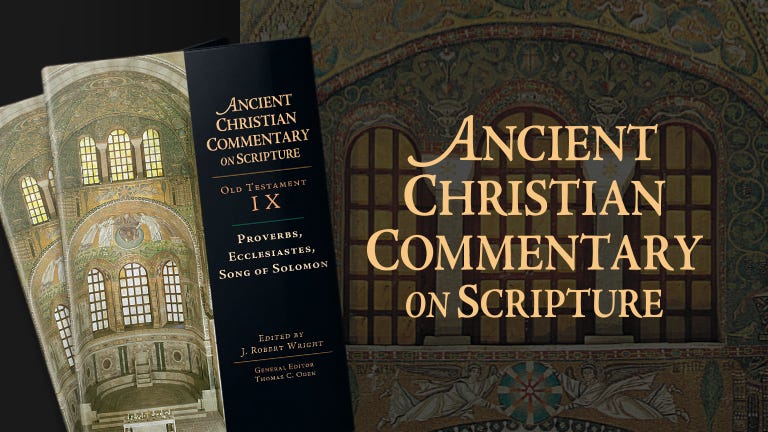
However, what I did do was look into a book I have, Ancient Christian Commentaries on Scripture, which features commentary on scripture from Ancient Christian voices such as Origen, Augustine, Chrysostom, and Cyril of Alexandria. In the edition for Matthew 14–28, the commentary provided from voices such as Origen, Chrysostom, and Cyril of Alexandria all suggest the same thing—the unfaithful servant is the third servant.
Now, again, obviously, the commentary I have hardly encapsulates all of historical Christian thought. Early Christian thinkers were especially prone to allegorize parts of Scripture. And there remains the possibility that divergent thinking on this story was written out of history by those in power and influence (much as a liberationist perspective might suggest).
But I also think the liberationist reading of this text highlights an increasing tendency I see within progressive Christianity—a move to sort of separate the pericope from its broader text. And this liberationist reading in particular often treats the parable as an isolated story rather than reading it within Matthew’s larger narrative.
Jesus tells this parable as part of an extended discourse about his return, judgment, and what faithfulness looks like in the meantime. In Matthew 25, the Parable of the Talents falls between the parable of the ten bridesmaids and the judgment of the nations. Both surrounding passages concern judgment, accountability, and readiness for Christ’s coming. Surely that larger context ought to inform how we interpret the story.
Luke also includes a similar parable, in which the master tells the servant, “I will judge you by your own words” (Luke 19:22). That raises the possibility that the third servant’s description of the master reflects his own mistaken understanding of the master’s character—an approach I explored in a recent sermon on this same passage.

A brief aside:
I don’t want to ignore the fact that many biblical scholars think this parable comes from an imagined “Q” source, a collection of sayings by Jesus which scholars have imagined that both Matthew and Luke would have drawn from to compile their gospel stories of Jesus. Of course stuff like that matters, and should inform our interpretation—but what I’m trying to get at in this essay is this increasingly accepted move within progressive Christian circles to assume that the Bible is essentially a human endeavor.
I find it interesting that so much of the past critique of conservative Christianity was that its interpretations of scripture did not examine the fuller context.
Instead, in some contemporary interpretations, the text undergoes a sort of desacralized reading, in which its supernatural claims and eschatological connections are seemingly set aside. The parable becomes primarily a critique of economic exploitation or an ethical directive—not wrong per se, but also not, in my opinion, most faithful to the text or the ethos of what Jesus was trying to say—be ready for my coming!
Certainly, liberationist and Marxist perspectives can raise worthwhile questions about wealth, power, and exploitation. But I wonder whether some of these interpretations allow those frameworks to override the literary and theological context of the passage.
I’ll share another especially egregious example of this in a forthcoming review on a book on Acts, but in the meantime, some questions I can’t help but asking:
At what point does reading a parable through a particular ideological lens become reading that ideology into the parable?
And perhaps more importantly, how do we interpret this story without losing sight of the larger Gospel narrative and the one telling it—Jesus?
P.S. Speaking of books:
If you haven’t already, please check out my book The Church as Community Hub, available wherever books are sold and available at a discount here through the publisher:

Oh, and if you’ve already read it, could you do me a big favor and leave a short review from wherever you bought it!
https://churchpublishing.org/products/9781640659988-the-church-as-community-hub
What? I am fascinated by this, ah, creative interpretation of the parable of the talents by American progressives.
Our* Catholic priest--who literally quotes Karl Marx as well as other socialist thinkers in the weekly bulletin on a regular basis--discussed this reading in this week's homily as follows:
1. Gifts are given "according to our ability," and we have an obligation to use them to the best of our ability to glorify God and *promote the common good.*
2. Even those with humble gifts can improve on them, turning them into something greater *to the common benefit.*
3. The third servant is thus an example of what not to do--to hide your gift out of fear that you can't do something good with it, or out of fear that that's all you'll get. You can do amazing things! This is what the first two servants understand but that the third servant does not believe.
4. So don't be afraid that you don't have skills or resources to help others. The Kingdom of God is all of us doing the best we can with what we have, be it little or big.
4a. Oh and btw this means that those who have been given a lot of gifts have even more of an absolute obligation; with great gifts comes great responsibility to help others.
See? You can still be really economically progressive and have an orthodox reading of this parable.
*I live on a small Caribbean island, not in the USA. Many Caribbean and Latin American Catholic priests are quite economically progressive.
Rip that parable out of context completely, tell me it's from Karl Marx himself, and I still can't see the pro-third-servant interpretation.