


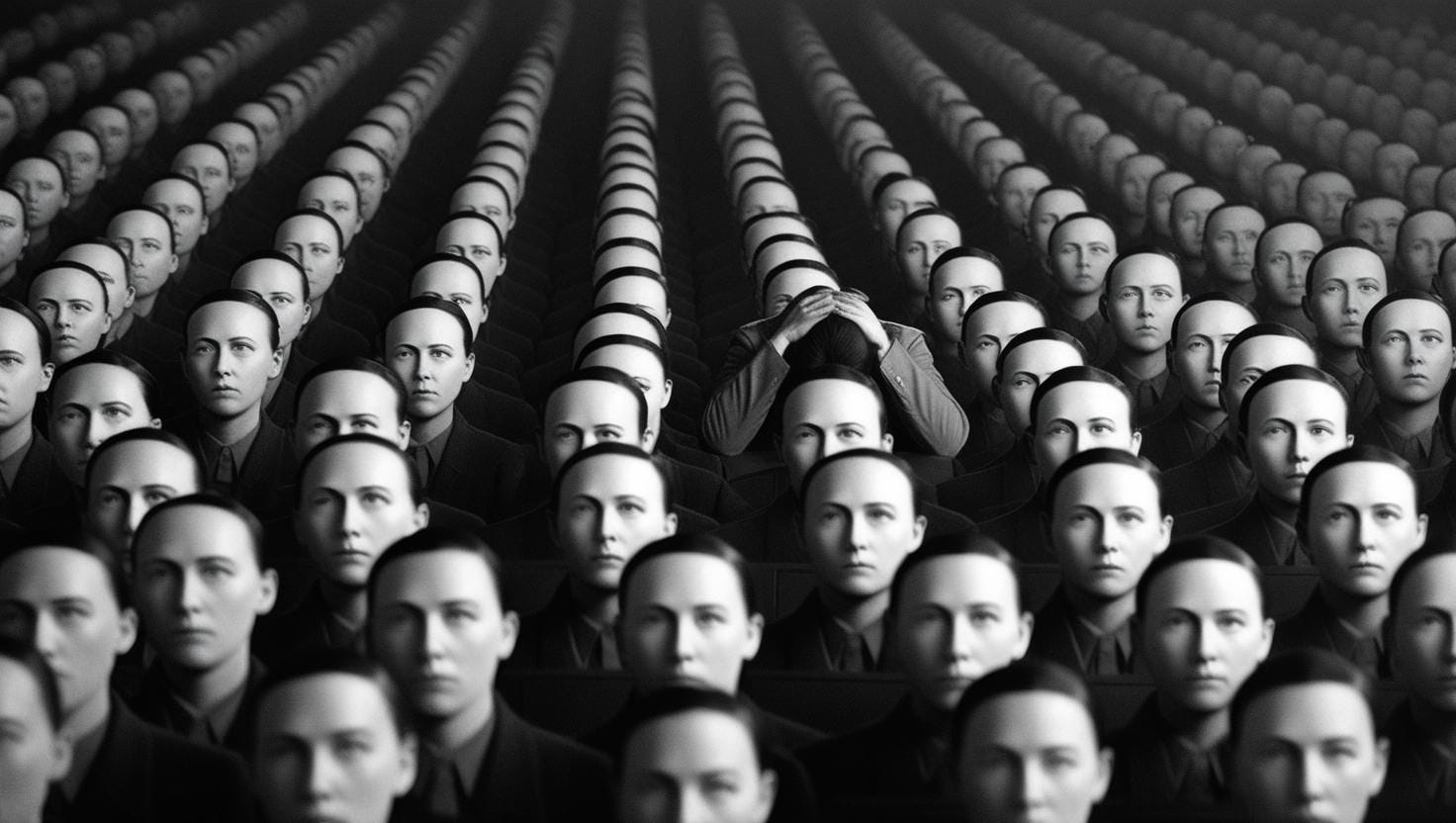
“The party told you to reject the evidence of your eyes and ears. It was their final, most essential command.”
– George Orwell, 1984
Huxley, Orwell, and the War on Reality
I’ve never read 1984. Honestly, it always seemed overbearing and alarmist. I preferred Aldous Huxley’s Brave New World—a dystopia dulled by pleasure, consumerism, and soma, a drug that keeps everyone happily numb. It felt far more relevant to our times. Orwell’s warning—that people would be forced to deny reality—seemed exaggerated. Who, really, is telling you to reject your own eyes and ears?
As it turns out—everyone.
The Trump Era and the Manipulation of Facts
As I was working on this Substack, reporting came out from the New York Times that a top aide to DNI head Tulsi Gabbard ordered changes to an intelligence analysis regarding Venezuela and the “TDA” group, specifically to ensure the report couldn’t be “used against” Trump. Think about that for a moment: a national intelligence agency rewriting its assessments to avoid contradicting the false assertions of a sitting U.S. president.
I don’t know why I’m surprised.
Donald Trump’s entire political playbook—from “alternative facts,” to the sharpie hurricane map, to the doctored Abrego Garcia photo, to calling economically reckless tariffs “Liberation Day”—depends on muddying the waters of reality. Even amid low approval ratings, he continues to poll ahead of Democrats. Many progressives can’t fathom why. Until recently, neither could I.
The Rise of Compelled Orthodoxy
That changed after reading a recent Substack by British journalist Louise Perry, responding to a UK Supreme Court case. Perry argues that a particular ideology—not any one group of people, but the ideology itself—demanded the impossible: for society to reject biological reality and accept self-declared identity as absolute truth. This wasn’t just a cultural shift; it was, in her words, a “state-sanctioned assault on reality itself.”
She ends with this Orwellian echo:
“The …movement told you to reject the evidence of your eyes and ears. Some very brave people refused to do so.”
To be specific, I’m referring here to some of the cultural pressures around gender identity—especially the expectation that all people, including institutions and faith communities, affirm the idea that gender is entirely self-defined and fluid. This isn’t a judgment on any person’s worth or lived experience. I’m simply observing how quickly this expectation has hardened into a kind of social mandate, with consequences for those who don’t conform.
Let me be clear: I’m not opposed to people living beyond rigid or outdated cultural scripts. I don’t have a problem with pronouns or public accommodations. But I’ve never fully understood the vitriol against figures like J.K. Rowling, or the “TERF” label thrown at women who argue that certain boundaries are important to their advocacy.
I may be wrong on this, but I don’t think the public shift happened because people were bigoted. I think it happened when tolerance became coercion—when certain statements became required affirmations, rather than personal convictions. The mockumentary What Is a Woman was intentionally inflammatory, but it resonated with many not solely because of its cruelty, but because it asked a basic question that few seemed willing or able to answer.
For most Americans—outside certain fringes of the right—this wasn’t about hate. It was about being asked to say things they didn’t believe, and being punished if they didn’t comply.
A Cultural Flashpoint
Case in point: the U.S. Supreme Court recently ruled in favor of restoring the voting privileges of Maine lawmaker Laurel Libby after she had been censured. Libby had posted side-by-side photos of a high school athlete competing in different sports categories over two years as part of her critique of state policy.
Now, to be clear: I have serious reservations when politicians—or anyone online—use minors to make a political point. I recently called my GOP representative’s office to object after he shared a post publicly shaming a 15-year-old undocumented teen involved in a fatal accident. The incident was tragic, but the kid didn’t need to become political fodder.
Libby, to her credit, obscured the students' faces—but the move still struck me as opportunistic. She could have made her point in a less public and less performative way. But that’s the nature of virality, which in many ways is the real point of such posts.
Still, this illustrates Perry’s larger argument: the backlash wasn’t directed at individuals—it was aimed at a rigid ideology that demanded more than acceptance. It demanded obedience. And when dissent—especially among moderates—was treated as heresy, many “live and let live” Americans began to say, “enough.”
Image of God and Public Discourse
These ideological battles have real-world consequences. And in the midst of them, we must remember this: all people are created in the image of God, loved by God, and deserving of love, respect, and dignity. That truth must remain foundational, even as we wrestle with how to navigate cultural and political complexity. Whether or not we agree with someone’s conclusions, each person must be treated with grace and humanity.
I don’t ever want to see a person in a position of power mock, shame, or humiliate any person on social-media, especially a minor.
Two Forms of Authoritarianism
Trump’s rise isn’t just about embracing authoritarianism. It’s about choosing one version of control over another. Many Trump voters aren’t drawn to authoritarianism blindly—they’re reacting to what they perceive as a compelled orthodoxy on the cultural left: a system that demands ideological conformity, punishes dissent, and defines virtue in narrow terms. In a recent interview on The Ezra Klein Show, congresswoman Sarah McBride made the observation that “you can’t have absolutism without authoritarianism.”1
David Brooks put it succinctly in a New York Times column: “Cultural elitism is more oppressive than economic elitism.” For those of us embedded within the cultural institutions that shape media, education, and activism, that claim might feel baffling—even offensive. But, the point is this; what feels like inclusion and progress to some can feel like condescension and constraint to others—and our inability to recognize that tension only deepens the divide. Faced with the pressure to affirm beliefs they may not share—or risk professional, social, or relational consequences—they’ve chosen the form of control that aligns more closely with their values, even if it comes wrapped in its own authoritarian impulses.
Still, we should be clear-eyed about the differences. Trump’s version of authoritarianism is tied to state power—to threats against democratic institutions, the press, the justice system, and the peaceful transfer of power. That makes it, in my view, a more immediate and dangerous threat. But for many voters, these concerns feel distant or abstract compared to the very personal and immediate fear of saying the “wrong thing” and facing social or professional consequences. They fear cultural exclusion; others fear institutional collapse. Both fears are real, but they’re not equal in scale. We need to find a way to hold that complexity honestly.
Resisting Orthodoxy, Reclaiming Pluralism
The United States of America must find a way to affirm that all people are worthy of dignity and respect—while also honoring a diversity of thought, opinion, and belief. It’s not enough to include people based on identity or background; we must also make space for those who hold differing convictions, especially on complex cultural and moral issues.
Many Americans already feel this tension. They care deeply about justice and compassion but are uneasy with a public discourse where dissent—even thoughtful, good-faith disagreement—can carry social or professional risk. These concerns are often left unspoken, not because they aren’t real, but because dominant cultural voices have leaned into a compelled orthodoxy—a sense that only one set of beliefs is acceptable and that deviation signals moral failure. This approach is increasingly seen by moderates and independents as rigid, moralizing, and out of step with real life.
If we want to rebuild trust, we must learn to hold space for both conviction and conscience. Inclusion must not come at the expense of intellectual humility. A healthy democracy—and a healthy society—depends on the freedom to speak, to question, and to disagree with dignity.
A Path Forward
I don’t pretend to have all the answers. I may be wrong in my framing, my conclusions, or even in the weight I give to certain cultural shifts. But I write this not to provoke outrage, but to make sense of the tensions I see around me—tensions that are deeply affecting our public life, our churches, and our relationships. My hope is not to choose a side in a culture war, but to advocate for honesty, humility, and compassion in how we live with difference. If we want to move forward as a society, we’ll need to recover the courage to speak truthfully, the grace to listen generously, and the humility to admit when we’ve gotten it wrong.
I’d recommend listening to the whole episode. As I heard it, McBride says what I’m trying to say here, likely even better.