


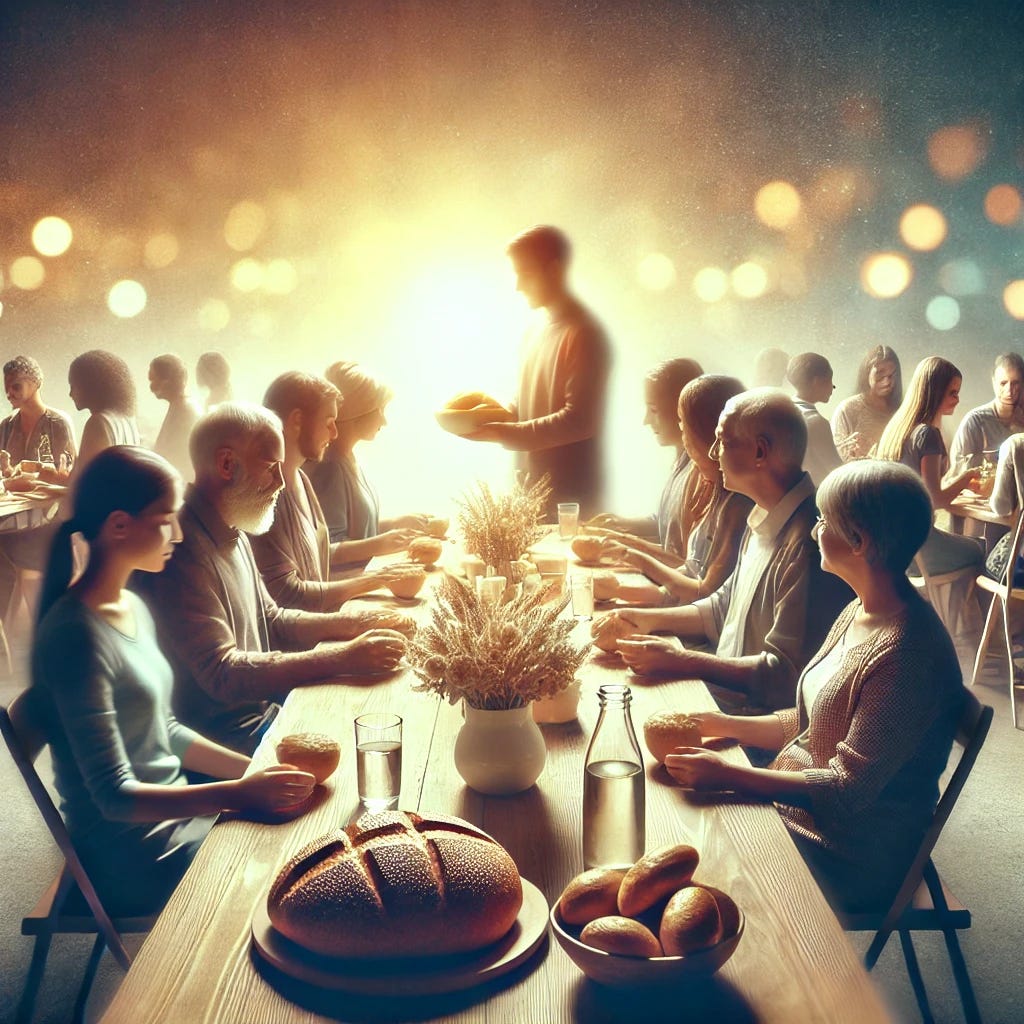
I want to talk to you all today about bread and give you an opportunity to talk to me about your favorite memories of, uh, bread. So I'm going to move around here. So I don't know how. Well, we'll record this, but let me do this. Let me do this.
So who doesn't love bread, right? Do you remember that quote from, oop, that's awkward. Do you remember that quote from Oprah? Right? “I love bread.” So I want to hear some of your favorite memories around bread. So I'll start.
And this is not a favorite, I suppose, but something that comes to mind for bread. Uh, who goes to Texas Roadhouse here? Any of you Texas Roadhouse fans? Okay, we got some. My parents, especially my dad.
My parents, especially my dad, loves Texas Roadhouse. And what's the best thing about Texas Roadhouse, right? The rolls. The rolls, yeah. I love a good Texas Roadhouse roll. Can eat way too many of them. I'm also thinking about, I don't know if anybody's been to southwest Missouri. There's a restaurant called Lambert's. Okay, we got some people here. What's famous about lamb? Lebrija. I couldn't even remember the name. Lambert's, right. Lambert's throw and roll. So literally, if you've never been there, they kind of bake them like, uh, muffins or, um, am I right? Muffins, yeah. But they'll walk around and come out with a fresh batch and literally throw it to you across the dining room. I haven't been there in a number of years, uh, so I imagine they're still doing it. Cause it was so popular when I was in that neck of the woods. Uh, but throwed rolls were a lot of fun. And man, good bread. So I wanna hear, what kind of bread stories did we have this morning? Okay, we got one back here.
Speaker B: My mom, uh, when I was growing up, made apple made biscuits from scratch, and she was using a comping coat to cut them out and make the nut. She was nice, like a weird shave and vein.
Loren: Yeah, yeah. Good. Who else? Breadstory.
Speaker C: My mother always baked her own bread. And about three days before thanksgiving, she would bake bread and let it set out to be stale to make her stuffing with.
Loren: Okay.
Speaker C: And when I was a kid, if for some reason I got a slice of wonder bread, I thought it was great because I always just had to eat my mom's homemade bread.
Loren: Bread story. Yeah, homemade.
Speaker D: Girlfriend's mother always made bread on these days. Okay, I love to go to her house and have homemade bread. My girlfriend was like her. She wanted the store bought bread because she always had the homemade bread.
Loren: And.
Speaker D: But I love going over there for homemade bread. Everyone's name brand new, out of the.
Loren: Oven, melting on kids we don't know better. Right? So thank you. Other bread stories. Uh, other bread stories. Okay.
Speaker C: My grandma made home.
Loren: Yeah.
Speaker C: And they lived in Kansas. So every time we went back, we looked so forward to going back and having grandma's homie.
Loren: Yeah. Good. Anyone else? Okay. In the back?
Speaker C: Uh, my mom, like, really was the roles which exist.
Loren: Yeah. I mean, how can you not. How can you not talk about those rolls? Texas Roadhouse. Yeah. Yeah. So I, uh. The problem with Texas roadhouse, you always go there, they're so busy. I mean, that's the problem. But you gotta find a time where they're not busy, which is never. So thinking about bread, thinking about rolls, thinking about enjoying the bread. Let's talk about now some of the feelings. Some of the feelings you get. What is, like, because, sure, bread is good to eat, but, like, it has a way of satisfying you. So how do you feel when you eat bread? Like, when you. What memories come back for you when you're eating that bread? Maybe you're thinking back of your. Your grandmother's bread or your mom's bread. I don't know if you want to share. Or else just think about those feelings that come to mind with good bread. Mmm. Making me hungry right now. Thinking about it. Thinking about some good bread, some Texas roadhouse bread. Because, you know, we feel. We feel full, right? We feel satisfied. We feel if we eat too much bread a little bit in the tummy, right? We feel full and satisfied.
And the thing is, though, this is what Oprah, right, was playing on to when her whole, like, I love bread thing is that bread satisfies us. But because it's carbs, right? To get real specific, because it's carbs, it only lasts so long. So we get full and full belly and feeling all satisfied and perhaps even bloated. But, like, after an hour or 2 hours or 3 hours, we're hungry. Cause we need some protein. We need something that will really satisfy us, that'll really stick with us for a long time. So that's. That's the trick about bread. Like, it stays with us for a time, gives us a short, meaningful satisfaction, but not really a long lasting satisfaction. Bread does.
You know, I was thinking about bread because obviously, Jesus talks about himself as bread, the bread of life in our gospel reading today, but also thinking about how we live in a culture. We live in a time and place where people are increasingly dissatisfied. Stephanie and I were talking a little bit about this before service, and it's. It's, uh, frankly terrifying when we think about young people especially, and the amount of dissatisfaction, the amount of hunger or in young people's lives today. I'm not sure if you've heard the term dopamine addiction. Anyone heard that term? We know what dopamine is, right? It's like the positive vibes in our brain. I mean, someone who's smarter than me could say more about that. But basically, whenever we feel good, it's because we're getting, like, a hit or a rush of dopamine.
So some people, they talk about what's called a dopamine addiction, where it's like you're essentially chasing after those good feelings of dopamine. And often, I left mine, I'm trying to get off my dopamine addiction. Right. Often people see that. You see that with people on this phone scrolling on the phone, because scrolling can't say it. Phone scrolling is like an element of dopamine addiction. So, basically, uh, the creators of social media have created and such where when you get a notification, it's like your brain gets, like a dopamine hit. Like it's a positive feeling. It's a positive vibe. So the more you scroll, then the more your brain gets these positive feelings of dopamine. Now, obviously, the downside is that our brain is wired as such. At least this is what I understand. The experts say that our brain is wired as such, that the more we chase after those dopamine highs, those addictions, they become lessened in their impact, and the impact lasts shorter, doesn't last as long.
So, essentially, when we're scrolling on social media, I know probably my demographic here. We're here, probably not huge social media addicts, right? But you probably have kids, you have grandkids, you have maybe great grandkids, you know, cousins or nephews and nieces, whatever, who you see on their phones constantly because they're chasing after that dopamine addiction. And again, the challenges with a dopamine addiction, whether it's officially called that or not, when people are scrolling their phones constantly, they're chasing after that high. They want to have that click. But again, when that hit of positivity comes from a post or a picture or an image or a phrase that they like, it clicks a high, but then it goes away. So we got to keep scrolling to find that next high. And that's how people, kids can end up scrolling for hours at a time, because they're chasing that dopamine addiction, that dopamine high. But again, like, the problem is, the longer one chases that dopamine, the high becomes lessened, the thrill, the excitement becomes shorter. So it's just an endless cycle of chasing after positivity.
Related to this challenge of dopamine addiction. I'm not sure if you've seen news reporting on this, is that many experts think that social media, which is very much related to this dopamine addiction, has been a serious catalyst of poor mental health for young women and young girls. I mean, since 2012. I think that's the number since 2012. If you imagine, like, a chart, it's kind of, like, done a hockey stick. For young women and their mental health challenges, it's like everything's going okay, and then also in 2012 hits, and then, just like, mental health challenges skyrocket from 2012 onward for young women. And experts obviously can't put a certain exact guesstimate on what is causing all the challenges. But many experts do think that social media is one of these big challenges that's affecting, uh, young girls and young women's mental health. I mean, it's quite scary to see just the vast challenges that so many young girls and so many young women are facing in mental health. Whether it's depression, whether it's anxiety, I mean, you name it, across the board, young women and young girls are facing all sorts of challenges with mental health, unless we think it's related only to young women.
I don't know if you've seen this, but young men are facing a, uh, similar, yet perhaps different and sometimes equally devastating challenge. And for me, at least, as someone who's a man who was a young man and teenager, uh, at one point in my life, I find this equally troubling, if not more so, because what we're seeing a lot today is young boys and young men being pulled and attracted into far right, alt right spaces where they're chasing after very strong, like, patriarchy and misogyny. And I'm the man, and I run the show. And, you know, this toxic masculinity, this really dangerous, uh, far right, alt right spaces that want to be tough and masculine. And again, I'm someone who's a man, who's formed masculinity and being a man, but some of these spaces are just. They're just dangerous and they're toxic. But because young men on their own right are facing this disconnectedness, this dissatisfaction, this hunger for something. They're finding it in these alt right, far right spaces that are not good, frankly, for anybody, in my opinion, especially these young men.
And it seems like we're in a time where people are facing increasing levels of dissatisfaction, disconnectedness and hunger. There's a therapist and author professor that I like to follow, and he writes something to the effect that addiction really comes down to disconnectedness. The person who's addicted is disconnected from something and that disconnectedness. They try to fill that disconnectedness with the addiction. Whether it be social media addiction, whether it be alcohol, whether it be pornography, whatever you name, whether it be these far right, alt right toxic male groups. Young men in this instance are feeling so disconnected from themselves, from society, from their families, whatever, that they fill this space with these toxic spaces.
It's about disconnectedness, it seems, whether it's physical, emotional or spiritual. Hunger is a very real predicament of the human experience. Interestingly enough, in our gospel reading for today, we find hunger again, even as I said, still a very real element of the human condition.
What's interesting in John chapter six is perhaps you remember from a couple weeks ago, I'm not sure if this, who spoke and gave the, if they gave the sermon on John six a couple weeks ago. But what, what's John Six? Does anyone remember John Six? What's the big theme of John Six? Feeding of the, yeah, feeding of the masses. Feeding the 5000. So the beginning of John chapter six, if we remember the story, Jesus is out teaching to the masses. And it gets to that time of day when folks start getting hungry. And the disciples were like, hey, Jesus, the folks are getting hungry. Like, we can't feed them. Let's go send them away. And Jesus is like, no, we, uh, got to feed them. So what happens? Right? Five loaves. The boy has five loaves, two fishes. All of a sudden, like, people are eating and they're full and they're satisfied. And then like, not only are they full and they're satisfied, but there are twelve remaining baskets full. So 5,000 people plus women and children all fed, all full, all satisfied. And there's leftovers.
So, it's the same group of people that Jesus is talking to here in John six two. So it's interestingly enough, they have followed him. They have kept following him here. And he says to them, John 6:35, he says, I am the bread of life. Whoever comes to me will never be hungry, and whoever believes in me will never be thirsty. But again, as you read the Jews and folks think this is the jewish leaders, some of the religious leaders. They get mad at him because they say, oh, who is this guy? Jesus? Verse 41, saying, he's the bread come down from heaven. Verse 47. Jesus says to them, very truly, I tell you, whoever believes has eternal life. I am the bread of life. Your ancestors ate this manna in the wilderness and they died. This is the bread that came down from heaven so that 1 may eat of it and not die. I am the living bread that came down from heaven. Whoever eats of this bread will live forever. And the bread that I will give for the life of the world is my flesh.
So, a couple things I want to point out here that I think is really interesting from this passage. Like I said, these are, uh, the same group of people that were fed from that 5,000 from that mass of people. They were following him. And I think at first glance we might think, oh, man, these are people who just want a free meal, right? Who doesn't love a good free meal? Uh, have you ever turned down a free meal? I have, actually. You know why? Because I do intermittent fasting. So if nothing I say today makes sense, that's why. Because I haven’t eaten since 6:30 last night. So if you're like, Loren, you make zero sense. Just blame it on that. That's fine. Now, I have a rule about it. So I basically try to eat within the window of twelve noon to 06:00 p.m. so I have a rule, though, that I'll pass up free meal for breakfast unless it's bacon. Like, if it's bacon available, forget it. I'm eating the free meal, right? Bacon is my rule breaker. Bacon. I go for bacon.
But broadly speaking, like, I have passed up a free meal. And I think when we're looking at this passage, these aren't folks who I think were just looking for another free meal. I think they recognized something that they had felt a feeling, a satisfaction, a fulfillment, a connectedness that they had never felt before in their lives. And they followed him and say, I don't want just another free meal. I don't want just more bread. I don't want more fish. I want to be filled. I want to be satisfied. I want to be connected.
You know, it's also interesting that Jesus says that your ancestors ate manna in the wilderness and they died. Do folks remember way back from Sunday school the story of Moses leading the, the Israelites in the desert? And every day God would send manna to fulfill the hunger of the people. It's interesting. They ate that manna every day. It satisfied them for that day. It fed their needs, but it didn't fulfill them. It didn't give them the kind of long term satisfaction that we would all like. Right? They had to eat every day, again and again and again. And then we remember right on the sabbath, they'd save it from yesterday, and that was the only day that it would save. Otherwise would rot. Had to do the same thing. Jesus says, I'm not that manna from heaven. I'm what can satisfy you.
I mean, it's pretty gutsy, right? You can understand why Jesus would have ruffled some feathers of the ancient religious leaders. He's saying, hey, I am the bread of life. That can satisfy you. I can fulfill you. Yeah, it's interesting. Hunger, satisfaction, disconnectedness, need.
You know, I was here a few. I can't remember. When was that? July, I think it was. I was on family vacation a couple weeks ago. So, like, my brain doesn't work for whatever happened before that. Right? I if some of you remember, I was here in July, and I want to speak openly and frankly for a moment. I was here in July, and an announcement was given about having, uh, a discussion about the future of this church. And I don't know what came of the discussion, if there has been a discussion, whether it's been good or bad, from that discussion, and you may say, Loren, I don't really care what you have to say about that, and that's fine, but I want to offer you some words of encouragement this morning, if I may.
So, like I shared, people are hungry. People are hungry. And I can imagine perhaps if I was having such a discussion about my church, thinking about what the future of my church would be. I can imagine thinking, boy, we don't have much to offer. We don't have a plan. We don't have resources. We don't have money. We don't have a lot going on. I was listening to a podcast interview with a Canadian pastor named Jason Byassee, and he spoke about this very thing, actually. He said that in his mind, the churches that he worries about aren't the churches that have no money, no people, no resources. He says the churches that he worries about are the churches that have a, uh, three to five year vision, that have money in the bank, that have a big, bold vision. He says those are the churches that he worries about.
Can you believe that? This is not just some fly by night guy. This is a guy with. Been a professor in a seminary, leads a big church. And he says the churches that he worries about are the churches that have money in the bank, uh, resources coming out of their ears, people coming out of their ears, a, uh, big, grand strategic vision. And he says the churches like that, why he thinks they could be in danger is because they can live, they can act in such a way as if they don't need God, they can just keep going based on their big strategic plan, based on their money, based on their people, and they can keep going forward. He says the churches with no money and no resources and no vision, they only have one option, to rely on God and to trust God to do something, to show up and bring a miracle.
I've spoken about this author before. My favorite author, Andrew Root, who's a seminary professor and author, and he writes in his book, Churches and the Crisis of Decline that the biggest crisis facing churches today is not a lack of resources and not a lack of people. It's not a lack of money. He believes that the biggest crisis facing churches today is a lack of God, a lack of ability to recognize and need and rely on God's presence and God's action in our world today. We can get so caught up on managing the budget and trying to gain people and trying to make things as fantastic and special and amazing as possible. When, I mean, we see it today, right? We see the churches with the amazing musical activities. We see the cool pastors. I mean, I am not a cool pastor. It's okay. Like, uh, when I joke about myself, it's okay. You can laugh. I don't have the hair to be a cool pastor, for one. You see it with the churches who are chasing coolness and relevance and hipness, knowing that these things can attract people. But again, Andrew Root thinks that what really the real crisis in american Christianity and american churches today is that we can so easily depend on ourselves, depend on our resources, depend on our money, depend on our buildings, depending on our stage effects, that we don't have to depend on God and rely on God to show up and do something in our midst, and us trust that God has a plan for purpose, for ourselves and our church.
In his book, Churches and the Crisis of Decline, Andrew Root, he tells the story of visiting an old church that had since closed. So imagine as perhaps you can, like me, a grand old church, uh, building one that's been around 50, 60, 70 years, and he walks into it. And what it is now, can you guess? It's a cool restaurant, right? It's either. It's either. A church is always either a restaurant or condos. Well, a bar, restaurant, or condos. Right. Dance club. But, you know, it's either condos or, like, some kind of food, people gathering. So Andrew walks into this old church that's now a restaurant, and he imagines I what would have had to gone differently for this church to still exist, still be worshipping. And so in his book, he kind of formulates this imagined story that I don't think is too far off from what reality could be. So in a story, in a situation probably not too unlike, um, your own, he imagines this church with an old, aging demographic. Not a lot of young people, not a lot of relevance, not a lot of cool hit music. And Root imagines that, uh, upon the passing of one influential matriarch of the church, the woman's grandson comes into church again. Think of a, uh, 20 something young man trying to figure out his way in life. Like, we see that all the time, don't we? So this 20 something young man, he comes into the church one evening for the Bible store, bible study, and he says to this group of people, can you help me? I want to find God. And the people themselves are kind of flummoxed because they wonder, do we even know how to find God? Do we even know how to find and connect with this very being that we believe? And we say we believe in worship every Sunday morning. Do we know how to find God?
So through this kind of impetus, the people begin a, uh, very earnest and sincere search for God that's focused around three things. They worship, they pray, and they wait. And the waiting is the hardest part. Right? Isn't there a song? What's that? The song, waiting is the hardest part. Tom Petty? Yes. The waiting is the hardest part. They worship and they pray, and they wait for God to show up and do something. You know, I want to be clear that this threefold path is nothing, easy. It's not full of solutions. Nothing is going to dramatically change. But through this threefold path, God can show up and bring miracles. That's what I believe.
I remember what Jesus said in John six, because Jesus essentially gives this path to those people who had been fed. He says, hey, look, the way ahead is not going to be easy. It's going to be challenging. And many of those initial followers walked away. And Jesus, perhaps, I don't know, maybe in his humanity, a little discouraged or disgruntled. He says to the twelve disciples, he says to Peter, hey, everybody else is leaving. Do you want to leave, too? Do you want to leave, too? And what does Peter say? Verse 67. Verse 68. Excuse me. Simon Peter answered him, Lord, to whom can we go? To whom can we go? You have the words of eternal life.
Friends, here in this place we hear and share the words of life. Here in this place we give and receive the bread of life. Where else can we go? Where else can we go? The world is hungry. The world is hungry for what we have here to share. Let us remember that.
Let us pray. God, thank you for the gift of your son Jesus, the bread of life. We thank you that he satisfies us like nothing else can. God, we know there is so much hunger and disconnectedness in our world. Help us to remember that what we have here. We have the words of life. We have your words of life. We have your bread of life. Help us to remember and to share those words of life and that bread of life with others. I ask this in Jesus name. Amen.