


The last few years, I’ve noticed a trend in which there’s been essentially a societal role-reversal when it comes to “censuring” or “policing” offensive or inflammatory speech.
During my formative years in the 90’s, I remember conservative Christians being alarmed by offensive and inflammatory speech exemplified by so-called “shock jocks” like Howard Stern and Opie & Anthony. It was conservative Christians (aka, those on the social “right”) who would decry such conversations and call for a more respectful tone.
In recent years however, the dynamic has completely flipped, as now it is often those on the “left” who are often “censuring” or “policing” offensive or inflammatory speech. Similarly, those on the “right,” even conservative Christians, lament the lack of “freedom of speech” or “academic freedom” often exemplified in which college campuses restrict or refuse controversial speakers or enact strict language guidelines.
While I’ve noticed this trend for some time, I hadn’t been able to find any real evidence to support my theory, until now. Just the other day, I came across a 2003 study from UCLA on Spirituality in Higher Education. While the study is post-90’s, it’s timing matches my own academic career, meaning students polled would have grown up in a very similar time-frame as myself. In polling data regarding the “Social/Political Views of Students with High and Low Levels of Religious Engagement,” a few responses really stood out to me.
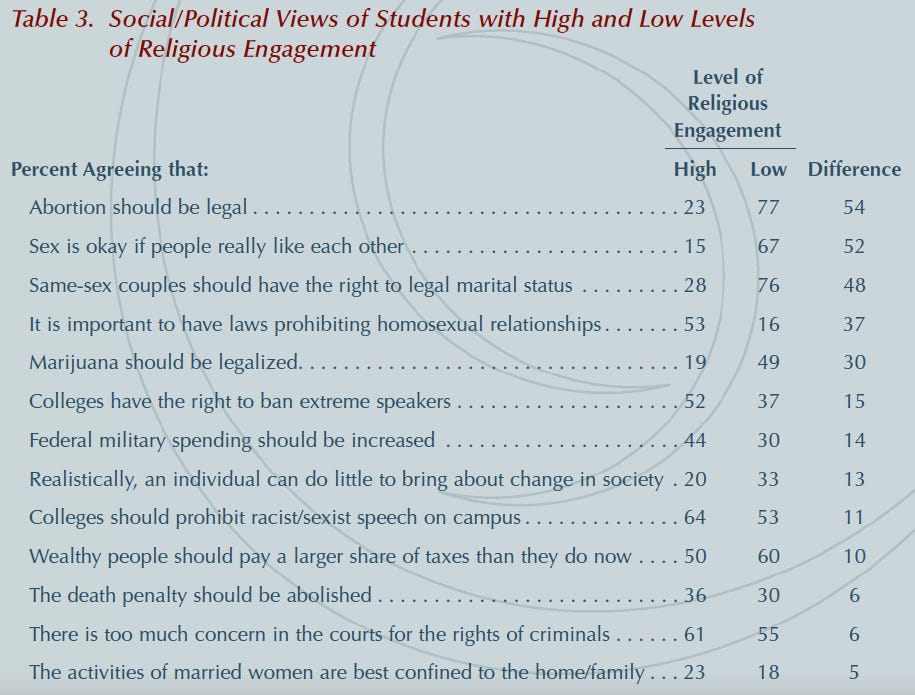
Among respondents with high levels of religious engagement, defined by the study as praying, believing in God, and going to church (among other factors), these students were more likely to think that “colleges have the right to ban extreme speakers” and that “colleges should prohibit racist/sexist speech on campus” than those with low religious engagement. Also, high levels of religious engagement also led to a higher belief that the death penalty should be abolished.
And, lest there be any doubt regarding my interpretation of the data, notice also that among those with high levels of religious engagement, such persons did not favor legalized abortion, homosexual relationships, or legal marital status for same-sex couples—markers which certainly speak to a more conservative religious worldview. In fact, in nearly every other metric, military spending, taxes, and gender roles, respondents aligned with a more traditional/conservative religious worldview.
One can perhaps see my amazement in that it is those with a lower religious engagement (those most often associated on the “left”) who have less problems with extreme speakers or racist/sexist speech. Fast forward twenty years later, and the dynamic has completely flipped. From a 2021 study, highlighted in the Daily Caller;
When the survey categorized respondents by political ideology, it showed that 85% of liberal students believe a professor should be reported for saying something other students found offensive, compared to 41% of conservative students. Fifty-nine percent of conservative students said the professor should not be reported for offending students, versus 15% of liberal students.
Conservative students who responded to the survey were even less supportive of students being reported to the university for saying something other students found offensive, as were liberal students: 76% of liberal students responded that a student should be reported to the university for saying something other students found offensive, while 31% of conservative students responded that students should be reported in this scenario.
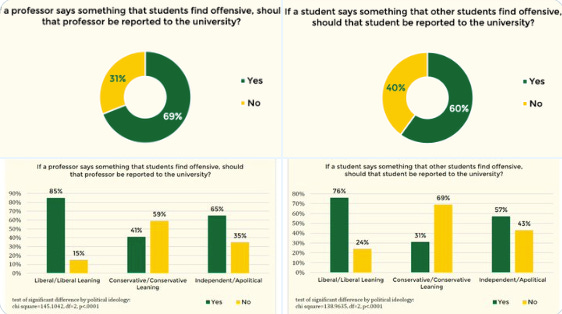
Yes, the Daily Caller is a right-wing news org, but this speaks to my point. Whereas 20 years ago, it was those on the right calling for language moderation, now the dynamic has flipped. Back then, it was often those on the left being bombastic and inflammatory, now it is those on the right, such as Matt Walsh, Ben Shapiro, and of course Tucker Carlson, who also bemoan the “limits” on “free speech.”
At this point, I really don’t have any conclusions or implications at this point, other than a general observation that society (at least in the US) tends to move in big pendulum swings, from one side to the other. Therefore, I wonder if rather than immediately jumping on board with whatever the latest cultural trend, we should instead respond with patience, wisdom, and perhaps a bit of moderation.