


Introduction
The recent Paris opening ceremony scandal offers offers valuable opportunity, through the investigation of the differences and similarities between the Dionysus and Eucharistic meal, to explore how Christianity has historically adapted and utilized prevailing cultural norms for corporate worship gatherings and shed light on current and future trends in Christian gathering practices. This article explores how early Christian practices, particularly the Eucharist, were influenced by ancient cultural institutions, examines the implications of these historical adaptations and suggests values for navigating the current transition from institutional to individualistic models in contemporary religious and social organizations.
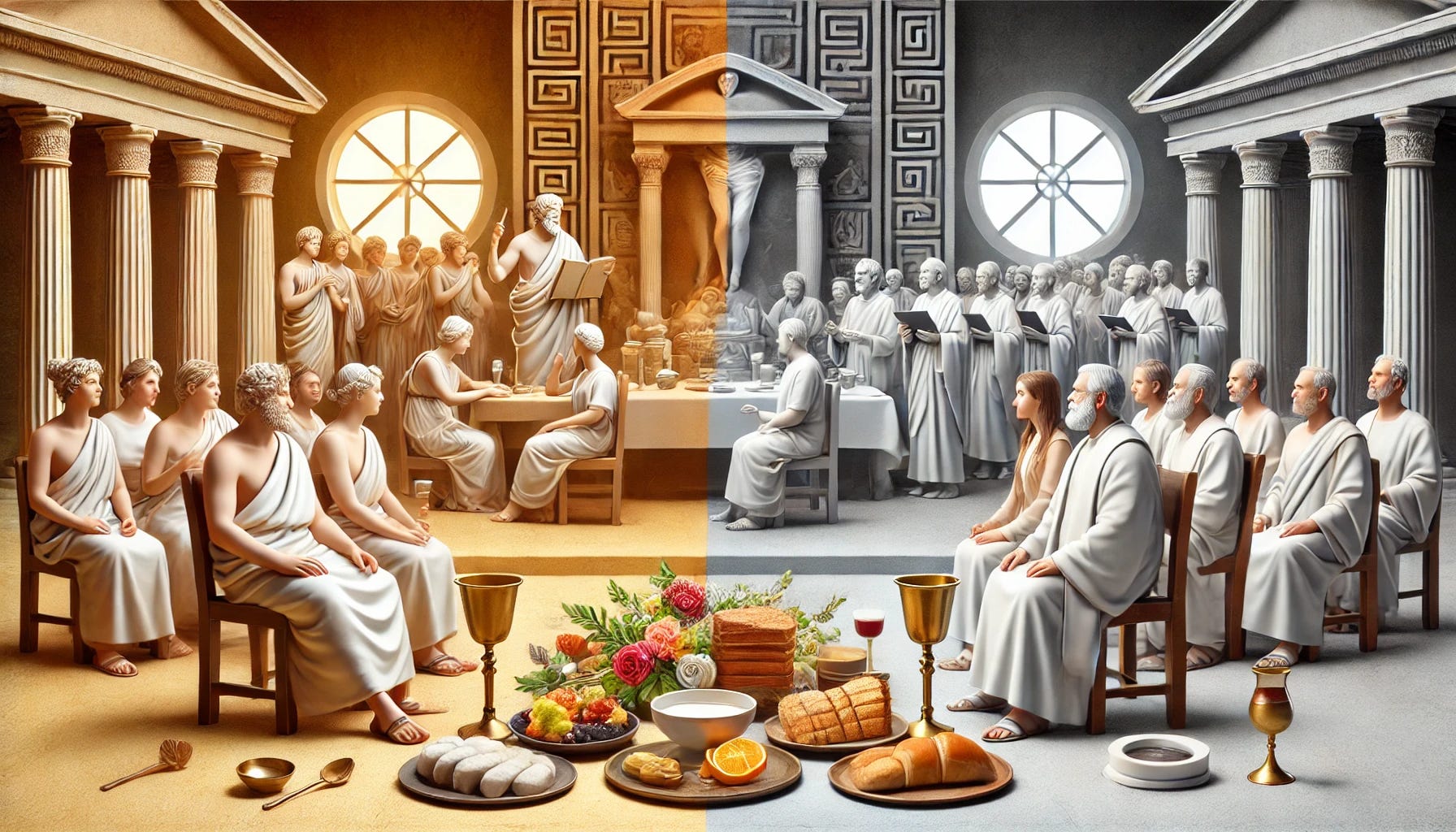
As I’m writing this, the opening ceremonies of the 2024 Paris Olympics just took place last week, complete with the controversial scene that some Christians have blasted as being offensive and disrespectful. As initial reporting suggested that the scene was instead inspired by an ancient greek celebration of Dionysus, the god of wine and pleasure, I was thinking about writing a post based on how meals in the ancient world inspired/influenced the Christian Eucharist practice, citing the book From Symposium to Eucharist: The Banquet in the Early Christian World. My thought was that in many ways, the Lord’s Supper is sort of itself a parody of the Dionysus meal.1
New reporting is detailing that the creators of the scene were in fact inspired by Leonardo Da Vinci's famous rendition of the Lord’s Supper, but didn’t mean it to “show disrespect towards any religious group or belief.”2 Rather than weighing in on this latest controversy that has become the most recent sticking point in our broader cultural wars, flipping through Smith’s book From Symposium to Eucharist got me thinking about the ways in which Christianity has utilized cultural institutions and norms to advance its own purposes.
Meals and Social Institutions in the Ancient World
In the book, the late Dennis Smith goes into great detail on the ways meals functioned within various cultures in the time Christianity began to form. The banquet, according to Smith, was a “social institution”3 that encapsulated many elements of society, including clubs, symposiums, and even religious rituals, such as worship of Dionysus.4 Smith declares “the banquet was a single social institution that pervaded the culture as a whole.”5
Which brings us to the practice in the early Christian context. Here Smith notes, “When early Christians gathered for meals, they were engaging in a practice common to all religious people and sectarian groups in the ancient world…the origin of the early Christian meals is not to be found in any one type or originating event but rather in the prevailing custom in the ancient world for groups to gather at table (my emphasis).”6 Smith goes further to say that “meals were so common for all groups in the ancient world that one can virtually assume that the Christian groups would have met for meals unless there is evidence to the contrary.”7 In short, gathering for a meal was the sociological structure provided by the culture at large.
Smith does note that when it comes to controversies around inclusion (as seen in Corinth for example) were for Paul important as they contradicted the truth of the Gospel (Gal. 2:14). Meaning, while early Christians utilized these broadly understood cultural forms of gathering, they were not automatically rubber-stamped nor aspects left uncritiqued along the way—which I want to highlight as for coming discussion.8
The Decline of Institutions and Sociological Models
There has been much conversation of late about the decline of institutions in America—especially religious (think Church). Author and professor Ted Smith’s important work The End of Theological Education details the way Christianity in America adapted to changing cultural institutional norms. Specifically, Smith notes the switch from what he refers to as the “standing order” (think state-sponsored churches) to the voluntary association after the Revolution.9
In my interview with Dr. Scott Thumma on my Future Christian Podcast, when I asked him about sociological models that would guide future gathering, Thumma surmised that such would be individually centered, meaning, at least as I understand it, people would gather around an individual and focus on meeting their own individual needs.10 If I remember correctly, Ted Smith also gave a similar response when I asked him the same question.11
Historical Evolution of Church Models
I’m not a professional church historian, but if I had to make an educated guess, the sociological model or cultural institution around which church has functioned over the course of the last 2,000 years has looked something like this:
The Meal/Banquet Gathering (early Christianity)
Something here (I think I’m missing something here…)
The Constantinian Church (from Constantine to the Protestant Reformation)
The Standing Order (Reformation to the Revolution)
The Voluntary Association (American Revolution to the present and declining)
The Individual (present and future)
When we think about Christianity utilizing these different cultural/institutional models over the centuries, a few observations come to mind for me, at least in terms of the present and declining model—the voluntary association. Despite many, many attempts over recent years such as the Emergent church model, the dinner church model, outdoor/adventure church model, and so on and so forth, except for a few exceptions, the voluntary association model—or more specifically—gathering together on a Sunday morning for corporate worship in a similarly-structured event is by far the most common and most replicable form of corporate worship that exists in America. And it makes great sense why—this is the cultural model most people in America understand!
Regular or scheduled communal gatherings for concerts, political rallies, even TED talks all build off this culturally understood format. There’s a reason why basically every new church start looks and acts the same! And, there’s a reason why any new church start that tries another way struggles to gain traction! In the Denver area, I’ve seen a few “outdoor” type churches launch and fail, for instance, but I knew of several church starts that began with a Sunday evening gathering, only to shift to a Sunday morning experience, because such was more culturally normative.

Transition and Future Models
Yet, as we are culturally in a time of transition, as institutional trust continues to decline and crater since the 1960’s, it makes sense that people would be seeking new models outside the voluntary association while also critiquing the current model. And, while plenty has been written about the limitations of the current model, I do wonder how much thought has been given towards future models.
Both Thumma and (Ted) Smith have suggested that future models will center the individual—people will gather around an individual (not an institution) and come and go as this individual meets (or no longer meets) their needs. We’re seeing this in many forms already, such as the power grip Trump holds on the Republican Party in America, but even more broadly when we think about the power of social media influencers. As I think to the future, churches will rise and fall on the power/ability/persuasiveness of an individual to lead/shape/influence a group of people. While Trump and many influencers are certainly negative examples, I don’t discount that there are positive examples of these types of leaders.
The real challenge I think will be that greater fame/reach/appeal will be easier gained through unethical/immoral actions rather than moral. Social media algorithms seem to reward bad behavior not good (outrage goes viral very quickly—this Olympics opening ceremony controversy is a great example). What will be essential moving forward will be to prioritize character—not charisma—in leaders as Jason Byassee noted in his conversation with Martha Tatarnic on a recent episode of Future Christian.12
Subtle Adaptations and Critiques
Finally, Christianity would be better served not to seek to disrupt the entire model (unless culture is already doing that, like now, yet even then I think there will need to be room for both), but to instead offer subtle tweaks and critiques, recognizing that any and all cultural model will be “shot through with sin” as Ted Smith noted on the podcast. In his book, he says it this way; “Changes in the modes of social life will not automatically bring racial justice. Those who celebrate new social forms might imagine that because older forms were shot through with white supremacy, the end of those old forms will bring the end of the racist powers they transmitted. But this misses the shape-shifting power of [sin].”13 Humans are going to be human no matter the form or shape—there can be no perfect institution or cultural model in my opinion, short of the Kingdom of God.14
Conclusion
Please don’t think I am excusing injustice or oppression in any form, remember that Paul criticized inequality in early Christian gatherings while at the same time not seeking to deconstruct the entire thing. What I am intending to say is that, for better or worse, we are as humans somewhat tied to the cultural norms around us, it’s the water we’re swimming in, so to speak. Asking a first century Christian to attend a 21st century Evangelical Sunday morning worship experience will as make about as much sense as asking a fish to start hanging out on land. It won’t work. What I think will instead be important moving forward will be to cautiously critique emerging models, preserve important existing institutions where possible,15 and elevate individuals with character before charisma.

I’ll end with this. Rick Warren is perhaps the most famous pastor of the 21st century after the passing of Billy Graham. Yet, for all Warren’s accomplishments, he has been, by and large, scandal free and generally commendable.16 In my mind, this stems from his many years toiling as a church-planter before his Saddleback Church became a mega-church and himself a New York Times Best-selling author. When I look at Warren, I see someone who acts wisely, seeks broader ecumenical collaboration, and acts for the greater good. More, Warren is a leader who has bridged (and perhaps helped build the bridge!) from the institutional model to the individual-centric church model. Whereas many leaders and influencers can become famous overnight from a viral video, Warren knows the fame can come and go, while also understanding the important of institutions and collaboration building.
Christianity will need some sort of “institution” to provide guidance and accountability. The denomination in which I’m ordained, the Christian Church (Disciples of Christ) created a more robust pastoral credentialing and accountability structure in light of the cult-leader Jim Jones, who was ordained by the DOC. But also, these same institutions must be able to recognize and prioritize gifted and talented leaders, not letting organizational hoops trip up talented potential. Finally, there will need to be some humility on account of the individual to stay committed to the institution or accountability organization. Adam Hamilton, the UMC pastor from Church of the Resurrection in Kansas, comes to mind as a good example.
Above all else, Christians and church leaders will have to walk a fine line of holding onto valuable—though perhaps outdated—cultural norms, recognizing and utilizing—while also critiquing—emerging cultural norms and forms, all while seeking to stay true to the testimony and tradition of the historical faith. It’s no easy task, but neither is it one we are unequipped or unprepared to walk. With the wisdom of the past saints, the testimony of Scripture, and the guidance of the Spirit, we can walk faithfully, seeking to follow the way of Jesus well into the 21st century.
and others—see the above book by Dennis E. Smith.
"Paris Olympics Producers Confirm the 'Last Supper' Inspired That Opening Ceremony Scene. Many Have Done It Before." MSN. Accessed July 28, 2024. https://www.msn.com/en-us/sports/other/paris-olympics-producers-confirm-the-last-supper-inspired-that-opening-ceremony-scene-many-have-done-it-before/ar-BB1qMcR6.
Smith, From Symposium to Eucharist, 1.
Smith, From Symposium to Eucharist, 146.
Smith, From Symposium to Eucharist, 12.
Smith, From Symposium to Eucharist, 174.
Smith, From Symposium to Eucharist, 176.
Smith, From Symposium to Eucharist, 175-176.
Smith, The End of Theological Education, 33.
Loren Richmond Jr., "Understanding the Impact of Societal Changes," Future Christian Podcast, episode 1000641831051, Apple Podcasts, accessed July 28, 2024,
Loren Richmond Jr., "Ted Smith Talks About the Past, Present, and Future," Future Christian Podcast, episode 1000651914519, Apple Podcasts, accessed July 28, 2024,
Loren Richmond Jr., "Jason Byassee on Whether There Is a Formula for Church Success," Future Christian Podcast, episode 1000663088673, Apple Podcasts, accessed July 28, 2024,
Smith, The End of Theological Education, 17.
I do use “kingdom” language here to speak of God’s reign as a new “sociological” model for human behavior. Perhaps “kindom” would speak better to that. Alas.
See my Future Christian episode with Todd Ferguson and Josh Packard.
This is not to say he is without critique!