


The Good Place is one of my all-time favorite shows. With its witty writing, philosophical undertones, and heartfelt character arcs, it’s both entertaining and deeply thought-provoking. The story of four flawed humans navigating the afterlife, guided by a demon-turned-ally (Michael) and a sentient AI (Janet), serves as a modern exploration of morality, personal growth, and justice. My favorite character, Chidi Anagonye, embodies the show’s core themes with his relentless quest to understand what it means to live a good life. Played by William Harper Jackson, Chidi is a “tortured academic,” best exemplified by the running joke that “everyone hates moral philosophy professors.” Obsessed with doing the right thing and making good decisions, Chidi often gets stuck, paralyzed by indecision.
While on this topic, I must reminisce about one of my episodes, episode 31, titled “Jeremy Beremy,” In which Chidi has a mental breakdown upon learning the complexities of the afterlife, leading him to buy $880 worth of Peeps and cook them into a pot of chili during a class lecture. Wearing a pink t-shirt he also bought on this same shopping escapade, he regains his composure just enough to lecture his class on the basic ethical concepts of duty-based ethics, goal-based ethics, and virtue-based ethics. We also see that Chidi is surprisingly ripped, implying he spends a good deal of time in the gym between reading moral philosophy books!
Despite its afterlife setting, The Good Place is fundamentally a humanist tale. It reflects the cultural milieu that philosopher Charles Taylor, in his landmark work A Secular Age, describes as the "immanent frame"—a vision of the world where human flourishing and progress are understood entirely within the bounds of human effort and reason, without the need for divine intervention.
This theme places The Good Place squarely in the headwinds Christianity and the church must contend with in the modern age. As Dwight Zscheile observes, “The central idea of modernity is that we can save ourselves.” The show leans into this idea, presenting a world where humans, given the right circumstances, can improve, reconcile, and even "save" one another. However, as theologian Andrew Root cautions in When Church Stops Working, “If we were enough, we would not need God, because then we could just save ourselves. Our inadequacy makes salvation into such a gracious gift from God” (134). The Good Place, in its humanist optimism, reveals what it might look like if humans could indeed save ourselves apart from divine intervention.
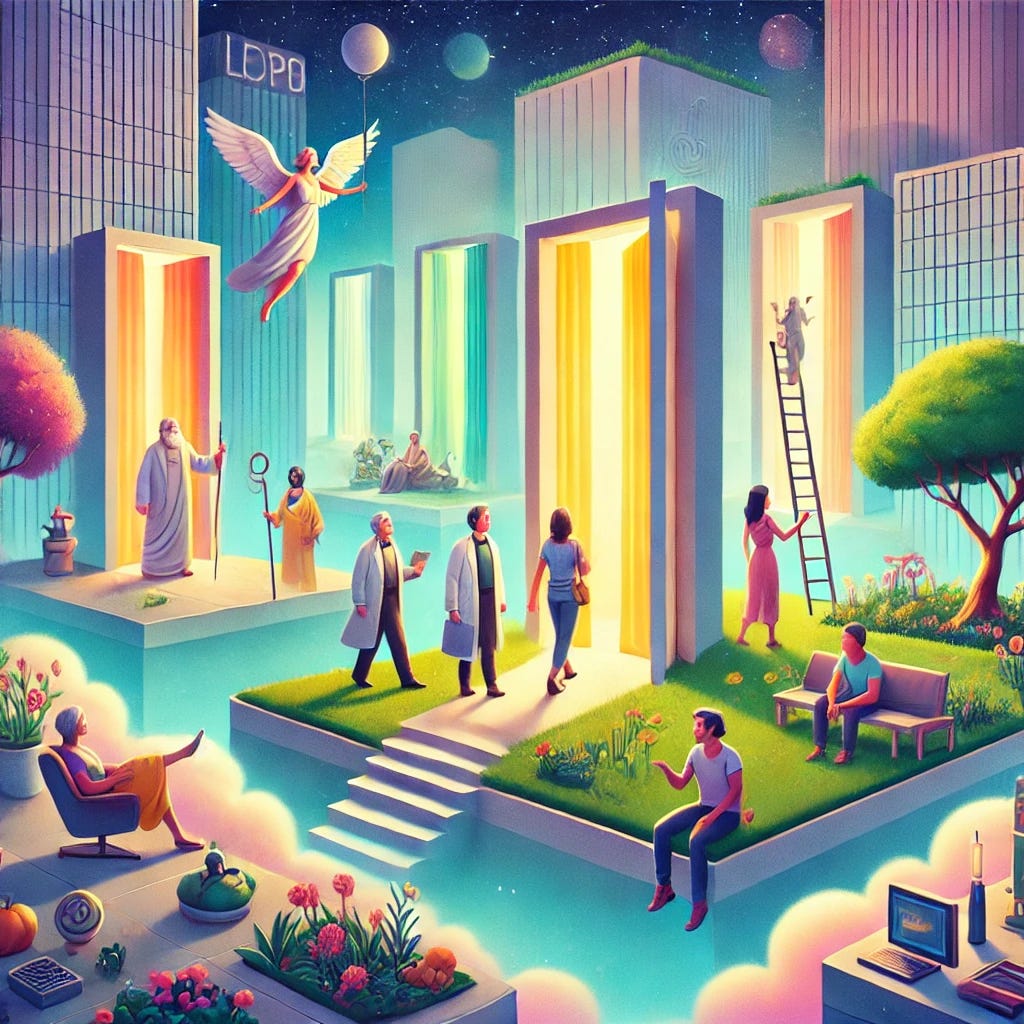
The Story and Its Basic Premise
For those unfamiliar, the show begins with Eleanor Shellstrop (Kristen Bell) waking up in the afterlife, mistakenly sent to "The Good Place." She quickly realizes that she doesn’t belong there, as her life on Earth was far from virtuous. Over time, Eleanor befriends three others—Chidi, Tahani, and Jason—and they uncover the truth: their supposed paradise is actually a sophisticated torture experiment designed by the demon Michael. However, the group’s growth and solidarity upend the system, and they eventually reform the entire afterlife.
What makes The Good Place so compelling is its core argument: humans are not static. We are flawed, yes, but we can grow and improve—so long as the circumstances allow it. In many ways it’s the perfect morality tale of Taylor’s “imminent frame” (at least as I understand it via Andrew Root). Salvation, or something akin to it, is not granted by a higher power but rather something we can achieve ourselves through effort, reflection, and community.
Examples from Episodes:
Chidi Sees the Time-Knife (Episode 38)
In one of the most striking episodes, the Judge visits Earth to observe human life firsthand. Overwhelmed by grocery stores, smartphones, and social media, she concludes that life is simply too hard for humans to live morally upright lives. This comedic yet profound observation underscores a key point: morality, in the show’s framework, is more about context and systems than inherent goodness or divine guidance. The focus remains on human effort and the barriers we face in trying to be good, reflecting Taylor’s "immanent frame," where human flourishing is detached from transcendence.
Chidi Sees the Time-Knife (Episode 38)
Also in episode 38, during a meeting in the IHOP, Jason delivers an impassioned speech about the human condition, leading the Judge to acknowledge that humans face significant disadvantages in moral decision-making. She agrees to repeat the experiment with new subjects, a test centered on the idea that humans can improve morally when given the right support and context. Season 4 revolves around this experiment, ultimately proving that people are not irredeemable and change is possible through persistence and favorable circumstances. Yet, this belief in human self-sufficiency operates entirely within the bounds of the immanent frame—it assumes no need for God or divine grace.
Patty (Episode 51)
Another key element of The Good Place’s humanist perspective is its portrayal of the actual "Good Place," which subverts traditional notions of divine perfection. When Eleanor, Chidi, and the others finally arrive in the real Good Place, they find it utterly dysfunctional—not because it’s a place of torment, but because it’s boring and uninspired. The supposed pinnacle of the afterlife, created and managed by divine beings, has failed to meet the needs of its inhabitants. This depiction reinforces the show’s central argument: humans, not divine intervention, hold the key to their own flourishing.
Whenever You’re Ready (Episodes 52-53)
At the end of the series, the Judge, Shawn, and even Michael essentially "retire" because the new system—designed by humans—is working so well. The divine and demonic beings, once the architects and arbiters of the afterlife, are no longer necessary because humanity has perfected the moral framework on its own. This resolution underscores the show’s philosophy: humans, given the right systems and context, are capable of moral perfection without divine guidance.
A Christian Response to The Good Place
While The Good Place offers a compelling vision of human potential, it stops short of addressing humanity’s deeper need for grace and divine intervention. At its core, the show operates on the assumption that humans, though flawed, are inherently good and capable of self-improvement on their own, given the right circumstances. However, this view of humanity largely eliminates the need for a savior. If humans are basically good and just need better systems or support, then divine intervention—and, by extension, the gospel message—becomes unnecessary. And I think this is the same basic premise that undergirds Progressive ideology, that through human effort alone, we redeem ourselves and the world on our own. As I’ve written about and the past and will likely write about more in the future, this inevitably creates a context in which the church (and it’s suggestion that we need a Savior) need not exist. Or, if anything, as we see in some Progressive churches, Jesus is simply a side kick marching alongside us on our human-led journey to justice.
I understand that the concept of original sin is complicated and complex, and an idea which I’ve gone back and forth on, I do think it is valuable, even if imperfectly, in the sense that it seeks to describe what is an essential truth to the Christian message, that humans are deeply broken, in ways they cannot fully see or fix on their own. And more, left to ourselves, we are prone to selfishness, pride, and harm—even with the best intentions. The core idea within The Good Place is that given enough time and chances, humans will make ourselves and everything else right. While we haven’t had eternity, I think the last 10,000 years or so has demonstrated that just isn’t—and never will be the case. We need a Savior.
Closing Thoughts: What The Good Place Teaches the Church
The Good Place is one of the best shows I’ve ever watched, not just for its humor and creativity but for its thought-provoking exploration of what it means to live a good life. At the same time, its vision reflects the cultural headwinds that Christianity faces in the modern world. By emphasizing human potential and downplaying divine grace, the show inadvertently highlights why the gospel is so radical: it proclaims that salvation cannot come from human efforts alone.
For churches and pastors, this show highlights the challenge of convincing people today that they cannot save themselves and that they do need a savior. Evangelism in the modern age might involve helping people see that they are better off in a relationship with God through Jesus. Instead of spending eons trying to fix themselves (as depicted in the show), the Christian message offers new life, wholeness, and healing through Jesus, who has already defeated sin and death.
Why Worship and Discipleship Must Come Before Activism

I’m working on a bigger post about the influence of progressive ideology/theology within Mainline Christianity, but after reading recent post by Ben Crosby, I wanted to to sort of setup my lengthier post this way.