


TL;DR:
In the temptation narrative, Jesus refuses to prove himself through spectacle or self-assertion. Like Elvis never needing to call himself the “King of Rock & Roll,” Jesus doesn’t loudly declare his divinity—he embodies it. The Gospels don’t offer anxious self-promotion but invitation and revelation. If someone has to constantly announce they’re the GOAT, they probably aren’t—and Jesus didn’t need to.
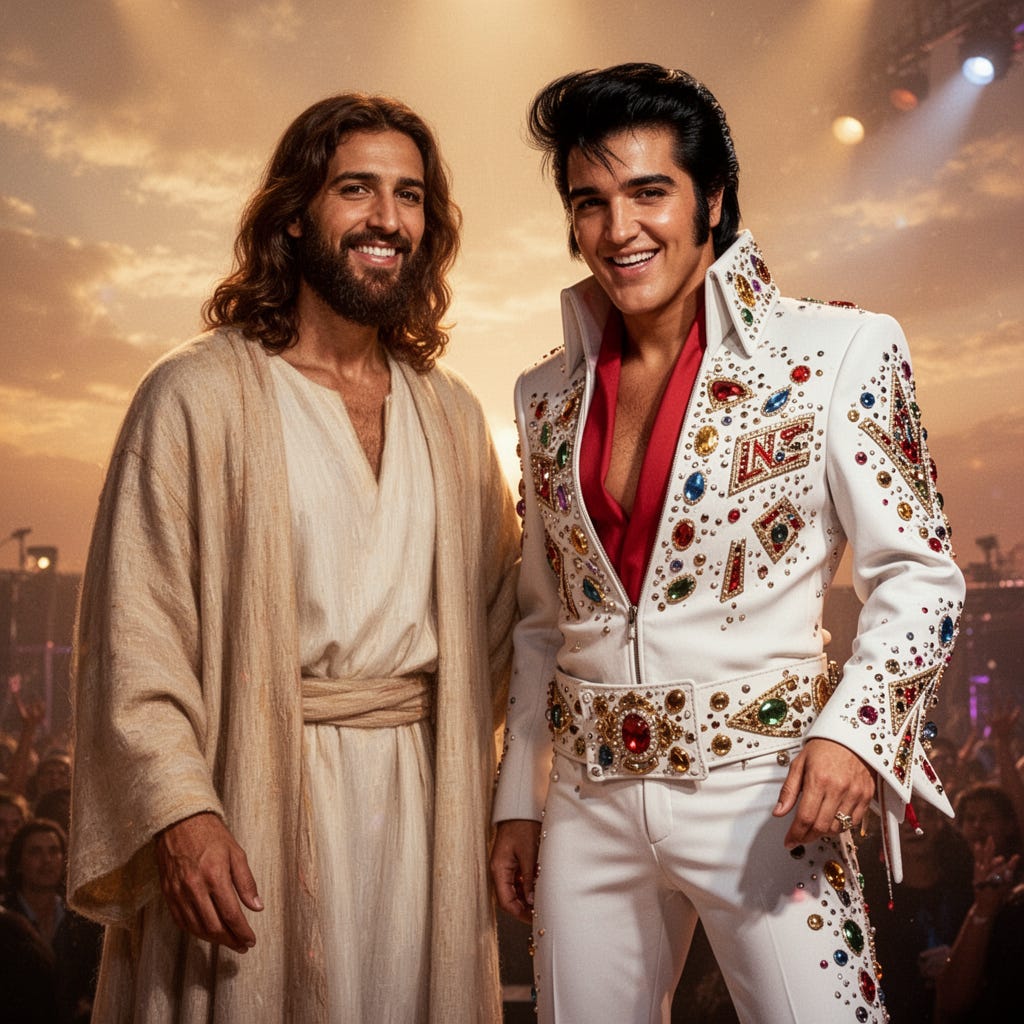
It’s the first Sunday in Lent, and in many churches the lectionary gives us the temptation of Christ from one of the Synoptic Gospels.
This year I heard a strong sermon on Luke’s account. My pastor noted how Jesus resisted the temptations of control, domination, and spectacle. The devil’s offers weren’t random. They were invitations to seize power, prove himself, and shortcut suffering.
Jesus refused.
After church, my family headed to lunch at Chuy’s—a Tex-Mex restaurant nearby so we could stay close and pick up my daughter returning from a youth retreat. I’d never been there before, but walking in, I immediately noticed the Elvis décor. An artistic piece near the entrance. Menu items like The King’s Memorial Combo. I ordered the Famous Steak Burrito, though I’ll admit I was tempted by the King.
And then a random thought hit me:
Did Elvis call himself the King of Rock & Roll—or was that title given to him?
A few days earlier I had read one of those Substack essays from someone who I only know how to refer to as an “exvangelical anti-apologist.” The argument was predictable: Jesus never explicitly claimed to be God. The Gospel words can’t all be traced back to him. Cue the usual references to the Jesus Seminar.1
That line of thinking was rattling around in my head during the sermon when something clicked.
In Luke’s temptation account, the devil keeps pressing Jesus: “If you are the Son of God…”
Prove it.
Demonstrate it.
Perform it.
But Jesus doesn’t take the bait.
My pastor observed that Jesus felt no need to justify himself. He was secure in his belovedness within God. There was no anxiety in him. No need to perform divinity on demand.
Back at the restaurant, waiting for my food, I looked it up. Sure enough, the title “King of Rock & Roll” was reportedly given to Elvis in 1956 by a reporter, Bea Ramirez. And in 1969 Presley himself deflected the title, referring to Fats Domino as the “real king.”
Elvis didn’t need to call himself king.
And that reminded me of Jesus’ words in Mark 10:
“Why do you call me good? No one is good—except God alone.”
Throughout the Gospels, Jesus regularly deflects premature or triumphal titles. When Peter confesses him as the Christ, Jesus immediately begins speaking of suffering—and when Peter resists that path, Jesus rebukes him: “Get behind me, Satan” (Mark 8:33). When crowds try to make him king by force, he withdraws (John 6:15). When demons identify him publicly, he silences them (Mark 1:34). When asked for a sign, he refuses to perform on demand (Matthew 12:38–39).
He redirects. He questions. He reframes.
Not because he isn’t who the church confesses him to be.
But because the recognition must emerge in the reader (or hearer).2
The devil wanted spectacle.
His critics want explicit self-assertion.
Modern readers want airtight transcripts.
But the Gospels don’t operate that way.
They invite.
They provoke.
They reveal—if you have eyes to see.
And that’s why I find those tired “Jesus never claimed…” arguments so elementary. They assume that truth only counts if it’s loudly self-declared.
But if I’ve learned anything in life, it’s this: anyone who has to constantly announce they’re the GOAT probably isn’t.
The King of Rock & Roll didn’t need to say it.
And the King of the universe didn’t either.
I have a copy of The Five Gospels on my shelf, so I’m not saying we should be theological Luddites or whatever. But, I also find it comical that we’re all going to assume that what a group of old, white men say is gospel—pun intended.
Perhaps I might also add through the work of the Spirit.