


TL;DR
The pastor shortage isn’t just about fewer candidates or broken systems—it’s also about formation. Many seminaries are producing leaders oriented toward activism rather than the day-to-day work of congregational ministry. The issue isn’t justice itself, but a growing mismatch between how pastors are trained and what churches actually need to survive and thrive.
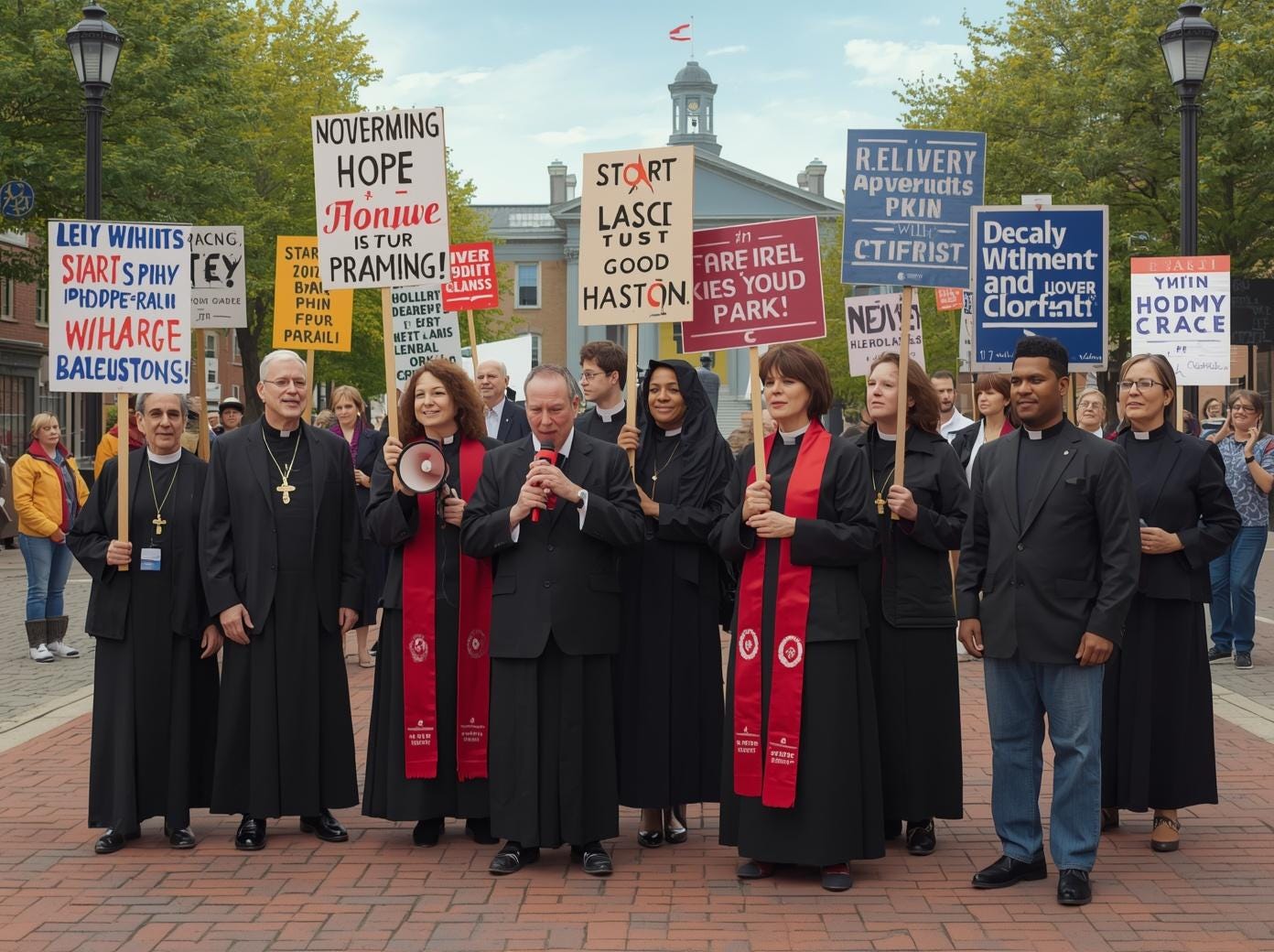
What if the pastor shortage isn’t just about numbers or systems—but formation?
What if we don’t just have fewer pastors…
but fewer people actually trained to be pastors?
In a previous post, I argued that while many churches think their biggest challenges are declining attendance and aging buildings, a deeper crisis is emerging: there simply aren’t enough pastors coming through the pipeline.
In a follow-up, I suggested the problem isn’t just the pipeline—it’s the system. Qualified, willing pastors (like me) are being sidelined by slow processes, geographic assumptions, and outdated models.
But there’s another layer to this.
Formation.
Or more directly: seminaries are turning out religious-leaning activists, not congregational pastors.
I say this as someone shaped by these same systems—someone who really bought into it for a long time.
A Strange Moment for Seminaries
More than a year and a half ago, I wrote a post asking, “what becomes of a seminary with no students?” Some seminaries are closing under financial pressure. Others—like my alma mater—are sitting on large endowments and effectively giving away degrees to access those funds.
At the same time, enrollment is declining across the board. Fewer churchgoers. Fewer job prospects. Less incentive to pursue ministry.
In his book The End of Theological Education, Ted Smith notes that many seminaries have responded by broadening their offerings—degrees in social justice, ethics, trauma, and healing.
I get it. You expand the customer base.
But it raises a real question: what exactly is being formed?
Because at some point, you’re no longer just training pastors. You’re training something adjacent to that.
Where This Becomes a Church Problem
Here’s where this actually hits congregations.
These graduates—like anyone—need jobs. And those jobs, especially well-paying ones in the “social justice” space, are hard to come by.
Churches, meanwhile, need pastors.
So the two meet.
But not always cleanly.
As one mainline pastor told me:
“seminaries are turning out religious leaning activists not congregational pastors.”
Another put it more bluntly:
“wannabe activists need jobs, so they get pulpits because they’re charismatic, but they suck at the daily congregational ministry work.”
That’s harsh. But it’s not coming out of nowhere.
Megaphones vs. Pulpits
At times it feels like grads don’t want a pulpit—they want a megaphone.
And again, to be clear, I’m not anti-activism. The church has always had a role in social engagement. Some of the best examples of justice work have come directly out of Christian communities.
But there’s a difference between activism flowing from pastoral formation… and activism replacing it.
In seminary, I remember hearing a version of this over and over: the pastor is less a preacher and shepherd, and more an activist or community organizer.
Fine.
But then where does that leave room for God? For the gospel? For the actual work of pastoring?
By “pastor,” I mean someone formed to preach, care for people, administer the life of the church, and sustain a community over time.
Because congregational ministry is not primarily about visibility or platform.
It’s about showing up.
Week after week.
In rooms that no one else sees.
In a recent post, Gerardo Martí said it far better than I could: “What the church needs from its leaders is not more statements on social media. It needs pastors willing to invest in the long, slow, costly relational work of orienting their communities…”1
The Limits of Deconstruction
The problem isn’t that seminaries care about justice—it’s that, in some cases, they’re neglecting formation for the work churches actually require.
And here’s where I think this becomes a real issue.
Many of these leaders are trained in deconstructing and dismantling. Those things have a place; the church has real failures that need to be named.
In his recent book Baal and the gods of More Andrew Root shares a story about a pastor who said “I want the opposite of growth. I want the church to diminish. That’s what I’m after” (26).
But those tools are not enough to sustain an institution.
You can’t pastor a congregation on deconstruction alone.2
At some point, you have to build. Stabilize. Endure.
And I think the last few years have made something pretty clear: we still need institutions. However flawed, they shape communities, form people, and provide continuity.
We are so drunk on the cult of individualism that we assume we can just reinvent everything on the fly.
We can’t.
A Telling Example
In my own denomination, the “new church ministry” leader recently posted a video on how to make protest signs.
Whatever your politics, two things seem obvious:
First, there are probably other departments better suited for that.
Second, making protest signs has very little to do with starting or sustaining a worshipping community.3
That gap matters.
What I’m Actually Saying
To be clear, this isn’t a call to abandon justice work. It’s not a defense of the status quo. And it’s not a denial that churches have caused real harm.
It’s a question of formation.
Are we training pastors?
Or are we training activists who happen to work at churches?
Because those are not the same thing.
And right now, in too many cases, the gap is starting to show.
The church doesn’t need less engagement with the world—it needs leaders formed deeply enough to engage it without losing the core of pastoral ministry.
The Mainline Church Is Running Out of Pastors

TL;DR: Many Mainline churches may think their biggest challenges are declining attendance and aging buildings. But a deeper crisis is emerging: there simply aren’t enough pastors coming through the pipeline. Falling ordination numbers, aging clergy, seminary formation questions, and the lack of a leadership “farm system” are creating a shrinking pastoral…
The Mainline Church is Running out of Pastors: Part 2

TL;DR The pastor shortage isn’t just a pipeline problem—it’s a systems problem. Qualified, willing pastors (like me) are being sidelined by slow processes, geographic assumptions, and outdated models. We don’t need to reinvent ministry formation—we need faster, supervised on-ramps that deploy pastors in real time.

It is especially frustrating to me to see some leaders “divest” institutions that faithful Christians have invested in for generations, as if an NGO is the equivalent of a church. Again, I’ve written on this previously.
There’s a lot of talk about affinity groups becoming the new mode of church, and let me just simply say, that’s a very bad idea.
Thank you for this thoughtful piece! As I pastor in a small rural town, I am frustrated by the devaluing of the steady and patient (and very rewarding) calling to shepherd congregations. I've co-officiated (with my ministry colleague) two funerals for congregants in the past three days, and this is holy work.
Yep! You nailed it. The progressive view that our mission is to work toward creating God’s kingdom in society has bad Christology and even worse ecclesiology.