


TL;DR: Necessary change can still be badly led. Looking back at the cultural upheaval surrounding gay marriage and the political backlash that followed, I wonder whether humiliation and dismissal helped fuel the anger that eventually found a champion in Donald Trump. Churches face a similar challenge: people remain responsible for how they respond to change, but leaders are responsible for how they lead it. Compassion is not capitulation, and humiliation is a terrible change-management strategy.
“Just tell me again how gay marriage is going to tear this country apart.”
What If Liz Lemon’s Parents Were Right?
30 Rock, the American television comedy series created by Saturday Night Live alum Tina Fey, is one of my all-time favorite shows. As such, I was recently rewatching the series when a throwaway line from an early episode stuck in my head.
Season 2’s Christmas episode, “Ludachristmas,” features Liz Lemon’s family: her mother Margaret (Anita Gillette), father Dick (Buck Henry), and brother Mitch (Andy Richter).
Liz’s parents are sweet, small-town folks on the surface, but Jack’s mother, Colleen, insists on exposing the underlying tensions. By the end of the episode, what begins as a nice family dinner at a TGI Friday’s-type restaurant descends into a screaming match, as Liz and her family trade angry barbs, all the while Jack and Colleen sit idly by, smirking at one another.
One intriguing line, yelled by Liz at her parents, is something like: “Just tell me again how gay marriage is going to tear this country apart.”
While likely meant to be dismissive of the overreaction against gay marriage, I can’t help but wonder:
What if Liz Lemon’s parents were right?
Trump Did Not Happen in a Vacuum
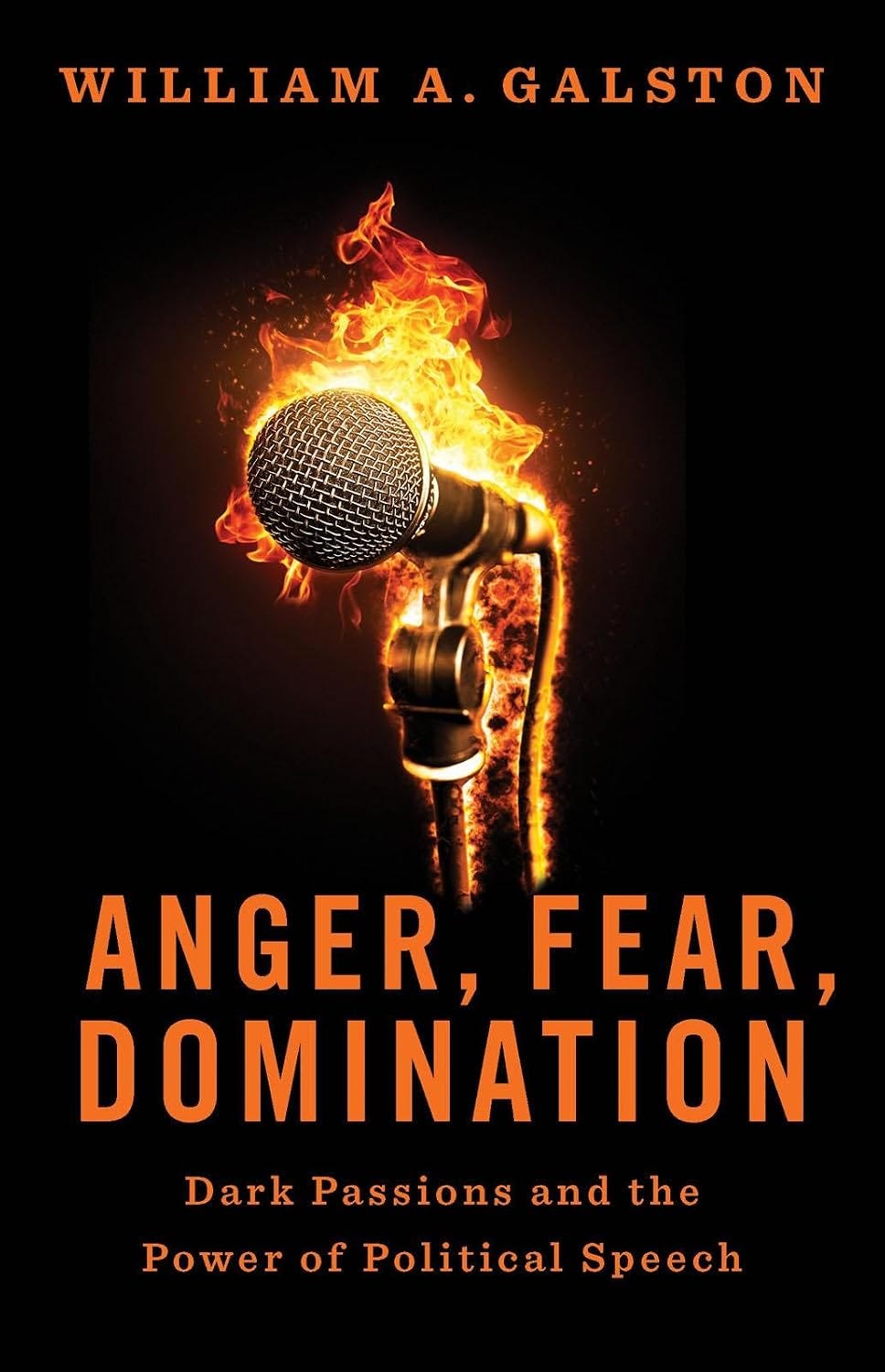
I just finished reading Anger, Fear, Domination: Dark Passions and the Power of Political Speech, a little book by William Galston that caught my eye at the local library. Checking in at only 176 pages, and with generous spacing throughout, it was a fairly quick and compelling read.
Galston’s central argument is that “liberal democracy,” or Western-style democracy, is actually quite rare and fragile, and especially susceptible to what he calls the “dark passions” of anger, fear, and domination—particularly when exploited by political leaders à la Trump.
While Galston and others deservedly place much of the blame on leaders like Trump and the voters who supported him, Galston makes some broader assertions that I think are important and are too frequently ignored in favor of simply blaming everything on Trump and his supporters.
To be absolutely clear, the point of this post is neither to valorize nor infantilize Trump supporters. Rather, the point is to say that Trump and the broader MAGA movement did not happen in a vacuum.
And while I believe that many of the reactionary actions and efforts spearheaded by Trump are unethical, immoral, and sometimes blatantly evil, I don’t think it does much good to resort to public shaming and name-calling. Such moves can themselves become acts of anti-liberalism, as Galston argues.
To that end, I would argue that we in the United States find ourselves in such an angry, divided, and polarized predicament in part because the prediction of Liz Lemon’s parents has turned out to be true:
Gay marriage really did help tear this country apart.
The Right Side of History
Now, before I get blasted with angry comments, let me first say that I was and still am an enthusiastic supporter of gay marriage.
More importantly, the point of this blog is not to debate whether gay marriage is morally good or not—though I would argue that it is. Rather, my point is that during the twenty-teens, the overwhelming assumption among Democrats and much of the progressive left became not simply that gay marriage was morally right, but that there should no longer even be a debate about it.
I will concede that some might find my argument myopic or imprecise; perhaps so. I intend this not so much as a rehashing of historical events, but rather as a generalized view of the last ten to fifteen years of American culture.
Broadly speaking, during that time the American left increasingly treated people operating from different moral frameworks as backward or bigoted, all the while adopting a sort of cavalier and presumptuous attitude perhaps best illustrated by the repeated moralistic language of being “on the right side of history.”
My argument is that this mattered.
Perhaps going back to the reelection of Barack Obama (whom I voted for and still support), conservatives—and especially religious conservatives within America—increasingly felt diminished, isolated, ignored, and culturally displaced. By the time a morally—and somewhat financially—bankrupt, swashbuckling political leader came riding down a golden escalator in 2015, many of these folks were ripe for the picking.
Consider the timeline:
30 Rock’s “Ludachristmas” first aired: December 13, 2007
Seth Meyers roasts Trump at the White House Correspondents’ Dinner: April 30, 2011
Obama administration announces it will no longer defend DOMA: February 2011
Obergefell v. Hodges argued: April 28, 2015
Trump descends the “golden escalator”: June 16, 2015
Obergefell v. Hodges decided: June 26, 2015
Trump elected president: November 8, 2016
The Politics of Humiliation
This is where Galston’s wisdom is especially helpful.
First, Galston argues that liberals have too often underestimated just how important cultural and moral questions actually are:
“Today’s defenders of liberal democracy often suffer from what might be termed myopic materialism: the belief—especially pervasive among elites—that economic issues are the real issues and that cultural issues are diversions, deliberately heightened by unscrupulous leaders to gain support for their anti-liberal agendas.” (18)
In other words, cultural issues aren’t merely distractions from the “real” economic issues. People actually care about them.
And I think this is something the progressive left has sometimes been unable—or unwilling—to accept: many Americans operate from genuinely different moral frameworks. Galston continues:
“Until liberals—mostly clustered in large cities and national capitals—make the effort to understand the enduring influence of religion and traditional morality in the hinterlands, they will continue to be surprised by political events.” (19)
But Galston’s second point is even more important to my argument: humiliation is a particularly dangerous way to respond to those differences.
In my opinion, shaming and belittling people who held traditional views on issues like gay marriage became an increasingly prominent move of the progressive left. And it wasn’t without blowback.
As Galston notes:
“Of all the variants of anger, the most powerful, and often the most dangerous, is anger born of humiliation.” (46)
This is what I want my friends on the progressive left to understand, especially when we respond to the rise of Trump with a sort of feigned innocence: How could they?
There was, I think, a real sense of humiliation experienced by many people who opposed gay marriage—not simply because they lost the political and legal argument, but because their position increasingly came to be treated as beyond the bounds of respectable public discourse. Meanwhile, within progressive politics, the direction of history itself was often treated as inevitable. We were, after all, on the “right side of history.”
Galston’s final example helps connect these threads directly to what happened in 2016:
“After the 2016 election, I asked a leading evangelical Protestant why so many evangelical voters had abandoned their long-held conviction that private morality is a threshold qualification for public office. His response: because evangelicals believed they were on the verge of losing every vestige of the culture they cherished, they were looking for a fighter, not a preacher. When people feel their backs are against the wall, they are unlikely to be particular about the character of those who step forward to defend them.” (112)
They were looking for a fighter, not a preacher.
That doesn’t absolve anyone of responsibility for choosing that fighter.
To be absolutely clear, I do not want this blog to be perceived as an apologetic for Trump voters or as me pretending they are not responsible for their choices. What I am trying to say is that those choices did not form out of a vacuum.
And while I don’t agree with those choices, I think we as a country would be far better off if those of us on the left had responded with more compassion—or at least some measure of understanding and curiosity—when people reacted so strongly to enormous social changes such as gay marriage.
A Lesson for the Church
Or, to say it somewhat differently, I’m not an expert in change theory, but I’ve learned enough over the years studying church growth and revitalization to know that shoving change down people’s throats won’t work—even if the change is desperately needed.
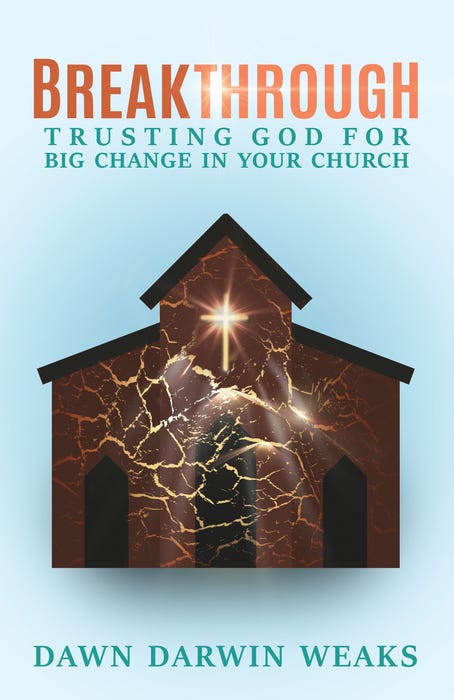
I’m reminded of Dawn and Joe Weaks, pastors of what is now Connection Christian Church, a stereotypical aging and declining Mainline Protestant church. In her book Breakthrough, Dawn describes Joe patiently—and perhaps also painstakingly—sitting with longtime members, going over item-by-item lists and descriptions of elements of their old building as they prepared for a change of venue.
No doubt, some people were likely offended and maybe even angered by the decision to sell their building and move to a newer location. But rather than shaming and humiliating them, Dawn and Joe offered kindness, care, and compassion—with, of course, a steady dose of realism and boundaries.
To be clear, they still sold the building. They still got rid of a lot of stuff. And they still changed the name of the church. I’m sure, through it all, they lost some people. But in the end, they gained a lot more.
And, to bring this back to the church, as this is a church—not political—focused blog, I’d make the same point as I did above.
Churches, like liberal democracies, are fragile ecosystems, and without wisdom, patience, and care, they can be derailed by nefarious actors looking to take advantage of offended and aggrieved groups of people.
And while those people are certainly responsible for their own actions, I guess what I would ultimately argue is that so are we.
Meaning, we can’t diminish and disregard whole swaths of people and then be shocked and surprised when they start following someone who affirms and supports them.
So What Do We Do Now?
The law of holes, or the first law of holes, is an adage that states: “If you find yourself in a hole, stop digging.” It is used as a metaphor, warning that when in an untenable position, it is best to stop making the situation worse.
Galston says it a little more eloquently:
“When backsliding is occurring, the most urgent challenge is to prevent things from getting worse. In such times, naïveté about historical progress and human nature is especially dangerous.” (134)
I think there are two important points there.
First, stop making things worse.
This is where I find Alexandria Ocasio-Cortez’s recent efforts to laugh off “woke 1.0” as “crazy” dismissive and unhelpful.
Please read the room.
If part of what helped produce our current political moment was the humiliation and dismissal of people who felt culturally displaced, then we need to acknowledge that some overreactions occurred and that innocent people were caught in the crossfire. Laughing it off as “crazy” diminishes those people’s feelings and becomes emblematic of the very dynamic we need to name.
That doesn’t mean capitulating to their demands. Compassion toward people experiencing change is not the same thing as capitulation.
People remain responsible for how they respond to cultural change. But leaders are also responsible for how they lead change—and humiliation is an extraordinarily dangerous and ultimately ineffective change-management strategy.
Second, abandon our naïveté about historical progress and human nature.
I’m not too sure of Galston’s religious beliefs, but he makes strong use of Augustine and what I recognize as a classical Christian view of sin and human nature.
And maybe this is one of the real challenges for parts of the progressive left: we can fundamentally misunderstand how human beings actually work.
Galston, for what it’s worth, seems to understand this quite well:
“The psychology of alarmism is seductive. It gives the alarmist a sense of superior insight, and by raising the stakes of one’s judgment, it heightens the excitement. When leaders convey alarm to their followers, they enable ordinary citizens to feel a sense of significance that may otherwise be missing from their lives.” (90)
Human beings don’t inevitably march toward greater enlightenment simply because history is supposedly moving in that direction. We are susceptible to fear, anger, humiliation, tribalism, and the desire to feel significant. And importantly, that is true of people on both the left and the right.
Which brings me back to the church.
You don’t have to believe that the person resisting change is right to believe that they deserve dignity. Joe and Dawn Weaks didn’t keep the old building because people were upset. They helped people grieve. They listened. They treated people with compassion.
And then they changed it anyway.
I think there’s something important there for church leaders—and perhaps for our politics too.
Change may be necessary. Sometimes it may even be morally imperative.
But how we lead people through that change matters.
We cannot control how people respond. They remain responsible for their choices. But we are responsible for how we treat them along the way.
And humiliation is a terrible strategy for change.
P.S. One More Thought About DOMA
There’s another piece of this history that doesn’t quite fit the argument above but has sat uncomfortably with me since it happened.
In 2011, the Obama administration announced that the Department of Justice would no longer defend Section 3 of the Defense of Marriage Act in court because the administration had concluded that it was unconstitutional. Importantly, the administration continued to enforce the law while it remained in effect, so this wasn’t simply Obama deciding that DOMA no longer existed.
Still, I remember finding the decision a little unsettling even at the time—and I say that as someone who supported Obama and opposed DOMA.
The problem is bigger than whether I agree with the particular policy outcome. Liberal democracy depends not only upon getting the outcomes we want, but upon institutions, processes, and constraints that remain in place when someone we don’t support holds power.
If we become comfortable with executive officials stretching those norms when they produce outcomes we like, we shouldn’t be entirely surprised when future leaders push them considerably further to produce outcomes we despise.
That’s a different argument than the one I’ve made above, and probably deserves its own treatment. But looking back from where we are now, I think my discomfort in 2011 was pointing toward something important: the rules matter most when following them gets in the way of something we want.