


TL;DR
Slowing down isn’t about ignoring responsibility or injustice—it’s about living from a place of prayerful presence rather than constant urgency. When we step out of hurry, we don’t care less—we’re actually able to love, listen, and endure more faithfully over time.
I’m not in a hurry
I’m not a particularly fast walker.
Maybe it’s because my legs aren’t that long in proportion to my height (I’ve got more torso than stride).
Maybe it’s because, growing up, I remember my mom always telling my dad to slow down because he was too far ahead of us.
Or maybe I just don’t like walking that fast.
But my training as a hospital chaplain added something deeper. I was taught not to walk quickly, but to walk purposefully—and prayerfully. Never in a hurry.
Learning to Slow Down
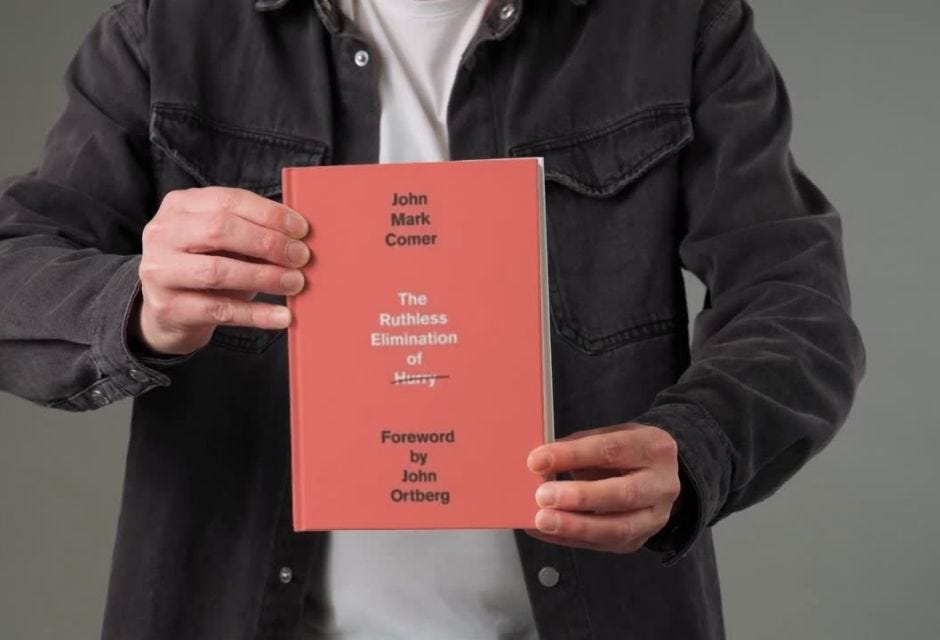
I recently finished The Ruthless Elimination of Hurry by John Mark Comer. While I wish he spent more time acknowledging the systemic realities that contribute to hurry—what some of my progressive friends might call systemic injustice1—I still found a lot worth holding onto.
Comer writes, “Hurry and love are incompatible” (23). That line stuck with me. It echoes what I’ve seen elsewhere too—love requires presence, and presence requires time.
He also notes that “hurry is a threat not only to our emotional health but to our spiritual lives as well” (52).
I just want to say: it absolutely is.
About a year ago, I made a significant shift. I moved away from full-time work into a patchwork of part-time roles, which has allowed me to be home more.
I didn’t fully expect what that would do.
It’s been refreshing—not just practically, but physically, emotionally, and spiritually. And I think a big part of that is simple: I am far less often in a hurry.
What’s Beneath the Hurry
One of the more convicting parts of the book was this:
“All too often our hurry is a sign of something else. Something deeper. Usually that we’re running away from something—father wounds, childhood trauma, last names, deep insecurity or deficits of self-worth, fear of failure, pathological inability to accept the limitations of our humanity, or simply boredom with the mundanity of middle life” (55).
I’ve found that to be true.
If I’m always busy—always moving—I don’t have to stop and ask harder questions.
I don’t have to reflect on whether my life is actually aligned with what I say I value.
Hurry can be a kind of avoidance.
Contentment and Enough
Another unexpected outcome of slowing down has been financial.
Making less money—and therefore spending less—has actually produced a kind of contentment.
Comer puts it this way: “At some point you have to draw a line in the sand and say, ‘I’m good… I have enough’” (169).
And honestly, when you do that, it’s not nearly as painful as you might expect.
There’s also what I’d call a “busyness tax.”
I recently watched a YouTube clip breaking down how, for some families, a second income might only net around $6,000 after accounting for childcare, transportation, eating out, and other costs.
Which raises a fair question: is all that added stress and hurry worth it?
Justice Without Hurry
One of the most important clarifications Comer makes is this:
We should not “close [our] eyes to injustice in the world… What I’m saying is, let prayer set your emotional equilibrium and Scripture set your view of the world” (229).
That matters.
Especially because in recent years—particularly around 2020 and 2021—there was a strong sense that stepping back, even briefly, from engaging injustice was itself a kind of privilege. That the faithful response was constant action, constant awareness, constant urgency.
I understand that instinct.
But I’ve also noticed something else: increased pessimism, despondency, and even bitterness among some who live in that constant state.
It makes me wonder if, at some point, we push past faithfulness into something unsustainable.
Or, as Comer might say, into hurry.
Not in a Hurry
I’m reminded of the lyrics from Not in a Hurry by United Pursuit:
I’m not in a hurry
When it comes to Your spirit
When it comes to Your presence
When it comes to Your voice
I’m learning to listen
Just to rest in Your nearness
I’m starting to notice
You are speaking
Often, when I’m driving to the hospital to respond to a crisis page, I’ll turn on some Christian music—or just sit in silence. I try to pray, or at least recall some version of the St. Francis prayer: “Lord, make me an instrument of your peace.”
Like Comer suggests, when we are not in a hurry—when we are actually listening to God, to Scripture, and to the voices around us—it’s hard not to be moved to respond to the brokenness in front of us.
But there’s a difference between reacting out of urgency and acting from a place of rootedness.
When we act from that place of restful nearness—depending on God’s strength rather than our own—we are sustained for the long haul. We begin to recognize that it’s not on us to fix everything, that we don’t have to rush, and that we can wait on God—and then move as God leads.
Comer does spend some time talking about how much junk we buy is likely made by workers in sweat-shops or other oppressive working environments. He also acknowledges the ecological cost of consumerism, saying at one point, “Before you buy, ask yourself, By buying this, am I oppressing the poor or harming the earth?”