


TL;DR: Reading N.T. Wright reminded me that our greatest intellectual temptation may be oversimplification. We naturally reduce complex realities into neat stories, but Christian faith calls us to humility, patience, and the recognition that God's work is always bigger than our explanations.
Humans—or at least humans in modern Western culture—have a remarkable tendency to simplify.
I’ve heard marketing guru Donald Miller say that the human brain is designed to thrive and survive. I read very nearly the same thing again recently in the book Inside the Box by David Epstein.
Because our brains have limited capacity, they’re constantly looking for ways to automate tasks and conserve energy so it’s available when we really need it.
The funny thing is that even this explanation is itself a simplification of far more complex neuroscience. Yet from that admittedly simplified observation, Miller has built an entire marketing philosophy.
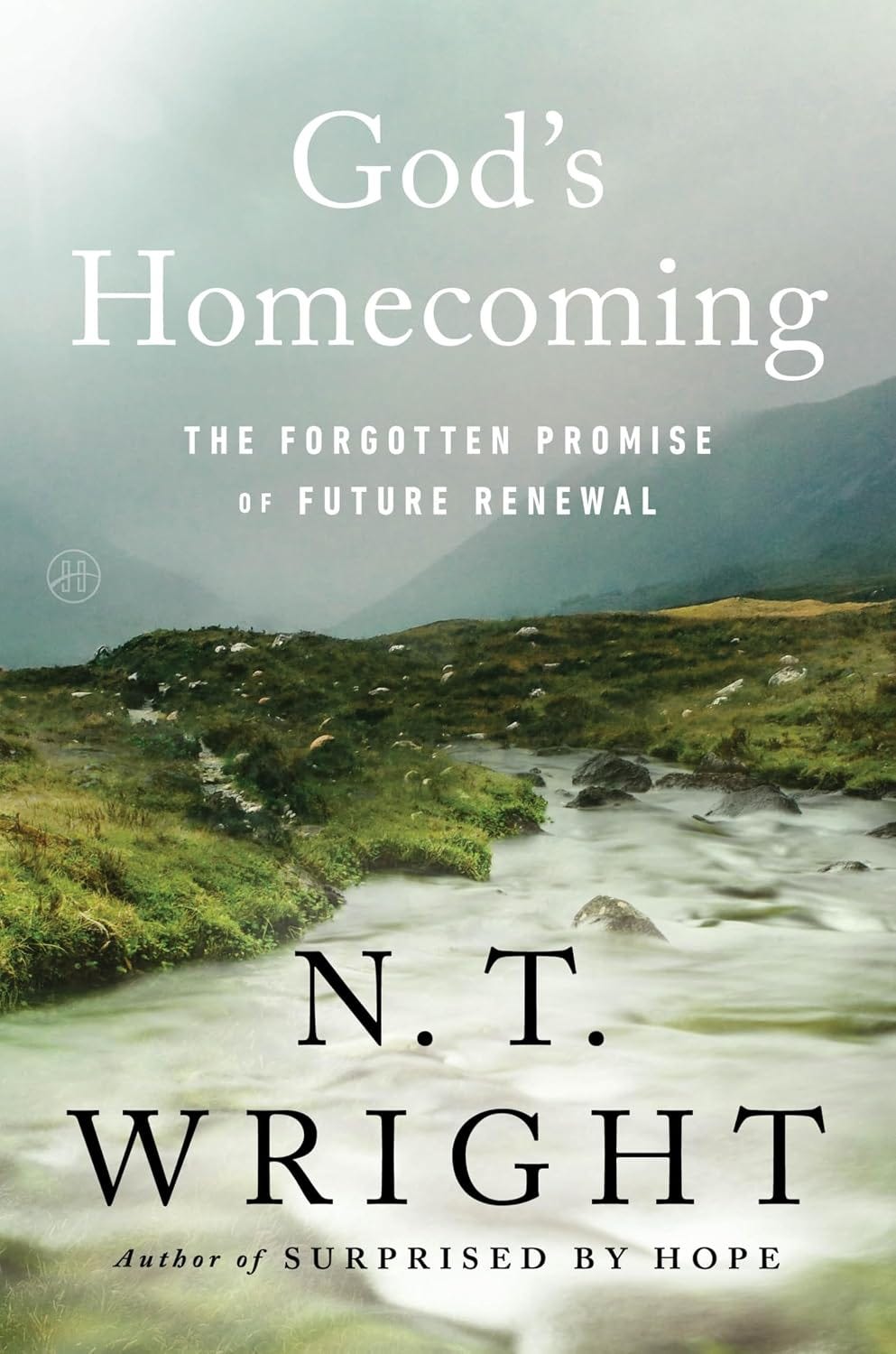
I found myself thinking about that while reading N.T. Wright’s recent book, God’s Homecoming: The Forgotten Promise of Future Renewal.
I found the book deeply engaging—to the extent that I saved fifty-seven highlights in my reading app.
Heaven, Earth, and the Afterlife
Broadly speaking, the book unfolds in two parts.
In the first half, Wright argues that the way many Christians have come to summarize Christianity—“getting saved so you can go to heaven when you die”—is a fundamental misunderstanding of both the gospel and the broader story of Scripture. Instead, salvation is something more like “experiencing the kingdom of God in this life—not simply in the life to come” (my summary, not Wright’s wording). Rather than God rescuing humanity from creation, Wright argues that the biblical story culminates with God coming to fully restore creation itself.
The second half explores why Christianity has come to be understood primarily as “going to heaven when you die,” while also addressing what Wright believes happens to believers between death and the final resurrection.
Spoiler alert—here’s the version that made the most sense to me.
“At death God will download our software onto his hardware until he gives us new hardware to run the software again for ourselves.” (291)
Wright credits the analogy to theologian John Polkinghorne and admits he doesn’t especially like it himself. Still, I found it considerably easier to grasp than Wright’s own description of entering a state of refrigerium—the “refreshing and awesome gladness of being ‘hidden with the Messiah in God’” (295).1
And you wondered why I preferred the software analogy!
Our Need to Simplify
As much as I appreciated Wright’s book, in between thinking about “heaven”2 and the afterlife, I found myself wondering about our remarkable human tendency to simplify complex realities—I’m guilty as doing as much in this very post!
Sitting and praying with grieving families in the hospital, I often find myself wondering where their loved one is now. Wright offers one compelling answer. But reading him also made me wonder:
Is our impulse to simplify one of the greatest obstacles to faithful thinking?
Ironically, even Wright occasionally seems to simplify the history he’s critiquing.
I found myself wondering whether the “Christianity is simply about going to heaven when you die” narrative has really been as dominant throughout church history as he suggests. It seems to me that this understanding only became broadly normative in many circles with the rise of Billy Graham and the modern “born again” movement.
Then again...
Who am I to critique N.T. Wright of all people?
I also grow a little cautious whenever anyone suggests, “Most of historic Christianity has gotten this wrong—but I’ve finally gotten it right.”
My point isn’t that Wright is wrong.
My point is that even Wright, at times, seems to simplify a far more complicated story.
Which raises the obvious question:
How do we resist that tendency ourselves?
Three Ways to Resist Simplicity
I’m not entirely sure, but a few thoughts come to mind.
First, we have to continually expose ourselves to new books, new perspectives, and new voices.
That’s difficult because it requires tremendous mental energy. It’s far easier to sort ideas according to labels we’ve already assigned than to genuinely wrestle with whether they might teach us something new.
And the dangerous part about algorithms is they decrease our exposure to other topics while assuming we are actually widening our perspectives.
Second, we need intentional ways of disrupting our own assumptions.
I recently heard the story of an airline crash involving pilots based in Florida. Accustomed to warm weather, they routinely breezed past the checklist asking whether the wings needed to be de-iced.
The problem? That particular flight departed from the frigid Northeast.
Since then, many aviation checklists have been intentionally redesigned so pilots can’t simply move through them on autopilot. A pilot friend told me that they have disrupted the routine itself in order to encourage careful thinking.
I wonder whether Christians need similar practices.
Third—and this may sound counterintuitive—we HAVE to be patient.
The human brain has limited capacity. Faced with a constant flood of information, most people eventually stop processing altogether or retreat into familiar categories and cultural scripts.
I think this helps explain many of the political and cultural reactions we’re witnessing today—including, at least in part, the MAGA movement. While I understand the frustration of having your own freedom or dignity depend upon someone else’s willingness to change, what I know about change theory is this:
Overwhelming people rarely changes them.
More often, it simply causes them to cross their arms.
Real change is slow and requires trust, patience, and perhaps most difficult of all—believing that people are capable of growth.
Which also explains why it’s so tempting simply to write off those with whom we disagree as irredeemably prejudiced, ignorant, or bigoted.3
I suppose I’ve wandered rather far afield for a blog that began as a reflection on N.T. Wright’s book about the afterlife.
Then again, this series is called Thinking with Books.
Books rarely leave me thinking only about the topic they set out to discuss.
Maranatha
In the end, Wright’s book made me long all the more—or perhaps, as Paul would say, groan all the more—for God’s promised homecoming.
It reminded me that while I can participate in the early signs of God’s kingdom even now, neither I nor humanity as a whole can bring that kingdom fully into reality ourselves.
And honestly...
I think that’s very good news.
Even so, come, Lord Jesus.
Maranatha.
Wright talks about our spirit being fused with God’s spirit and that eventually, God will put our spirit into a new/renewed body (readers are welcome to correct or further clarify that).
Also, I didn’t quite fully grasp Wright’s insistence on the lower case “holy spirit?” — Would a reader like to comment?
I put “heaven” in quotations here because Wright would disavow popular understandings of heaven.
Some may be—but I think a lot more people just don’t understand or rather are themselves adhering to a simplified script they’ve given.