


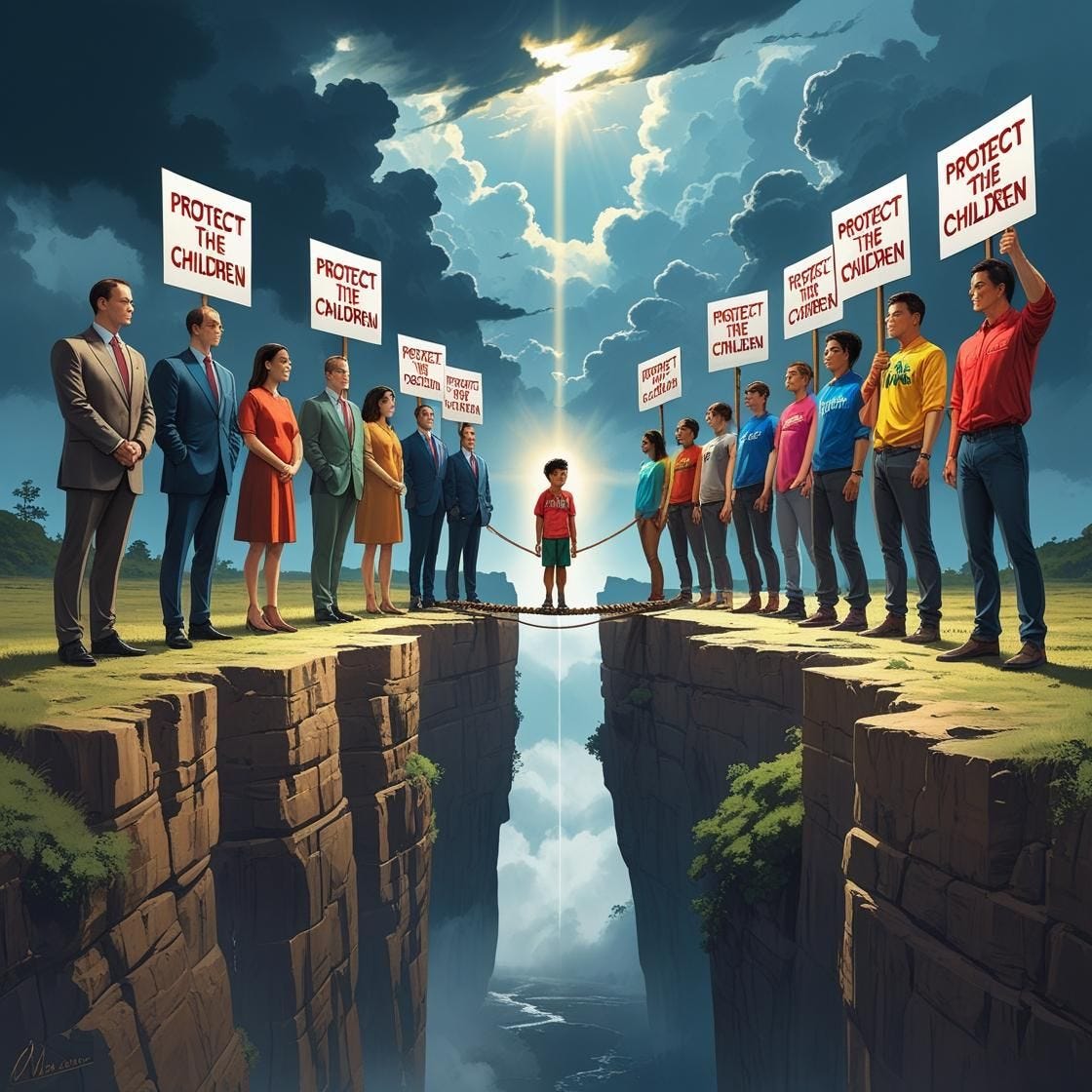
We all want to be the good guys. That’s part of what makes today’s cultural debates so tense—on issues like gender and youth, everyone believes they’re defending the innocent. But when both sides are driven by the same moral urgency, it’s no wonder the conversation feels impossible.
In his book Do I Stay Christian?, Brian McLaren writes about what he calls the “cult of innocence.” He puts it this way:
“The pro-life movement has become a cult of innocence.” (p. 123)
What does he mean by that?
“When white Christians see themselves as valiant defenders of vulnerable unborn lives, they identify with the innocence of the victim so that the innocence or purity of the unborn victim is transfused to them.” (p. 123)
When I first read that, I thought McLaren’s observation was insightful—except he only got it half-right.
Innocence as a Moral Framework—On Both Sides
In my conversation with him on my podcast, we talked about what it means to be Christian in today’s climate—how it could mean “standing with trans kids or standing against them” (my paraphrase). He was firmly of the opinion that standing with them was the more faithful Christian stance.
But I don’t think he recognized that he was using the same logic he had critiqued: appealing to innocence. Just as the pro-life movement casts itself as defending innocent unborn children, McLaren was—though less explicitly—framing trans youth as innocent victims in need of protection.
He writes, “Staying Christian is a way of leaving the cult of innocence” (p. 127). But in this case, I don’t think he left it—I think he just switched sides.
To be clear: I’m not disagreeing with his compassion. I’m pointing out that both sides in this debate use the same basic framework.
Each sees themselves as protecting the innocent.
That’s the core issue. One side believes it’s protecting kids from “trans ideology”; the other believes it’s protecting kids from transphobia and suicidality.
Both are animated by deeply held beliefs. And both believe their moral vision demands urgent action.
When Moral Clarity Meets Moral Gridlock
This is why arguing in terms of absolute right vs. wrong, or good vs. evil, won’t get us anywhere.
The “other side” isn’t just confused or hateful1—they’re morally convicted. They believe they’re saving lives.
For one side, it’s about preventing what they see as unnecessary or premature medical interventions—especially when the long-term outcomes are still being studied.
For the other, it’s about preventing harm through inaction, including increased risk of mental health struggles and suicidality.
I’m not here to make a sweeping judgment about gender-affirming care; I believe there may be cases where it’s the right path.
But when both sides are convinced they’re protecting vulnerable kids from irreversible harm, the conversation quickly turns into moral gridlock. The stakes are enormous. And the perceived victims—children—are seen as entirely innocent. That’s why this issue is so tense. It’s a moral standoff between two sides who are using the same playbook: different victims, different villains, same logic.
And this is why the “moral clarity” element is so important to name. In episode 6 of The Protocol podcast, Dr. Annelou de Vries comments, in essence, “There are so many more important things going on in the world. I wish people would focus on those things.” And she’s not wrong. But that’s exactly why this issue becomes so emotionally charged. Most major problems—war, climate change, poverty—are overwhelmingly complex. This one feels morally simple. And humans don’t like complexity—we crave clarity. That’s why both sides have distilled their positions into a single, potent narrative: we’re saving lives from irreversible harm.2 When everything else feels murky, this feels obvious. That perceived clarity is what gives the argument such force—and such intractability.
Not a “Both Sides” Post, But…
I don’t intend this as a typical “both sides are bad” argument. But I do think there’s some merit to the idea behind Horseshoe Theory—that the extremes of left and right can end up looking surprisingly similar in form, even if their content differs.

And frankly, both sides have made serious mistakes:
On the right: sweeping efforts to ban gender-affirming care, often with little medical nuance.
On the left: a noticeable lack of clear protocols or consistent safeguards in treatment decisions for minors.
(On that point, check out The Protocol podcast by The New York Times —it’s worth your time.)
Are We in a Moral Panic?
Recently, I listened to The Devil and the Deep Blue Sea, a podcast from Christianity Today about the moral panic of the 1980s. I’m convinced we’re living through another moral panic now—though I’m not sure which side is panicking more. Maybe both. Maybe on side more than the other. And maybe in different ways. Or maybe it’s me.
That’s part of what makes this moment so exhausting. So frustrating. So unproductive.
I wish folks on the left would take a breath and acknowledge that safeguards and second opinions aren’t betrayal—they’re wisdom.
We should be helping kids build resilience, not treating them like they’ll collapse if we don’t affirm every self-understanding instantly.
That familiar line—“Would you rather have a dead son or a living daughter?”—feels like an extreme and emotionally manipulative false choice.
It reminds me of Friedman’s fable The Bridge, where one person jumps off and expects the other to hold their weight forever.
Sometimes gender-affirming care is the right call.
But treating every case like an emergency isn’t helping anyone in the long run.3
And the Right? Chill Out.
On the other hand, the right needs to chill the flip out about bathrooms and pronouns.
The performative outrage over signage and school policies makes it seem like some people are waiting to be offended.
It’s exhausting. It’s unserious.
And it’s another version of The Bridge—offloading responsibility for their fear or discomfort onto everyone else.
Let’s all take responsibility for our own attitudes, our own reactions, and our own maturity.
A Familiar Ending
I’ll end with the same words I used in my last post on this topic, because they still apply:
I don’t pretend to have all the answers.
I may be wrong in my framing, my conclusions, or even in the weight I give to certain cultural shifts.
But I write this not to provoke outrage, but to make sense of the tensions I see around me—tensions that are deeply affecting our public life, our churches, and our relationships.
My hope is not to choose a side in a culture war, but to advocate for honesty, humility, and compassion in how we live with difference.
If we want to move forward as a society, we’ll need to recover the courage to speak truthfully, the grace to listen generously, and the humility to admit when we’ve gotten it wrong.
Reject the Evidence of Your Eyes and Ears

“The party told you to reject the evidence of your eyes and ears. It was their final, most essential command.”
Some very well could be.
Again, both sides think they are saving kids from irreversible harm.
In many ways, I’m convinced this is an issue of process, not content. Maybe I’m wrong.
This post brings up an important point that I hope others will consider. As a gay man in Austin, I can’t help but be alarmed reading about the high numbers of kids in various studies (like the Cass Report) who are gender nonconforming gay kids. I was one of those kids, and if I hadn’t grown up in West Texas in the late 90s/00s, I might have ended up being pushed toward some of these treatments. When I see shirts around Austin that say, “Protect Trans Kids,” I can’t help but wonder, “but who is protecting the gays kids like me?”
The brilliant (future President?) Pete Buttigieg got savaged online by some in the trans community after he recently made a nuanced statement about trans people in sports. He also got an avalanche of support. This “innocence” framing is spot on. Reminds me of the contentious all-church meeting where the guy says, “Let’s pray about it,” and shuts down all argument.