


TL;DR:
A book I didn’t expect much from turned out to be deeply grounded and quietly wise. Grandberg-Michaelson argues that meaningful work for justice requires an anchor—a deep trust in God that can hold us through uncertainty, loss, and limits we cannot control. Without that inward infrastructure, even our best intentions can burn out or drift. In anxious times, this kind of trust isn’t escapism—it’s what makes faithful action possible.
Why So Much Activism Burns Out
I’ve written before about how much of today’s social activism burns hot and then burns out—not because people don’t care, but because care alone isn’t enough. Without deep moral and spiritual formation, outrage becomes unsustainable. The work asks more of us than our inner lives can hold.
Several weeks back, someone messaged me on this platform: “I have a book that echoes much of what you’re saying in your posts. I’d like to send it to you.”
“Sure,” I said—having no idea who he was.
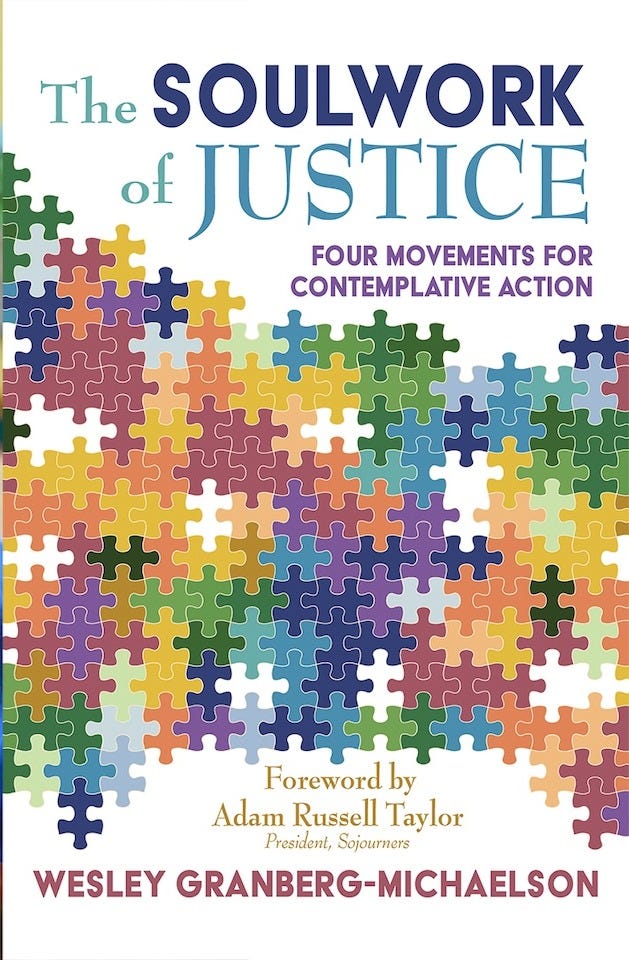
I wasn’t quite sure what to expect, to be honest. As a podcaster, I often have authors pitching me their books. Often, when promoted in this way, the books are fairly forgettable. Wesley Granberg-Michaelson’s certainly was not. And after reading about his career and the scope of his work, I felt a bit foolish, remembering my initial skepticism once I’d finished the book.
To be clear, Grandberg-Michaelson’s book isn’t life-changing in a flashy way. It’s something better than that: really, really solid. I’d absolutely recommend it—especially for Christians working in the social justice space, and frankly, it would work well as a church study book too.
The book explores four “movements,” as he calls them:
From self-sufficiency to belonging
From certainty to connection
From grandiosity to authenticity
From control to trust
In the final section, Grandberg-Michaelson closes with eight pieces of gathered wisdom that I found quite exceptional. I won’t share them here—for his sake, I’d like you to buy the book after all.
The final highlight I made really encapsulates the depth and richness of the book as a whole. Grandberg-Michaelson writes:
“It’s important to ask yourself, ‘Where is my anchorhold?’ This is another way of exploring whether you have a holding space that will serve and sustain you in the necessary soulwork of justice. That’s the primary question for you to face. So much that follows in your life will depend on your answer.”
That is hauntingly good.
He sets up this statement by sharing the history of an anchorhold—a small room attached to a church in the Middle Ages. Figures like Julian of Norwich, known for her “All shall be well” wisdom, lived in one.
What’s especially intriguing is that Julian wasn’t retreating into a kind of luxury spiritual escape during easygoing times—far from it. She lived amid plague, war, and famine. And yet, through all of this, she could say, “All shall be well, and all shall be well, and all manner of thing shall be well,” because her anchor held in God.
As Grandberg-Michaelson notes, she trusted that “all of life is permeated and upheld by the presence and breath of God.” This isn’t to suggest that we simply ignore evil or injustice. He goes on to say, “None of this minimizes the gravity of the threat to human flourishing and planetary sustainability… Your witness should always embrace and announce these threats.”
Still, I was especially struck by his discussion of control and the acceptance of death. Here, Grandberg-Michaelson highlights the importance of trust in God, “facilitated by an expanding view of God’s mysterious, pervasive, sustaining presence in all of creation, holding together all things, including the center and future of your life. That gift of trust is the only way to embrace this grace” (my emphasis).
I could share more, but to close, I’ll return to something he offers near the beginning of the book: “It’s imperative…to create the inward infrastructure to process, together, both the pain of life’s struggles and the grace of healing that can flow from them.”
I’m under no illusions that the future of America will magically burn brighter, regardless of the outcomes of elections in 2026 or beyond. For us to become a people—and a nation—more fully shaped by the love and justice of God, we’ll need to trust in God and ground ourselves in God’s grace, so that we’re ready to respond when God calls us to act. Grandberg-Michaelson writes with the wisdom of someone who has seen a thing or two.
I’m taking his advice.