


TL;DR
Hospital chaplaincy often reveals the end result of years of unresolved grief and trauma. Watching these stories unfold has shaped how I think about faith as well. When Christianity becomes little more than our best intentions or moral effort, it cannot carry the weight of human suffering. Like recovery in Alcoholics Anonymous, real healing begins with confession and surrender—acknowledging our limits and depending on the power of God rather than our own strength.
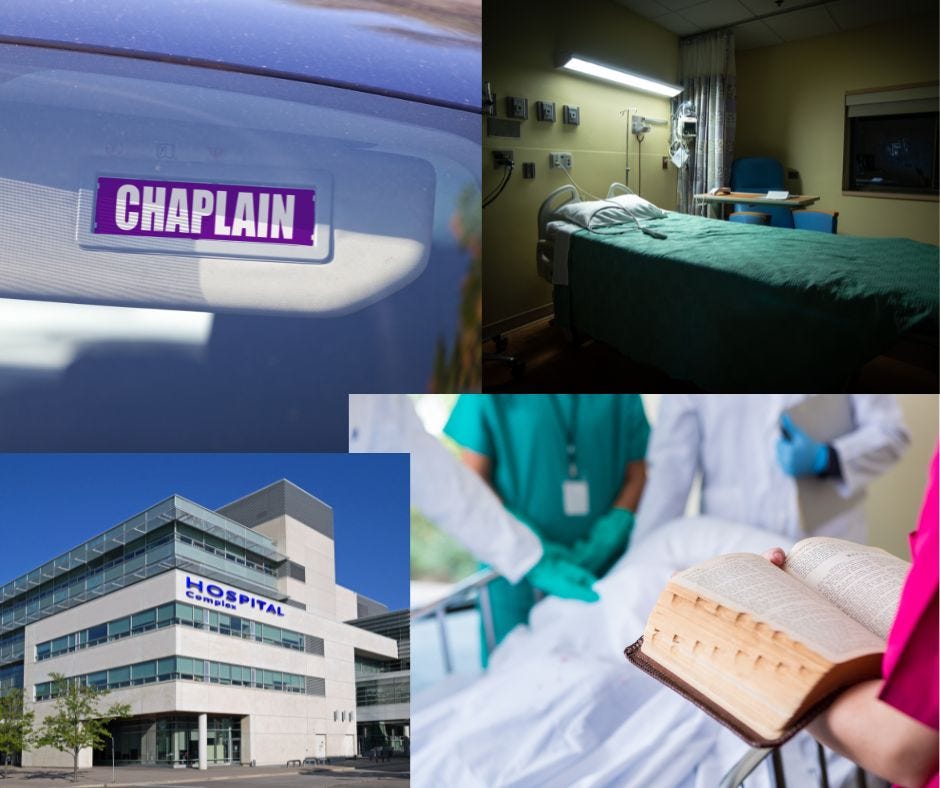
When Pain Goes Unexamined
The interesting thing about serving as a hospital chaplain is that I rarely see the beginning of a tragedy.
I usually see the end of it.
The ICU bed.
The machines.
The family gathering outside the room.
And almost always, when the story begins to unfold, you realize the crisis didn’t start here.
It started years earlier—with grief that was never faced, trauma that was never named, pain that was simply pushed aside until it became something far more destructive.
A dad who, isolated and alone during Covid, relents to addiction and ends up hooked up to machines in the ICU, awaiting death, leaving behind a wife and young daughter.
An older man, his siblings exasperated and exhausted as unexamined grief from the passing of his own parent decades ago cascades into an addiction that has made his life unsustainable.
A young man seeking to escape and outrun his own trauma through risk-taking and drugs, only to end up piling more trauma upon himself.
First, believe it when you hear people say men—and especially young men—are in trouble. I have more stories I could share.
Second, as I’ve said before, the hospital is often the end point of unresolved grief and trauma—the almost inevitable outcome when it isn’t dealt with but simply ignored.
And because of the way my mind works, for good or ill, I often wonder: when did this start? What was the unresolved grief or trauma that set this person on the path that led them here?
Once, a family member said it quite bluntly:
“This all started when his dad died. He’s been escalating and isolating ever since.”
For better or worse, that’s how my mind works. Seeing the end results of so much ignored pain and grief perhaps heightens my awareness of unintended consequences—or, said another way, leaves me somewhat obsessed with implications.
And that instinct doesn’t stop with the hospital. It shapes how I think about theology as well—especially the kinds of theology that try to carry the weight of the world without the resources the Gospel of Jesus actually provides.
I’ve written about it before, but I’ll say it again.
What has cooled me so much on so-called “Progressive” Christianity1 is that I’ve seen where it can end up: cynicism, mistrust, isolation, and a flattened view of divinity that reduces God to little more than a conglomeration of humanity’s best intentions.
But when sh*t hits the fan—or when a certain president unconscionably wins a second term—there’s not much left to do but fall into hopelessness, despair, and/or rage.2
After all, if Jesus is simply an example for us to follow, we have quite clearly failed to live up to his standards.
If the goal is simply to become more loving, as some might say, our nation seems to be descending further into anger and chaos.
If the Bible is merely a conversation partner, then clearly we must tell it what is what—because loving your neighbor and showing kindness to those who persecute you begins to sound quaint, old-fashioned, even irrelevant.
I don’t mean to say that every person who identifies as a “Progressive” Christian ends up bitter or despairing.
No—the message of the gospel is too powerful for that. Even in diluted form, it still transforms.
What I am saying is that, left to its own internal logic, this is where the trajectory of “Progressive” Christianity can lead: despondent, alone, exhausted.
It’s no wonder the Apostle Paul wrote, addressing those who doubted the resurrection of Jesus, that such people are “most miserable…having no hope in this world.”
Is it any wonder that those who reduce Jesus to a mere thought leader and the Bible to book club fodder can find themselves overwhelmed and exhausted when things don’t go as expected?3
This is where I say: thank God for the Bible. Within it we see testimony of God’s presence and participation in life even when things seem bleakest.
I think of Elijah and the still small voice when he believed he was defeated and alone. All his earthly efforts had failed him. He didn’t need a pep talk—he needed to be reminded of a living God. And he was.
Hospital beds are, in many ways, liminal spaces, as I’ve written about before.
They represent crossroads, where the addicted or broken must confront in real time their own inability to overcome their demons alone.
This past year in America, if I may be so bold, feels like a similar kind of acute-care moment for the health of our nation.
And yet many people—including many in our churches—seem convinced that doubling down on anger and effort will somehow fix things, as if trying harder or “fighting harder” will resolve the polarization and mistrust tearing us apart.
Sure—tell me how responding to gerrymandering with more gerrymandering will solve our problems.
But I digress.
Often when I speak with someone hospitalized after an overdose, they say the same things:
“This is a wake-up call.”
“I’m going to change some things in my life.”
Trying to be supportive, I encourage them to name who they can rely on for support, where they can find help, and what communities they can reconnect with—especially a church.
I rarely get to see the outcome.
I say rarely because I did once see a man again several months later who had made similar promises but had not implemented the changes he hoped for. Now, deeper in the grip of alcoholism and with his body further brutalized by it, the results were not pretty.
Let me close with this.
As I understand it, one of the key steps of Alcoholics Anonymous is confession and surrender—an acknowledgment that one is indeed an alcoholic and cannot defeat the addiction alone.
Recovery begins when someone stops pretending they can fix themselves.
“Progressive” Christianity, I believe, needs to come to a similar place of confession and surrender.
We cannot defeat all the evil and injustice in our world on our own. We cannot solve it through effort, outrage, or even our best intentions.
We must depend on the same power that raised Christ from the dead—the power revealed in Scripture and present with us through the Holy Spirit.
When Christianity becomes little more than our best intentions dressed up as “God,” it eventually collapses under the weight of reality.
But when we confess our limits and surrender to God’s power, something very different becomes possible.
Grace.
Renewal.
Hope.
And sometimes—like the first honest words spoken in a hospital room—the beginning of healing.
I’m putting “Progressive” Christianity in quotation marks because I’m trying to respond to fair critique that I am too imprecise as to what I mean when I say “Progressive” Christianity. I try to be more precise in this essay, being clear that the part of “Progressive” Christianity I seek to critique is theological not sociological. Specifically, efforts that seek to downplay the divinity of Christ, the power of the Scriptures, or the reality of a living God are what I label as “Progressive” Christianity.
This is not to say we should not “resist.” Rather, this is to change our perspective on what it means to resist. Is resistance about us, through our own ingenuity and efforts, righting all the wrongs? Or is this resistance, like Andrew Root says, a testimony and witness to the coming reality of the kingdom of God on earth?
This is not to say that exhaustion is a lack of faith, even Jesus took breaks. But, as I share about Elijah, exhaustion often confronts us with a choice—lean on our understanding, or to trust God.
Jesus could have taken over the Roman government, become Emperor and implemented the most perfect and Godly government possible if he wanted to. Instead he did as literally opposite from that as you can get, instructed us to do likewise, and pointed to self-sacrifice and love for our enemies as how to make "earth as it is in heaven."
The problem with "Progressive" Christianity isn't just the failure to let go and let God when times get rough. It's that they pursue and judge success by a measure--power over this world to enforce righteousness via law--that is literally the opposite of what Christ taught. It's not even the other side of the coin from Christian Nationalism. It's the same damned thing.
If someone in particular winning the Presidency makes you lose faith, then good, lose that faith, because it wasn't a faith worth having, and you were utterly missing the point of Christianity.
“Sure—tell me how responding to gerrymandering with more gerrymandering will solve our problems.
“But I digress.”
Know that I am trying to say this in the gentlest way I possibly can . . . I think you need to talk to some marginalized folks, people in the Black church tradition, people for whom elections have life-or-death consequences, like women who can be denied healthcare because of abortion bans, people who will lose their healthcare coverage, people who get racially profiled, people who say “I am a US citizen” and still get no due process, people who have literally lost 50-70 years of rights gained through much blood and tears. Our hope is not in a party or president, but we sure will do everything we can to limit harm, with or without the people whose lives will be relatively unchanged by the gerrymandering.