


TL;DR:
Jane McGonigal’s Imaginable highlights the power of imagination to shape the future, but it also reveals a deeper assumption: that human ingenuity alone can fix what’s broken. The last decade suggests otherwise. We don’t control the future—and we can’t save ourselves.
Speaking of books:
📖 Save 25% on my new book! Church as Community Hub: Sharing Spaces to Help Neighborhoods Thrive is now available for pre-order. Use promo code CHURCH25 at checkout to save 25% through July 31. Pre-order your copy
Imagination Isn’t Enough
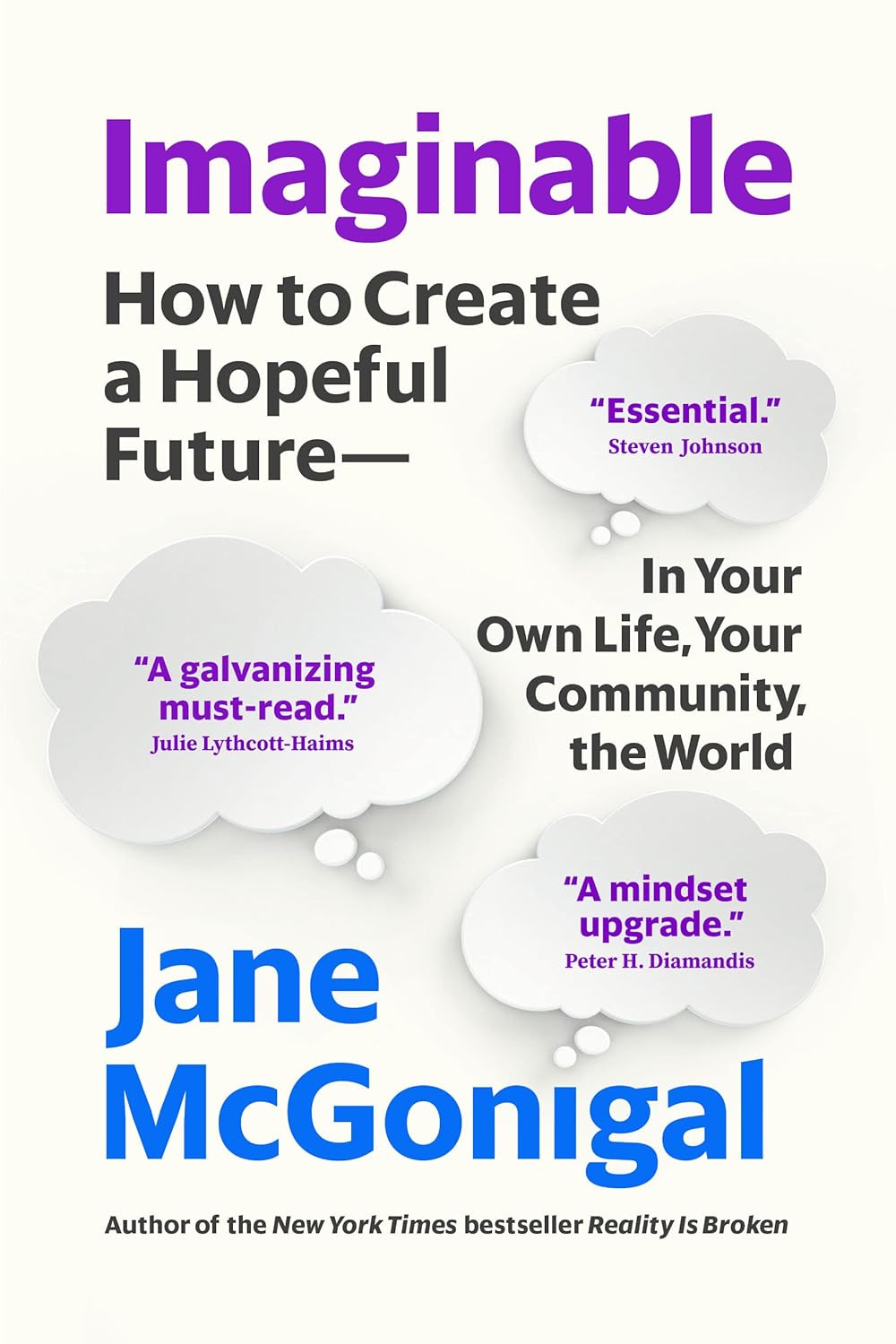
I just finished reading Imaginable: How to Create a Hopeful Future by Jane McGonigal. There’s a lot about the book I liked. Though not a religious book, McGonigal highlights the importance of imagination—something I think is certainly lacking in many churches and communities.
She smartly asserts that:
“Imagining literally anything you might experience in the far future, as vividly and realistically as you can, increases your motivation and likelihood of doing anything that has a longer-term benefit today” (35).
No doubt, imagination is integral to the life of any individual, community, or church. As McGonigal notes, feelings of stuckness and a lack of possibility can lead to depression and decline, whether for individuals or institutions.
She goes further, suggesting that by imagining a desired future, we can almost prophesy our own outcomes:
“If you want someone to believe that a future event is likely, you just have to ask them to imagine it happening, in as much vivid detail as possible” (138).
In the book, McGonigal spends a lot of time—too much time, in my opinion—walking through future-imagining scenarios. To some extent, I understand her point: imagining a better future can lead to different outcomes.
But a deeper theme kept surfacing for me throughout the book: the assumption that humans, through imagination and ingenuity, have the power to shape the future for good.
Now, to some extent, I agree.
But even though the book was published in 2023, it already feels dated—almost decades old.
McGonigal writes about imagining future scenarios to solve climate change, institute universal basic income, and achieve nuclear disarmament. Yet as I write this in March 2026—while my city is experiencing record-breaking temperatures, tax policy continues to shift in favor of the wealthy, and the United States is entering its fourth week of war in Iran—the book doesn’t feel a few years old. It feels like it belongs to a different era.
Imaginable was published in a particular cultural moment—one that, I suspect, historians will look back on closely. Coming out of a tumultuous Trump presidency, a global pandemic, and a national racial reckoning, the 2021 election felt, to many, like a return to normalcy. As if the disruption had been a blip, and we could now get back on track—and not just get back to normal, but continue shaping the future according to our ideals.
In that sense, McGonigal’s vision reads, at times, like the optimism of a certain kind of progressive imagination.
I don’t mean to be overly critical. I appreciated her broader points about imagination and ingenuity. Some of her exercises were genuinely engaging—I even wrote a recent post imagining how the church might change in ten years.
But in the end, what the book reflects is something deeper: a confidence that through human willpower and technological progress, we can ultimately fix what is broken in the world.
And that’s where I think it falls short.
Recently, for the Future Christian Podcast, I interviewed author and missiologist Todd Korpi about his book AI Goes to Church: Pastoral Wisdom for Artificial Intelligence. Wisdom is the word that kept coming to mind as I read McGonigal.
For as much as she looks toward the future, wisdom requires a deeper engagement with the past and a sober awareness of present realities. That grounding often feels absent in her book.
And I think that absence helps explain where we find ourselves today—on the brink of global conflict and potential economic instability. It’s not simply that leaders imagined a better future. It’s that they often lacked the wisdom to ask how those visions would impact the people already living in the present.
In many ways, the political moment we’re living through feels like a reaction against those kinds of future-oriented assumptions.
But even more fundamentally—and this is essential—Korpi writes:
“We can’t innovate our way out of the curse. We can only come to Jesus” (29).
Some might push back on Korpi’s theology. To be honest, I don’t always land cleanly on doctrines like original sin myself. But if anything, the last decade has made one thing increasingly clear:
Left to our own devices, we cannot fix things on our own.
As N.T. Wright notes, “part of the Christian story… is that human beings have been so damaged by evil that what the need is not simply better self-knowledge, or better social conditions, but help, and indeed rescue, from outside themselves” (Simply Christian, 22).
This isn’t meant to be a “throw up our hands and give up” kind of post, nor a call to disengage from the world.
It’s meant to be a grounding reminder.
We are not the authors of the future.
We cannot save ourselves.
We do not hold what comes next.
Only God does.
Ten ways church will be different in ten years.

TL;DR: Using a futures-thinking exercise, I sketch ten ways church might look very different in the next decade—from fewer buildings and more volunteer pastors to VR worship and shifting institutions.