


TL;DR: I read a lot of books, including far more than I have time to feature individually on the podcast or Substack. So I’m continuing with a monthly book roundup: a quick look at what I’m currently reading, what I’ve recently finished, and a few ideas from those books that have stuck with me.


What I’m Reading Right Now
Disciples and Theology: Understanding the Faith of a People in Covenant - Stephen V. Sprinkle
I’ve decided to do something fairly irregular for me—read from within my own theological tradition!
For those unaware, I am ordained within the Christian Church (Disciples of Christ), and I have been doing a LOT of reading of Wesleyan/Methodist theology of late, and I realized, I really don’t know the theology of my own tradition that well—hence the purchase.
I don’t have a lot to share about the book right now as I’m only a third of the way in and so far, it’s really more of a history of the Disciples movement with thoughts interspersed about theology.
But one observation has come to mind—reading so much theology from outside my own tradition has increasingly made my wonder if denominationally affiliated seminaries even like my own Phillips Seminary need to do a better job at teaching their students the theology of the tradition in which they exist.
For instance, if memory serves, I had to take a DOC History & Polity class in seminary, but I don’t recall an explicit Disciples theology class. My sense is that at most-all mainline seminaries, what one is getting is less Wesleyan or DOC theology and more a very generalized progressive theology. And I do wonder what that means for the future of our individual traditions. It’s long been obvious that Evangelicalism is melding into a sort of amalgamation, and I’ve increasingly become convinced the same thing is happening to the Mainline traditions as progressive Christian theology becomes the “de facto” theology.
I suppose in reading this book, I’m trying to do what I can to strengthen the tradition.
What I’ve Just Read
Last Stands: Why Men Fight When all is Lost - Michael Walsh
So… this was a book that I thought might be helpful for my current/next book project when I was doing some simple research at my local library. It was… interesting.
While I found the book somewhat engaging from a historical perspective—reading about historical battles and such, it was quite ideologically biased.
Among the quotes that made me squeamish:
“women (and feminized men) make poor political leaders in times of existential strife; their natural inclination to feminine virtues such as tolerance, as well as their innate sympathy for the stranger or the outsider, leads them to seek to understand their opponents rather than defeat them unconditionally and with all necessary force.”
And
“Talk rarely if ever settles anything. What it does do, though, is push the simmering resentments down into the emotions until they suddenly burst out, like a smoored fire that smolders and then catches flame once more.”
Obviously, Walsh has misogynistic tendencies. But more, as someone who wrote favorably of Christianity throughout the book, it seems he does not understand it whatsoever. To call virtues such as tolerance and sympathy for outsider “feminine” values reeks of a total misreading of Christianity. Has he never heard of the fruits of the Spirit? It’s quite troubling.
For those wondering why I finished the book, the historical nature was interesting to me, plus I do have this weird commitment that once I start a book I HAVE to finish it.
The Prodigal Prophet: Jonah and the Mystery of God’s Mercy - Tim Keller
At the same time I picked up the above book from the library holds section, I wandered over to the religion section and found this book.
Unfortunately, I didn’t read much of Keller when he was alive, but since his passing I’ve been increasingly intrigued by his works. While I still have a lot of points of disagreement with Keller, I have found him to be wise and thoughtful, including this book.
I’d also add this, which I posted as a note at got a lot of traction; I can understand why so many Evangelicals today are questioning the legacy of Keller—he has a lot to say about justice!
“When Christian believers care more for their own interests and security than for the good and salvation of other races and ethnicities, they are sinning like Jonah. If they value the economic and military flourishing of their country over the good of the human race and the furtherance of God’s work in the world, they are sinning like Jonah. Their identity is more rooted in their race and nationality than in being saved sinners and children of God. (104)”
“So preaching repentance is fundamental, but doing justice must be inseparably connected to it. This combination of doing justice and preaching judgment and therefore offering grace-goes together not only theologically and philosophically but also practically. (197)”
Might I also share this quote, which echoes a sentiment I’ve increasingly felt, sort of what my friend Dennis Sanders calls the “Democratic Party at Prayer” when Progressive Christianity seems almost lockstep in-line with the policy positions of the Democratic Party. And, to be fair, Dennis and I would both acknowledge Evangelicalism is guilty of this with the GOP.
“Another reason why Christians, especially today, cannot allow the church to be fully aligned with any particular party is the problem of “ethical package deals.” Many political parties today insist that members commit to all the proper positions on all issues. (167)”
Finally, in a quote that challenges me and my preaching:
“First, we must not think it really possible to transcend politics and simply preach the gospel. Those Christians who try to avoid all political discussions and engagement are essentially casting a vote for the social status quo. (163)”
Compassion: Living in the Spirit of St. Francis - Ilia Delio
I’ve read only one book of Delio, The Unbearable Wholeness of Being: God, Evolution, and the Power of Love, but as I work at a Catholic hospital with a Catholic mission director, it suddenly came to mind that my boss might have some Delio books I could borrow—and was in luck!
I can’t remember the exact wording used, but he mentioned that St. Anthony North and the CommonSpirit hospital system has a Franciscan heritage. That makes the connection to Ilia Delio understandable. Delio is a Franciscan sister and St. Anthony’s history is rooted in the Sisters of St. Francis.
Delio is quite brilliant and while this book was meant to be more accessible, little glimpses of her brilliance inevitably break through, especially her thoughts on “poverty”:
“Poverty and humility are the pillars of compassion. When we do not possess but live in openness to and dependent on one another, we live with a capacity for compassion. (44)”
“The sin of refusing our poverty is injustice. Our need to accumulate and possess everything can separate us from other people and the natural world, and we lord it over others through domination and power. (37)”
And especially this one…
“In our refusal to accept the poverty of our humanity, we may end up destroying ourselves… To live in receptivity to the gift of God’s goodness in creation is to live as a poor person, open to and dependent on the good of the human person, the good of the earth, and the good of the cosmos. (36)”
My Disability is Divine: A Joyful Witness that Defies Ableist Nonsense - Amy Kenny
This was a book I somewhat struggled with. While I appreciated Amy Kenny’s wisdom and perspectives in My Disability Is Divine, particularly her critique of ableism and the assumptions people make about those with disabilities. At times, however, I found her tone somewhat dismissive of those who might see things differently.
I was particularly struck by the tension between her admonition to “not be a jerk” near the end of the book and her description of responding to strangers who offer prayer by asking God to heal their ableism.
While I understand her frustration with unsolicited help, it seems that in challenging others’ assumptions about her, she risks making equally uncharitable assumptions about them. This struck me as particularly ironic given her own warning against dismissing those who practice their faith differently.
A Spacious Life: Trading Hustle and Hurry for the Goodness of God - Ashley Hales
I found a lot of wisdom within this book, especially around freedom and constraints. In fact, I think in the last version of this email, I shared that I had been reading a book on how constraints make us better, so Hales’ thoughts here were well-appreciated:
“We think guardrails restrict our freedom. When freedom is freedom from constraints, we live in a world we control yet we find ourselves caged by the things we chase. (112)”
“Freedom isn’t stuffing more on your calendar to feel good enough. We’ll find freedom-not in the absence of constraints but in the presence of loving ones. (59)”
“Freedom is not simply freedom from constraints but for something—for love. (8)”
A simple way I’ve heard this explained is that as Christians we are not so much free “from,” but free “for,” meaning, like Hales says, in Christ, we find freedom from sin and death not simply so we can live our best lives now but rather so that we can be free to love and serve others.
Hales’ point about the busyness of the calendar is especially intriguing, as for some years now, the marker of status has been “busyness.” Recently, I heard on the Hidden Brain podcast that the new marker might be lack of sleep. In other words, “I’m so important I only have time to sleep 6 hours a night.” Yikes!
Take advice from Hales and trade that hustle and hurry for the goodness of God!
Seculosity: How Career, Parenting, Technology, Food, Politics, and Romance Became our New Religion, and What to do about it - David Zahl
Last but certainly not least, this book by Dave Zahl, which reminded me so much of a book I shared in the September version of this email, Work Pray Code by Carolyn Chen. Zahl’s book here is the more accessible, practical version with a very similar thinking, and which I might also add, echoes what Christian Smith wrote about in his book Why Religion Went Obsolete. The short of it is this—increasingly, Americans have made a “religion” out of many other things.
From the introduction, Zahl has a few especially important thoughts worth highlighting:
“Perhaps a more helpful definition of religion comes from writer David Dark. He calls it “a controlling story” or “the question of how we dispose our energies, how we see fit to organize our own lives and, in many cases, the lives of others… religion is not merely that which explains the inexplicable but the lens through which you sort the data of your days, rank your priorities, and focus your desires… A person’s religion is shorthand for the shape that lens takes—namely, the specific ways it refracts what we see and directs our longings.”
And
“Our religion is that which we rely on not just for meaning or hope but enoughness. And finally, The objects of our seculosity-food, romance, education, children, technology, and so on-aren’t somehow bad. Quite the opposite-they are by and large great. It’s only when we lean on these things for enoughness, when we co-opt them for our self-justification or make them into arbiters of salvation itself, that they turn toxic.”
Recently, I was at an employee appreciation banquet with my wife for her job. She is a manager and regularly rubs elbows with some of the C-suite, so inevitably I found myself in the middle of a conversation about everyone’s travel plans. The mantra or “rule of life (my words) of “work hard/play hard” was of course shared. I decided to buck the trend and talk about how we were in the early stages of planning a pilgrimage in Europe (very early stages). I wanted to hint that there was another way of living.
Zahl also offers this thought, that “Our religion is that which we rely on not just for meaning or hope but enoughness.” And I just can’t help but wonder, does “work hard/play hard” really offer enoughness? Or is it simply, as Steve Cuss might say, “try harder.” There is no gospel within, and I think that’s the point of what Zahl is trying to say. It’s not that work or sports is bad, it’s just that they offer no relief, it is only “try harder,” with maybe a week off here or there.
And Last but not Least..!
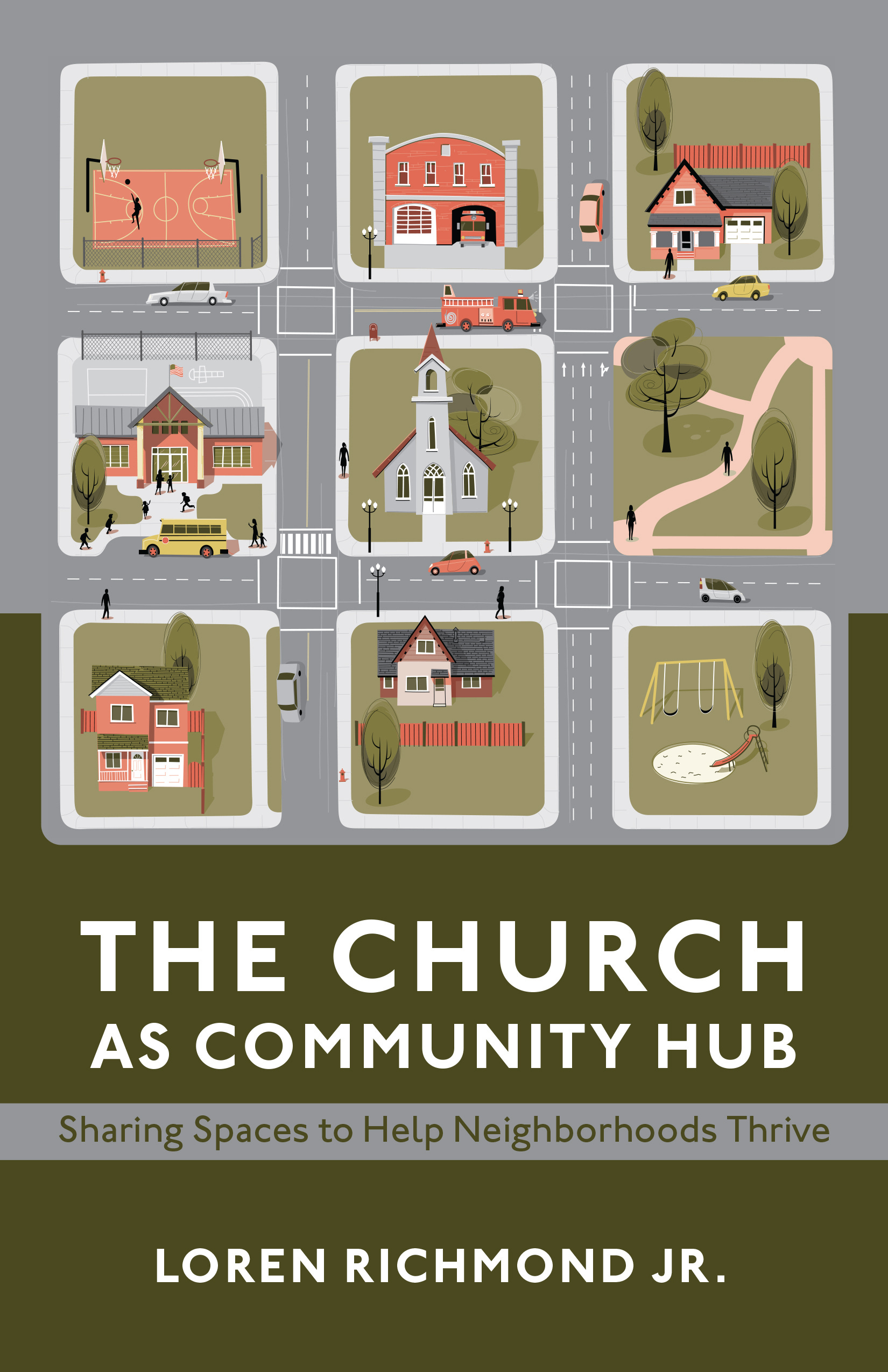
Have you read The Church as Community Hub?
If so, would you consider leaving a brief review on Amazon, Goodreads, or wherever you purchased it?
Even a sentence or two helps other church leaders discover the book and decide whether it might be useful for their congregation.
My publisher and myself thank you!
Thank you for reading—and for helping spread the word!