


TL;DR / Executive Summary:
After reading The Church Must Grow or Perish and talking with authors Mark Mulder and Gerardo Martí, I’ve been reflecting on the legacy of Robert Schuller. The authors let the story speak for itself, but I came away convinced: Schuller was prophetically right in diagnosing the American church’s decline—but his solution had unintended consequences. This post explores what Schuller got right, where it went wrong, and how his legacy still shapes church life today.
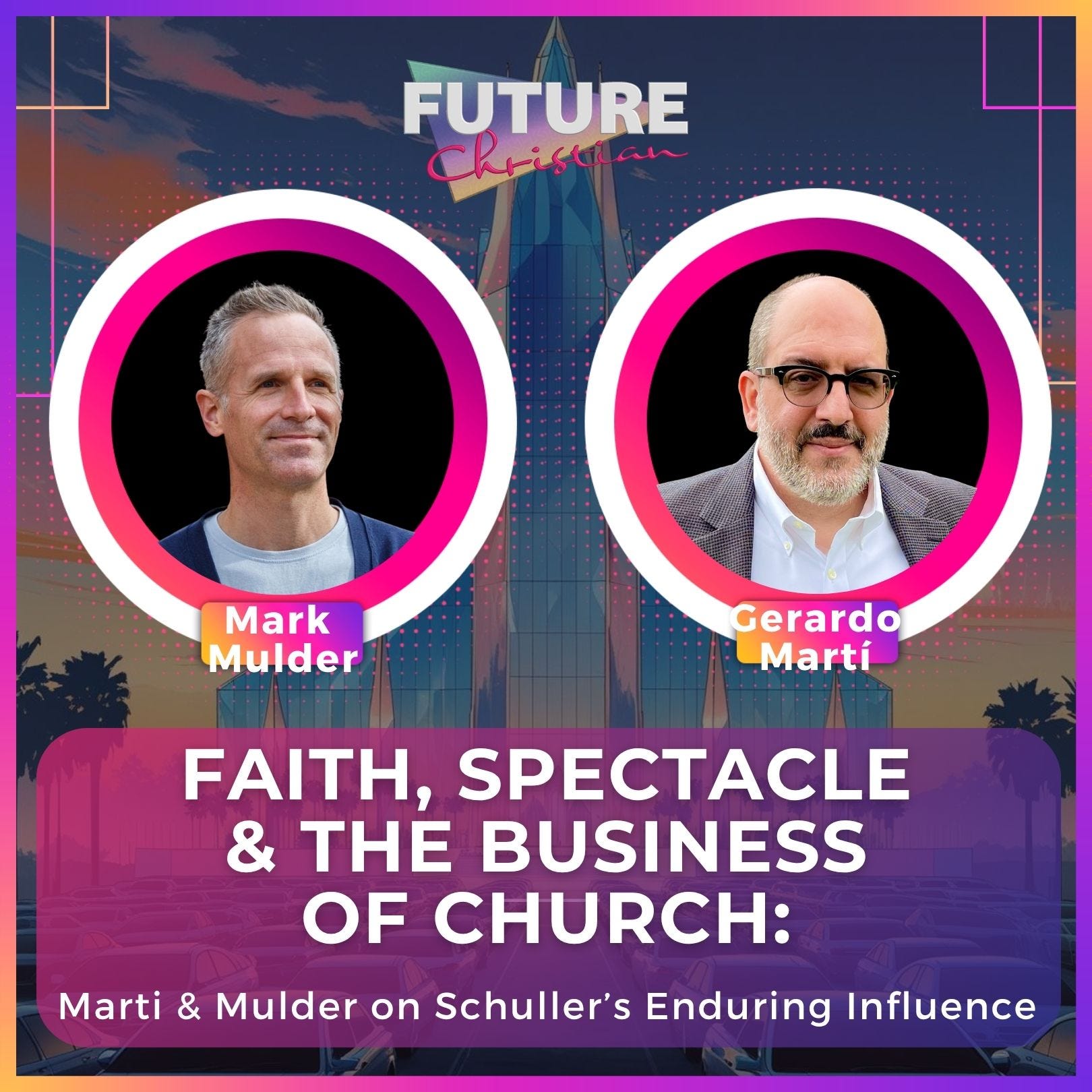
After I finished The Church Must Grow or Perish by Mark Mulder and Gerardo Martí, I couldn’t help but think about legacy. Robert Schuller’s, of course—but also the legacy of the Church Growth Movement, modern-day Evangelicalism, and of how we define ministry success.
Mulder and Martí don’t force conclusions. They wanted to let their work speak for itself. But even still, in our podcast conversation, they offered some compelling observations that stuck with me.
Schuller Was More Influential Than We Realize
“We really felt like Schuller’s influence was being underestimated.”
— Mark Mulder
Mulder reminded me that pastors like Rick Warren and Bill Hybels were direct disciples of Schuller. Both attended his Leadership Institute, with Hybels even flying out monthly and modeling his own conferences after Schuller’s approach.
“He intuitively understood change was happening. You could not ignore it.”
— Gerardo Martí
Schuller saw early on that the old denominational models were fading. So he innovated—ditching denominational language, preaching from a drive-in movie theater, and merging positive thinking with Protestant theology.
Right Diagnosis, But a Flawed Solution
Again, Mulder and Martí resist drawing sharp conclusions. They approach Schuller’s story with empathy and nuance. But as I read their book—and as I listened to them recount how his ministry rose and eventually unraveled—I came to a clear conviction of my own: Schuller’s solution had unintended consequences. The aphorism “the cure must not be worse than the disease,” comes to mind here.
“He adopted what he considered to be the best practices of Christian businessmen.”
— Gerardo Martí
Schuller saw the cracks in traditional church models and rightly understood the need to innovate. But his method—constant expansion, ever-larger buildings, borrowing for the sake of growth—relied too heavily on spectacle and unchecked optimism.
“Eventually the debt and the building projects caught up. It was visionary, but also unsustainable.”
— Mark Mulder
He believed the church should grow like a business, with growth itself as proof of effectiveness. But that logic has limits, especially in ministry. The more I sat with his story, the more I saw a warning—one we still haven’t fully heeded.
Resonance in a World of Acceleration
One of the most insightful parts of the book (and our conversation) was their use of sociologist Hartmut Rosa’s concept of resonance—the idea that in a fast-paced, accelerating world, what people long for is deep, meaningful connection.
“Acceleration is the problem; resonance is the solution.”
— Gerardo Martí
Schuller may not have known Rosa, but Martí argues he intuitively understood the concept. Schuller believed his cathedral, with its stunning glass walls and natural light, could create that kind of resonance. And perhaps it did. It’s also striking that the Crystal Cathedral continues to host millions of people a year in worship, thanks in-part to the significant decision of Schuller’s family to sell the campus to the Catholic diocese.
A Complicated But Enduring Legacy
“He believed in what he was doing. He took out personal loans to keep the ministry afloat.”
— Mark Mulder
What stood out to me reading the book, and the authors confirmed this in my conversation with them, was that Schuller wasn’t a prosperity gospel huckster. Everyone Mulder and Martí interviewed—even those who worked closely with him—spoke of him with warmth and affection. He had flaws, no doubt, but he was sincere. And he left behind something that still matters.
Today, the former Crystal Cathedral is home to a thriving Roman Catholic diocese serving Vietnamese and Latino communities. “It’s not what Schuller envisioned,” Martí admitted, “but it’s still what he would have wanted—it remained a church.”
Final Thoughts
I myself continue to wonder and wrestle with Schuller’s legacy. Perhaps because of his willingness and ability to reshape or retell the Christian message in a whole new way, his work and ministry reached countless numbers of people. His intuition and cultural sensitivities were spot on—yet I can’t help but wonder, was he aware of the consequences?
And, perhaps beyond Christianity, Schuller’s legacy and story makes me wonder about the lasting impact of growth-driven capitalism, the philosophy that undergirded Schuller’s efforts. There is still so much to consider.