


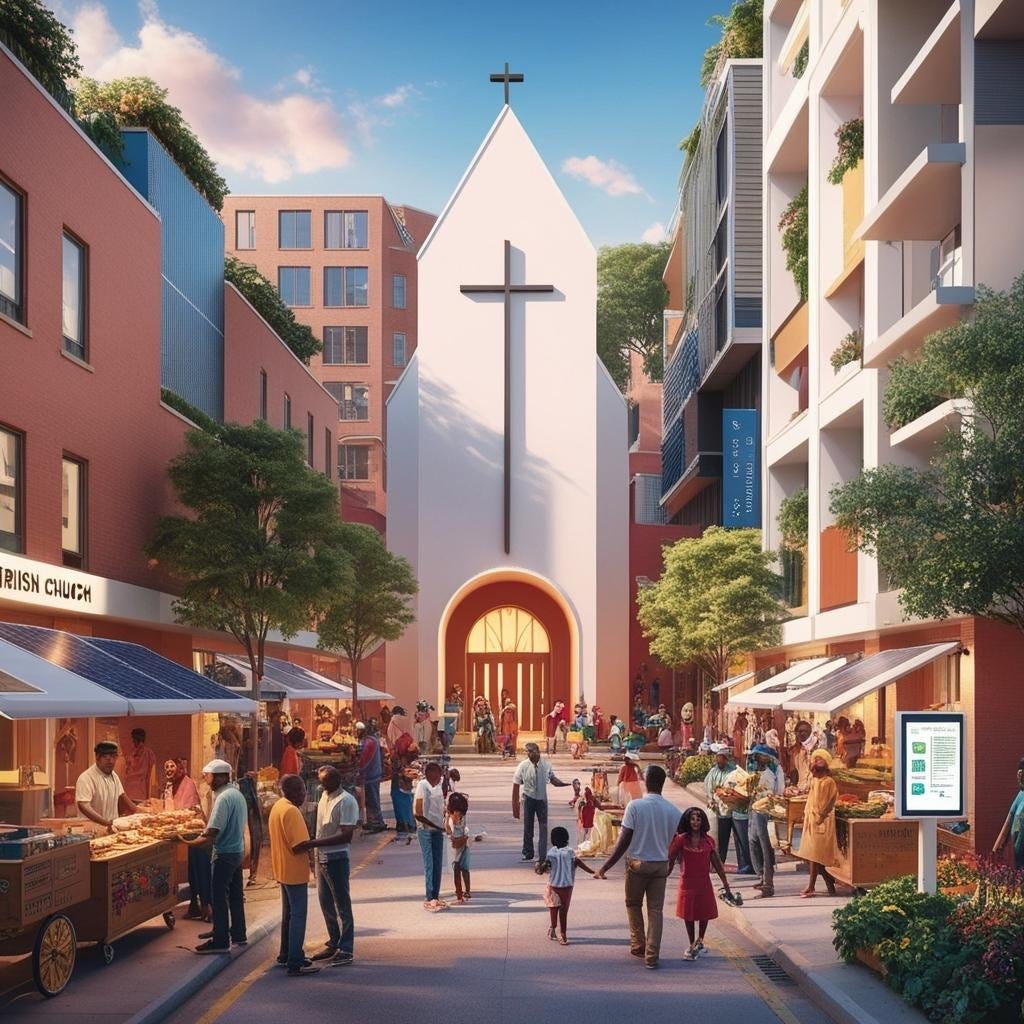
We are, in many ways, at a crossroads—deciding not just what the church believes, but how it organizes itself socially and structurally. What will be the dominant sociological models for churches in the decades ahead?
From State Churches to Voluntary Associations
For much of American history, churches functioned as “voluntary associations,” as scholars like Ted Smith and Scott Thumma have described. Before that, churches in the West were essentially local representatives of the state church. In the American context, this shift began in earnest after the Revolutionary War, which catalyzed the disestablishment of state-sponsored churches. But the groundwork was laid even earlier by figures like Roger Williams, who in the 17th century founded Rhode Island as a haven for religious liberty and called for a strict separation between church and state. This vision of religious pluralism helped pave the way for a uniquely American model of church life—where congregations would no longer depend on government endorsement or tax support, but on the voluntary commitment of their members.
As documented by the Faith Communities Today (FACT) survey, the average U.S. congregation near the end of the 20th century had around 150 people in weekly attendance. That was, for many, the assumed and sustainable model.
Today, that number has effectively been cut in half. The median weekly attendance is closer to 65. Multiple trends make sustaining mid-sized churches harder: fewer giving units, younger generations with less disposable income, families having fewer children, and in many cases, both parents working—creating less margin for consistent church engagement.
The Rise of the Megachurch and the Microchurch
The early 2000s marked a surge in the megachurch model, with churches like Flatirons Community Church and Red Rocks Church (both in the Denver metro) experiencing massive growth. The megachurch, and its more recent cousin the multi-site church, continues to thrive in many places due to economies of scale, specialized staffing, and strong branding. These churches often operate on business principles and function like mini-denominations—especially when networks like Life.Church expand across states and even time zones.
Yet another model that has persisted—and in some ways is being re-appreciated—is the microchurch. I'm curious to read The Strategically Small Church from Baker Books, though I suspect its insights will confirm what I’ve already seen firsthand. In 2024, I preached several times at a church of 10–15 people. It’s been that size for at least a decade, likely two. Lay-led, operating with part-time clergy, and financially stable due to a paid-off building, it functions faithfully. While I once dismissed such congregations, I now see—through the faithful ministry of a friend—that even the smallest churches can embody vital and vibrant discipleship. That church recently celebrated a baptism. How many larger, mainline congregations can say the same?
The Emerging Influence of… Influencers?
Beyond the mega- and micro-churches, another organizing principle is emerging: the influencer-led church. In my podcast conversation with Scott Thumma, he noted that the next wave may be highly individualistic—driven by personalities more than place. He’s probably right.
We’re already seeing elements of this in practice. Some megachurches have grown significantly through the personal charisma and national visibility of individual leaders—figures like Steven Furtick (Elevation Church) or Derwin Gray (Transformation Church). While they aren’t social media influencers in the typical sense, their personal appeal and online presence have played a major role in expanding their churches. In many ways, the church becomes closely tied to the identity of its leader, functioning almost like a personality-driven brand.
At the same time, there’s a growing category of “pastor-influencers” whose primary platforms aren’t pulpits, but social media feeds, YouTube channels, and podcasts. These figures often don’t lead traditional congregations, yet they hold spiritual authority for large, loosely connected audiences. My recent podcast guest, Bethany Peerbolte, is an example—using TikTok and other platforms to teach theology and offer pastoral insight to those who may never step foot in a physical church. Similarly, The Liturgists built online spiritual communities that occasionally translated into in-person events or gatherings.
While the engagement they foster is often more fragmented than embodied discipleship, it nonetheless shapes belief, identity, and spiritual imagination—particularly for those disillusioned with institutional religion but still spiritually hungry. Still, I do wonder: do clicks and digital engagement translate into real discipleship or lasting spiritual growth? These platforms meet a need, but formation requires more than content—it requires community.
A Forgotten Yet Faithful Model: The Parish Church
But while the megachurch and microchurch offer viable options, and the influencer-driven movement continues to grow, I believe there’s yet another model worth recovering—one deeply faithful, profoundly biblical, and increasingly promising: the parish church.
A recent episode of This Great and Complicated Place illustrated what this might look like quite well. The episode chronicled how churches can move from being commuter-driven institutions to becoming deeply rooted presences—seeing their buildings not merely as venues for Sunday worship, but as “anchors meant to foster the well-being of their communities.” Ryan VerWys of ICCF spoke of a church that approached his housing organization and said, “If we brought the resources, what kind of ministry could be done here?”—a clear sign of a shift from ownership to stewardship. Dave Cresta, who studied 400 churches, noted that only 21% reported being focused on their immediate neighborhood; the majority were either dispersed or non-geographically engaged, reflecting a wider trend of “place-agnostic” ministry.
Willie Jennings put it plainly: “Christians don’t really have a doctrine of creation… we don’t think too much about where we are,” leading to a theology where “anywhere is fine, which means nowhere is crucial.” But this episode offers another vision—churches embracing the prophetic call of Jeremiah to “build houses and plant gardens,” to seek the peace of the city where they are planted, because “your flourishing is bound up in the flourishing of your neighborhood.” This is the heart of the parish church model: presence over programming, rootedness over relevance, place-making over placelessness.
Local Presence, Lasting Impact
This vision of the parish church becomes concrete when churches begin to ask not just what do we need from this building? but what does our neighborhood need from this space? In Grand Rapids, a church partnered with ICCF to co-locate its ministry alongside affordable housing services, sharing a lobby with residents, housing counselors, and staff. “The church doesn’t have to do all the things,” VerWys explained, “but it can be a key partner,” especially when it sees its property not as an asset to protect, but as “God’s stuff” to steward for kingdom impact.
Elsewhere, a suburban church began learning about the housing crisis when families from a nearby motel came to their door in need. That congregation eventually offered up part of their land for affordable housing, helping create a “gleaning model” where market-rate homes help subsidize low-income units. These are not abstract ideas. These are churches living out incarnational presence. Whether by hosting nonprofits, starting food pantries, or opening their buildings to neighborhood use, the parish church asks: What does faithfulness to this place look like?
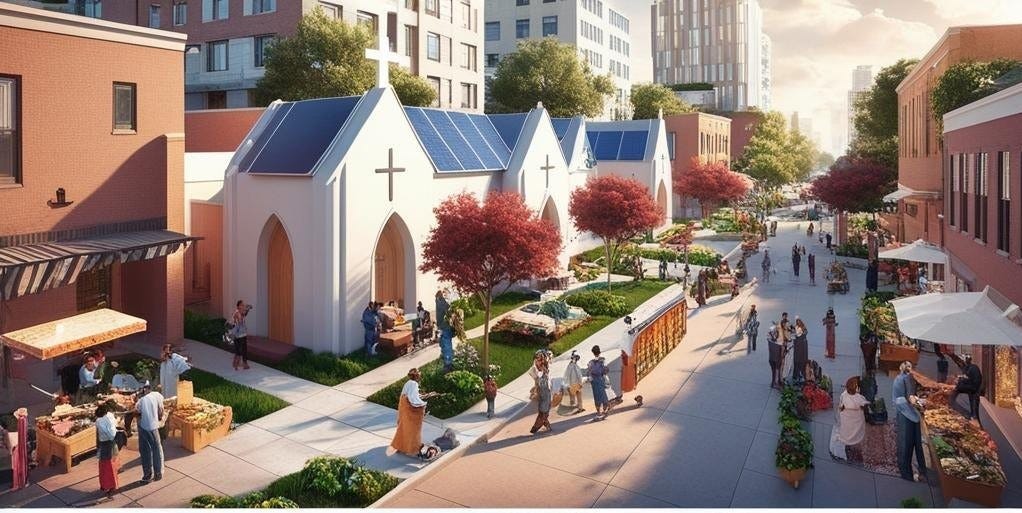
From Vision to Practice: Partnering with Churches Through Abundant Ground
This is exactly the kind of work I’m passionate about—and why I’ve partnered with Abundant Ground, a nonprofit initiative helping churches reimagine their land and buildings as catalysts for neighborhood renewal. Through discernment resources, technical support, and strategic partnerships, Abundant Ground walks alongside congregations exploring how to turn underutilized property into deeply needed housing and community-serving space.
I believe churches already possess much of what their communities need—space, presence, and a willingness to serve. What’s often missing is a roadmap. My hope is to help fill that gap: to offer tools, stories, and support that empower churches to become rooted, responsive, and resilient in the neighborhoods they’re called to bless. Whether through developing affordable housing, hosting local nonprofits, or simply becoming a more intentional neighbor, every congregation can take a step toward this parish vision. And I’d love to help them get there.
A Third Way Forward
In an era where the dominant ministry models often swing between the attractional spectacle of the megachurch and the minimalist intimacy of the microchurch, the parish church offers a third way—quietly radical in its localness, its staying power, and its commitment to neighbor over niche. It doesn’t require a stadium-sized budget or a house-church reinvention. What it does require is presence: a willingness to stay, to notice, and to serve.
As zoning debates rage, housing insecurity grows, and communal trust erodes, the parish church can become a credible witness—not through branding or programs, but through deep, consistent investment in the flourishing of its neighborhood. This is not a strategy of survival, but a vocation of faithfulness. It’s time for more churches to recover this ancient and enduring vision: to see their buildings as shared spaces, their land as holy ground, and their neighborhoods not as mission fields to fix, but as communities to belong to and bless.
Perhaps the future of the church isn’t somewhere out there—but right outside our doors.
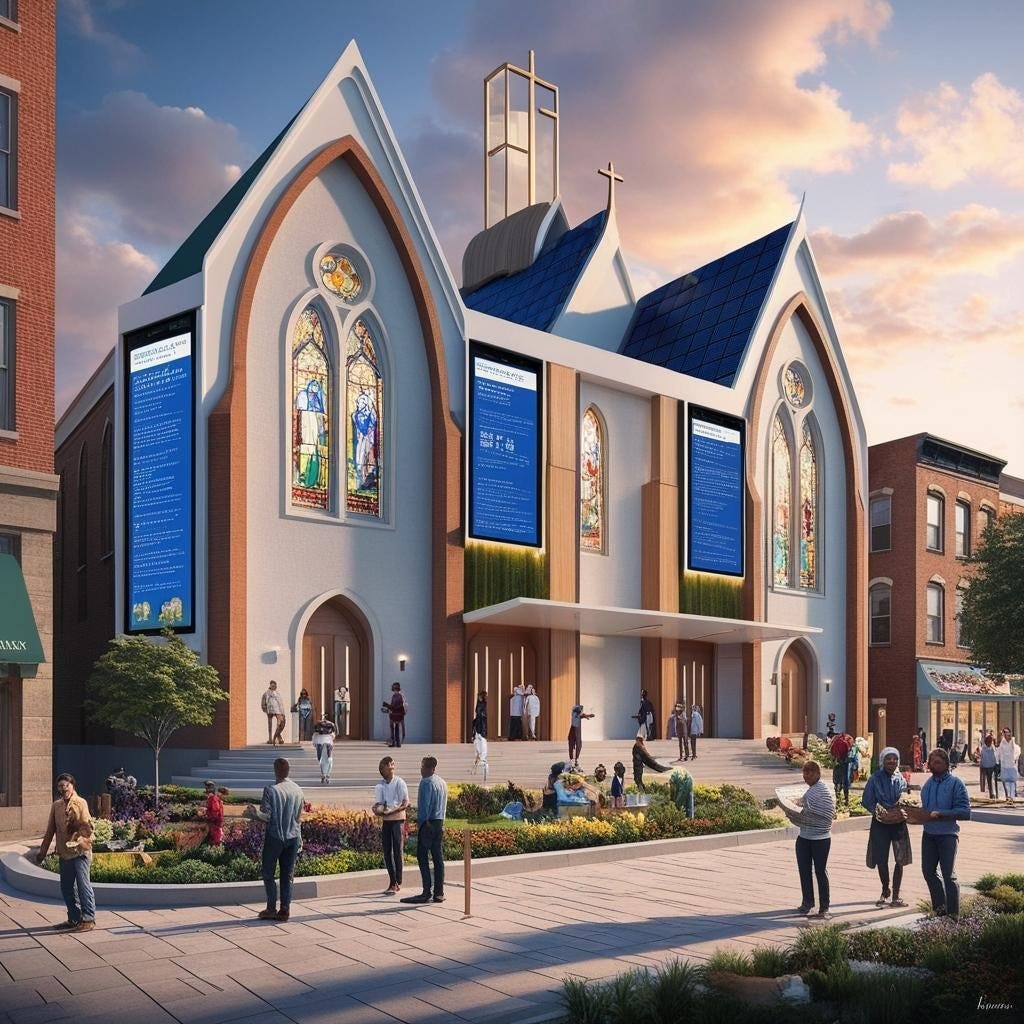
Ironically perhaps, this is a major tenet of the digital church I pastor. It was planted with the goal of providing a parish for the digital natives... not another 'connecting point' with a local church. We intentionally built to not be an extension ministry, but a thoughtful parish online.
What would happen if several people who followed different Christian "influencers" met each other through, say, their children's soccer games or in the workplace, and started discussing what they've been learning on their own. It's not necessarily a permanent community, but it certainly could form into a type of Christian fellowship that approximates "church."