


TL;DR:
I picked up Critical Dilemma expecting a predictable culture-war critique of critical theory and was surprised by how careful and nuanced much of it initially felt. The authors offer a serious treatment of CCT and rightly acknowledge racism and injustice, but in my view they ultimately become too dismissive of critical studies altogether. While I share concerns about works-based moral frameworks and ideology becoming totalizing, I still think critical studies have something valuable to offer—especially in helping diagnose injustice—even if they cannot ultimately provide the redemption or new life offered in the gospel.
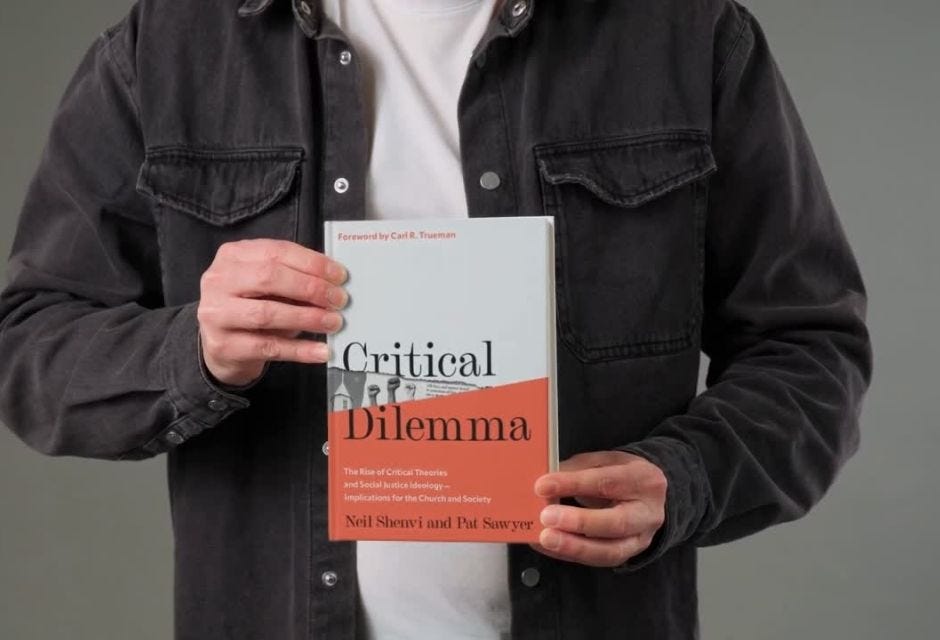
What happens when a book on the unreasonableness of Critical Theory becomes itself, quite unreasonable?
As I shared in a recent post, I came across an intriguing title at my local library in the usually disappointing Religion and Christianity section.
Titled Critical Dilemma: The Rise of Critical Theories and Social Justice Ideology—Implications for the Church and Society by Neil Shenvi and Pat Sawyer, I began the book with some measure of suspicion, especially given the publisher being Harvest Apologetics—a publishing house that certainly sounded conservative-coded.
Early on, I was actually quite impressed.
What I found was what felt like a very honest and accurate assessment of various forms of what the authors call “contemporary critical theory” (CCT): critical race theory, queer theory, and related schools of thought. At times, I was unsure whether they were even proponents of these ideas, based on how carefully and sympathetically they explained them. More than that, I found myself understanding these theories in greater detail than I had before.
Now, before I get too deep into critique, I want to acknowledge a few things.
First, I do think Shenvi and Sawyer make a genuine good-faith effort to describe these theories fairly.
Second, as much as I expected a culture-war diatribe, this was anything but—at least at first.
And finally, they rightly acknowledge the reality of injustice in America, writing:
“Real social injustices do exist. Racism does exist. Sexism does exist. Actual oppression does exist” (19).
And again:
“Too few Americans are sufficiently acquainted with America’s racist history. For those of us who are citizens of the United States, our nation has been marked and marred by the scourge of racism” (42).
I could share several more examples.
But beyond that, the book falls short in a few fairly obvious ways.
First: Less is More Sometimes
Simply put—it’s too long.
As an avid reader, I can often tell when a book begins to run out of gas, so to speak. It’s something I worry about in my own writing and forthcoming book.
This book clocks in at nearly 500 pages and, as much as I appreciated the detail, by the end it became exhausting. I genuinely think a hundred pages could have been trimmed without sacrificing much.
The authors clearly know their material.
But knowing your material and sustaining reader momentum are not always the same thing.
Second: Throwing the Baby Out With the Bathwater
My deeper concern, however, is that Shenvi and Sawyer become almost too suspicious of CCT—as though it is essentially unredeemable.
I’m not convinced.
Ironically, I think they do a good job naming what concerns me most.
They describe a kind of works-based moral framework in which:
“White privilege is [the] original sin; it has stained [every] White person. It has corrupted… every thought and action and cannot be avoided. Yet [white people] can achieve a ‘clear conscience’ by trying [their] best to disrupt… oppressive behavior, to apologize to people of color, and to ‘do the work’ of unlearning… whiteness” (357).
I hope to write more about this broader dynamic later, but for now I’m reminded of a point made in Disabling Leadership by Draper, Michel, and Mae.1
They write:
“We do not fear or demonize critical studies, nor do we end in deconstruction alone, but rather we use critical studies to help us describe the kingdoms of this world that will fall before the kingdom of God” (20).
And further:
“critical studies alone does not sow the seeds of new life” (19).
That distinction strikes me as exactly right.
Where critical studies can fall short—and where Draper, Michel, and Mae are helpful—is not necessarily in diagnosing injustice but in offering a compelling path toward redemption.
And this is where I think Shenvi and Sawyer overcorrect.
Rather than critically engaging and selectively receiving what may be true or useful, they sometimes seem to proverbially throw the baby out with the bathwater.
I don’t think critical studies are always wrong in their diagnoses of injustice. Rather, like Draper, Michel, and Mae suggest, they may struggle to offer redemption beyond forms of moral labor or works-based righteousness.
That, I believe, stands at odds with the gospel.
But even then, I still think there are things to learn from critical studies—provided they do not become our totalizing ideology.2
Third: The Problem of Voice
A third critique.
The authors spend considerable time critiquing critical race theory and Black Christian leaders aligned with aspects of it.
Now, I understand their critique of “lived experience” and agree that truth ought to be identifiable regardless of one’s skin color—those are my words, not theirs.
Regarding lived experience, they lament how it has trumped:
“even… pastors seeking to apply the Bible’s teachings to social issues” (294).
Fair enough.
But even still, I found myself struggling with something.
All this critique of critical race theory and Black Christian leaders is still coming primarily from a white man and a half-white/half-Indian man (Shenvi describes himself this way).
And honestly?
By the end, it just started to feel a bit…icky.
Maybe I’m too shaped by the very critical studies they critique and the prioritization of lived experience.
Maybe.
But I still think that section would have landed far better had portions been written—or at least substantially informed—by African American scholars or pastors.3
Finally: It Goes Off the Rails
And perhaps most disappointingly, the book simply seemed to lose its footing by the end.
On page 405, the authors write:
“Therefore, we urge our egalitarian brothers and sisters in Christ to recognize and reject the underlying assumptions of queer theory. If they don’t, it will be difficult to put the genie back in the bottle.”
I read widely across the Christian tradition and honestly cannot remember seeing egalitarianism correlated so directly with queer theory.
I can only imagine the eye rolls from someone like Sheila Wray Gregoire, who has advocated for egalitarianism from a deeply orthodox Christian perspective for years.
But I digress.
That was my last highlight before I largely skimmed the rest.
By that point, the book stopped feeling insightful and started becoming the sort of culture-war argument I had worried it might be from the beginning.
Final Thought
I’m not looking for critical studies to be the gospel.
But neither am I willing to say they have nothing to offer altogether.
In fact, what this book has helped me realize is that my own questions are becoming more specific.
If critical studies can help diagnose injustice, where exactly do they fall short?
What happens when critique becomes an identity or ideology unto itself?
And perhaps most importantly, what does redemption look like once deconstruction has done its work?
I hope to explore those questions in some follow-up posts.
I also thought the authors unfairly critiqued other writings of Andrew Draper which was sympathetic to CCT. I’ve had Draper on Future Christian and thought he was quite nuanced and wise around the topic.
I’m working on follow-up article on this topic…
Surely they could have utilized the work of someone like George Yancey, who has written extensively about the limits of anti-racism, for instance. I only saw him footnoted once. Maybe I missed others.
I think it was the Quaker theologian D. Elton Trueblood who said "If you can't write a book under 125 pages, then you haven't thought deeply enough about your subject." Then again, Mark Twain may have said it better: "I've written you a long letter because I did not have the time to write you a short one." :-)