


TL;DR:
Hungry for Hope contains moments of insight, but much of the book replaces Christian theology with progressive ideology. Scripture, resurrection hope, moral formation, and the active presence of God are repeatedly sidelined, leaving a version of Christianity that struggles to offer real hope—or a compelling reason for the church to exist at all.
Author’s Note:
As I write this blog, my head is spinning in shock and horror in the wake of the egregious killing of Alex Pretti in Minneapolis. What reads below is actually a toned down version of a previous draft as my rage was spilling over.
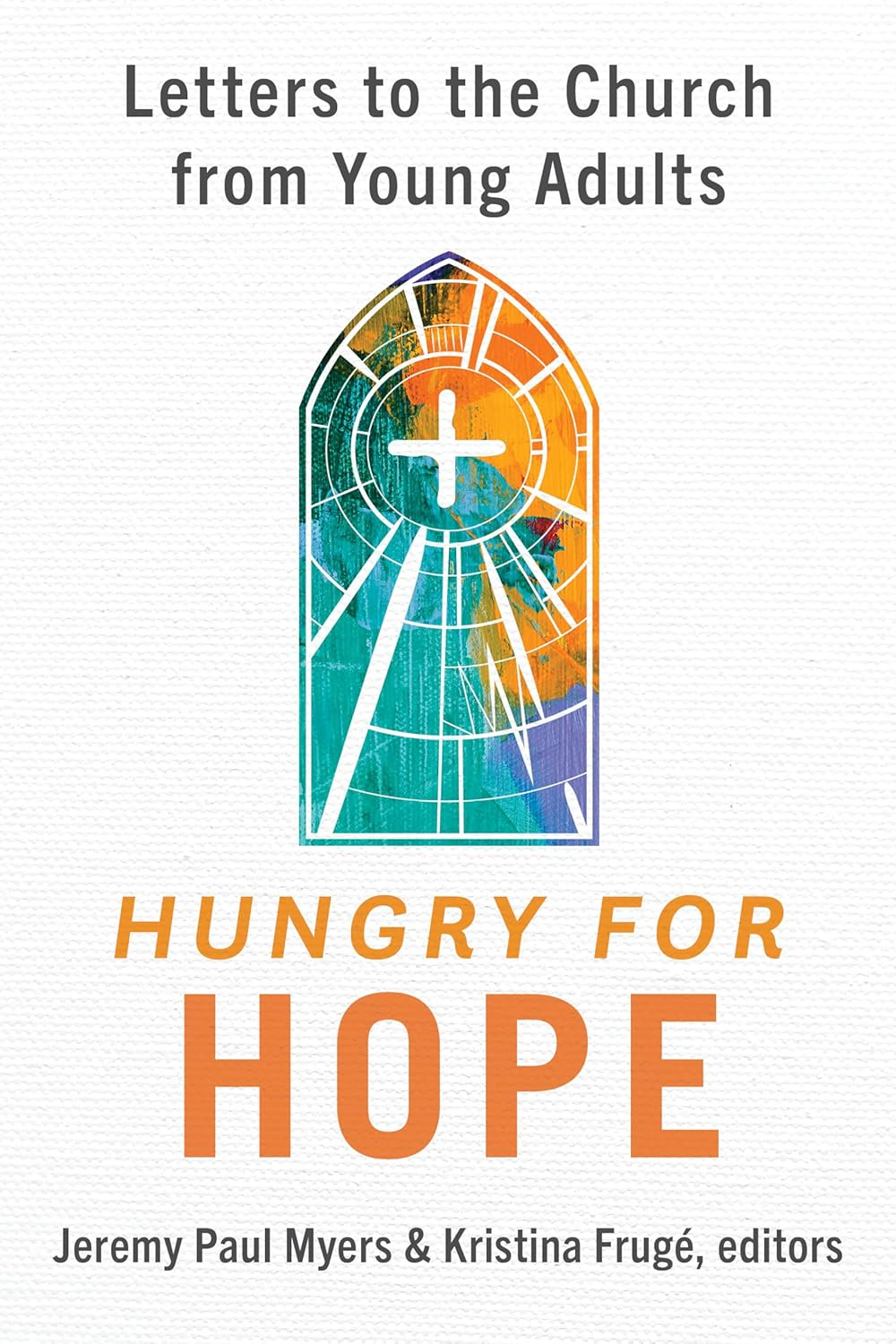
I read a lot of books—approximately seventy-five last year, and at the time of this writing, I’m well into book nine. One of my commitments is that whenever I begin a book, I aim to read it through, with only the rarest of exceptions. Hungry for Hope: Letters to the Church from Young Adults was one of those exceptions.
Months ago, I was sent the book, edited by Jeremy Paul Myers and Kristina Frugé, from Eerdmans Publishing. I had it in my stack for a while and threw it into my backpack while preparing for travel—I never want to run out of books on a trip.
This was a book I did not finish. It also did not make the return flight home. I picked up other books on the trip and ultimately decided this one was not worth the space or weight.
Let me be clear: the entire book is not terrible, which is to be expected in a multi-author volume. Eric Law, whom I’ve had on my podcast and whose work I respect, offered important insights. So did Soong-Chan Rah, whose The Next Evangelicalism still sits on my bookshelf even after a recent purge. There are moments of wisdom here.
The opening chapter, for instance, states:
“Churches now need ways of being that open them up to more vast possibilities… For this, the church is going to need a little more curiosity and a lot more courage” (14).
I wholeheartedly agree.
My problem is that much of what follows bears little resemblance to Christianity as a theological tradition. Again and again, theology gives way to progressive ideology, with Scripture and historic Christian doctrine either sidelined or functionally absent.
To clarify upfront: the examples I cite below are not isolated anomalies. They are representative of a broader posture throughout the book—one in which secular frameworks are treated as authoritative, and Christian theology is, at best, ornamental.
On the same trip, after setting this book aside, I began Sanctuary of Healing by Julia Matallana Freedman, a book on trauma-informed ministry. What struck me immediately was the contrast. Freedman makes use of tools often associated with critical theory—but those tools are clearly subservient to Scripture and Christian theology, not the other way around. That distinction matters. It is precisely what I found missing here.
A particularly egregious example appears on page 57:
“We must dwell instead in hopelessness and learn to cope without hope. This sounds terrible, but it is a necessary and life-giving journey.”
I only have my highlights—perhaps better called lowlights—but even so, this line stopped me cold. First, it is deeply confusing for a book titled Hungry for Hope to urge readers to abandon hope. Second, and more importantly, such a claim is not merely pastorally dangerous; it is unbiblical and unchristian.
Unfortunately, it does not improve from there.
“To be human is to be made in the image of God… this bred anthropocentrism, a privileging of all things human over the nonhuman” (68).
Yes—God does privilege humans over the nonhuman. That is precisely what imago Dei means. The authors seem to suggest this is a bad thing.
“We may smile when an old church building becomes a bar or a roller skating rink…” (79).
Who is smiling? I smile when people gather together in worship, formation, and perhaps even to meet with their neighbors to improve their communities—not because an old church is now a bar.
Another passage suggests that expecting God to save us reflects a theological error, critiquing belief in resurrection as a kind of deus ex machina. Again, the implication seems to be that Christian hope itself is the problem.
Perhaps most startling was this statement on biblical interpretation:
“The Center for Media Literacy provides great guiding questions, whether you are critically reading a social media post or a biblical passage…” (184).
This is not discernment; it is displacement—treating Scripture as just another text, governed by secular critical tools rather than received as revelation. I still cannot fathom, of all the available tools to suggest for biblical study and interpretation, the go-to recommendation was from the The Center for Media Literacy?!?!
The most troubling chapter, however, is the one on sex, which argues:
“We need to create a church that values consent, pleasure, and mutual well-being” (190).
And on the same page:
“Everyone needs to be able to access condoms, lubricant, sex toys, and contraceptives, with or without the involvement of parents and trusted advocates” (190, emphasis added).
My concern here is not prudishness or nostalgia for purity culture, which caused real harm and deserves its critique. The deeper issue is the collapse of moral formation—the abandonment of intergenerational wisdom, authority, and guidance altogether. Adults disappear. Parents are sidelined. Formation is replaced by affirmation.
This, to me, perfectly encapsulates the central problem with Progressive Christianity: God becomes a mascot—an idol, really—invoked when useful, but not living or active, and certainly not offering a moral framework for how to live.1
God—if God exists at all—exists mainly to reassure us that what feels good must therefore be good.
There are exceptions. Rah’s chapter on lament is thoughtful and needed. Law’s contribution is strong. But they are precisely that: exceptions.
What troubles me most is the theological vacuum at the heart of the project. This is not merely a disagreement over emphasis or tone. It is a fundamental question of what Christianity is for. When theology is displaced by ideology, hope thins, worship hollows, and the church loses its moral grammar altogether.
That loss feels especially dangerous in a moment like this—when cruelty is openly justified, when power eclipses conscience, and when the church seems unsure whether it still has anything distinct to say.
A deeply disappointing book.
It’s noteworthy that I read this while I was at a conference for the Iowa Preachers Project, with so much discussion about Law & Gospel and the gift of the Law.
Perhaps they had misunderstood this quote from Eliot's Four Quartets:
I said to my soul, be still and wait without hope, for hope would be hope for the wrong thing; wait without love, for love would be love of the wrong thing; there is yet faith, but the faith and the love are all in the waiting. Wait without thought, for you are not ready for thought: So the darkness shall be the light, and the stillness the dancing.
T.S. Eliot
Can you define "progressive" as you understand it. From your excerpts, that is not progressive, it is as you describe it. I far more often agree with you than not but many would call me progressive. I do not like the term progressive as it has lost meaning. I am a follower of Jesus and, from there I function as a social justice activist. I think many so-called progressives that I know would articulate their position in the same way.