


Author’s Note:
What follows is a critical engagement with John Paul Sydnor’s The Great Open Dance: A Progressive Christian Theology. While I found many of the book’s theological moves difficult to reconcile with historic Christian faith, I write this not to dismiss the author’s work, but to wrestle with it honestly as a pastor, chaplain, and reader who cares deeply about the future of Christian theology. Sydnor is clearly a gifted scholar, and I appreciate the creative ambition of this book—even as I push back on some of its foundational premises.
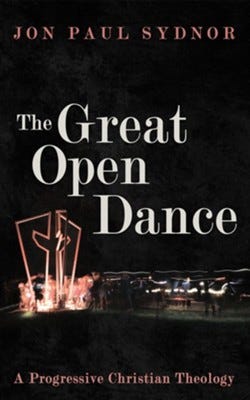
When Theology Feels Off From the Start
Several months back, I was sent a copy of John Paul Sydnor’s The Great Open Dance: A Progressive Christian Theology. I’ve been mulling over how best to engage the book, as it didn’t quite seem to fit within the wheelhouse of my Future Christian Podcast context. More than that, if you’ve been reading this blog in recent months, you’ve likely noticed my growing frustration with Progressive Christianity writ large.
Building on the Wrong Foundation
To me, Sydnor’s book is both brilliant and frustrating. And perhaps the brilliance and frustration both stem from a mislabeling in the title. Though it’s billed as a constructive theology, it often reads more like a comparative religion study—which makes sense, given that’s one of Sydnor’s academic specialties at Emmanuel College. From the opening pages, he builds his theological case not on Scripture or Christian tradition, but through the Buddhist concept of nondualism. While I have deep appreciation for the wisdom of Buddhism and am universalist enough to believe that God is at work in all religious traditions, I still found it somewhat disorienting and disheartening to see a Christian theology constructed from such an explicitly non-Christian foundation. In a comparative theology textbook, sure. But in a Christian theology book? It doesn’t seem appropriate.
Early on, Sydnor names the challenge of his approach: “To gain a place at the table of theological method, comparative theology must become constructive, pastoral theology. In other words, it must produce new (constructive) theology that is helpful to the church—to priests, pastors, and parishioners alike” (33). I agree with his aim—I just don’t think this is it.
Beautiful Language, But to What End?
Reading the book felt like reading so many other Progressive Christian books I’ve encountered lately: full of profound prose and flowery language that ultimately doesn’t say much or make any concrete theological claims.
Consider this:
“If God is anything in itself, then God is relationship itself, infinite relatedness expressed as interpersonal love mediated by time. When we participate in this divine reality, when we manifest God on earth, we may discover a Holy Spirit—an undertow of grace that bears us to our goal—God's beloved community” (63).
It sounds deep, but what does it actually mean? Is God merely the effect of two people loving one another? Is God just a manifestation of phileo love?
Just a few pages earlier, Sydnor writes,
“By divine decision, without relationship there is nothing, even for God” (52).
Do you see the confusion here? If God is nothing without relationship, how can God decide anything? Does God cease to exist when humans do not love each other? I don’t understand.
The Problem with Youth-Led Theology
Another concern comes early in the book, when Sydnor writes:
“Christianity shouldn't change its theology to attract young people; Christianity should change its theology because the young people are right. They are arguing that Christianity fails to express the love of Christ, and they have very specific complaints” (3).
This encapsulates one of my persistent frustrations with Progressive Christianity—the assumption that young people are prophets and sages whose critiques we should immediately enshrine as doctrine. I get it. I was once young and idealistic too. And I understand how a college professor might feel an affinity for his students. But I remain puzzled at how, on the one hand, we can acknowledge that human brains aren’t fully developed until the mid-20s, and on the other hand, assert that we should completely reshape Christian theology based on what these same young people feel or think.
Should Christianity improve its messaging? Absolutely. But to suggest that the theological wisdom of centuries of saints and scholars should be discarded because it’s not “hip” enough for today’s young adults is a textbook example of chronological snobbery.
Can Jesus Mean Anything and Everything?
Sydnor also echoes another recurring theme I see in Progressive Christianity: the belief that Jesus can be or mean whatever we want. He writes:
“Jesus always outwits identity. Like the plus symbol in LGBTQ+, Jesus's meaning is never defined, hence always open to expansion. Jesus becomes new things in new places for new people, so that he can always be healing anew... The meaning of Jesus changes in every context, so that Jesus is always becoming more, always surpassing himself, always transforming in new ways” (146).
To an extent, yes—cultures across time have contextualized Jesus in their own ways. Andrew Walls explores this well in The Missionary Movement in Christian History. But to say Jesus’s meaning “changes in every context” to the point that Jesus “is always surpassing himself” sounds like we’re making Jesus in our image. If Christ’s identity is wholly dependent on our cultural constructs, his divinity becomes meaningless. Yes, even the gospel writers may differ on when Jesus became divine—John’s gospel sees it as eternal, others less clear—but to say Jesus is whoever we want him to be may sound inclusive, but it also veers dangerously toward humanism or even heresy.1
If God Is Just a Metaphor, Why Speak at All?
One final concern: when theology about God becomes entirely metaphorical and mystical, it ends up meaning very little. Sydnor writes:
“Language about God is iconic. An icon is a depiction of a divinity or saint appropriate for contemplation and meditation... [Icons] remind the viewer that they are not looking so much at the icon as through it...” (77).
I understand the point. I understand the value of icons and the mystery of God. But if language is only a symbolic pointer, if God is only whatever we say God is, then what’s the point of saying anything at all?
The incarnation matters. Jesus Christ put on human flesh, spoke real words, and told real stories using concrete metaphors like mustard seeds (Matthew 13). Those parables weren’t meaningless riddles—they pointed to something true. I’m not convinced that Progressive theology’s persistent abstraction and imprecision helps anyone follow Jesus more faithfully.
Compelling Passages Worth Noting
That said, Sydnor does offer some beautiful insights. Here are a few of my favorite quotes—passages that genuinely moved me or articulated something striking. And yet, even these moments of brilliance often carry the same underlying ambiguity found throughout the book. They’re compelling, but also raise their own theological questions:
“God is trustworthy because God has chosen to be trustworthy, not because God is constrained by an unchangeable nature. If God did not have this freedom to choose, if God were constrained by an essence, then God would not be a person.” (58)
This is a fascinating claim, but I’d push back gently. I would argue that God is trustworthy not simply because God chooses to be trustworthy, but because trustworthiness is intrinsic to God’s nature. To say God chooses to be trustworthy implies the possibility that God could choose otherwise—that trust could be revoked. That feels unsettling. I’m reminded of theologian Thomas Jay Oord, who (if memory serves) suggests that while some aspects of God may change, there are certain core attributes, like love, that are unchanging.
“As a result of God's perfect wisdom God feels perfectly, which is to love perfectly. Within God there is no capacity for celebrating another’s pain or envying another’s success, because God is perfect. 'Perfect' does not mean unchanging, but changing perfectly.” (59)
This is an evocative statement, but I’m unsure where Sydnor gets his definition of perfect. It seems unanchored from the biblical usage, particularly in Matthew 5:48: “Be perfect, therefore, as your heavenly Father is perfect.” There, the Greek word teleios refers to maturity, wholeness, or completeness—something full grown. In that light, I struggle to make sense of the idea that perfection implies the ability to "change perfectly." The concept of divine perfection as consistent, faithful, and complete seems undermined by redefining it as an ability to change. While I appreciate the effort to express God's dynamic relationality, I worry this framing muddies the biblical witness and makes God’s character seem unstable rather than mature and complete.
“Some churches baptize infants because, quite factually, God’s love precedes our capacity to respond. It is waiting for us to become aware of it and always inviting us into that awareness.” (103)
This last point is perhaps the best argument I’ve ever heard for pedo-baptism. It beautifully affirms the theological claim that God’s love precedes our awareness or response—a love that reaches out to us long before we can reach back. And yet, one could also see a tension here: if awareness and response are essential, then baptizing a child who cannot yet comprehend or respond might seem to short-circuit that journey. Once again, the book proves both brilliant and frustrating—able to offer profound insight while also raising more questions than it answers.
Final Thoughts: Theology That Holds
In full transparency, I didn’t finish the book. I ran out of steam a little past the halfway point. Maybe I would have found a rhythm with it had I pushed on. Maybe I’m not academic enough for it. Sydnor is clearly an intellectual heavyweight, and his effort is commendable. My concern isn’t with his scholarship—it’s with his premise. And from what I see, the flaws in the foundation lead to conclusions that don’t hold.
More personally, as a pastor and chaplain, I found the book out of reach to the everyday churchgoer. It feels written for the academy, not the pews. And in our current moment, we don’t need more theological poetry; we need grounded, compelling, Christ-centered hope.
In the end, The Great Open Dance left me with more questions than clarity. I appreciate Sydnor’s creative ambition and his desire to offer something expansive, inclusive, and intellectually rich. But for me—and I suspect for many pastors, chaplains, and everyday Christians—the book dances too far from the anchor of historic Christian faith. It left me longing not for broader metaphors, but for firmer theological ground.
At a time when so many are spiritually adrift, I believe we need a faith that speaks clearly, offers substance, and is rooted not in abstraction but in incarnation. We don’t need more theology that gestures toward mystery without naming truth. We need a vision of God that is both big enough to embrace all people and specific enough to change lives. I want to believe Progressive Christianity can offer that—but this book, for all its beauty, didn't get us there.
And maybe that’s the real tension: if our theology is so open that it no longer asserts anything in particular, can it still be called Christian? I’m not looking for rigid dogma or exclusion. But I am looking for a faith that has edges—something to hold onto when life is uncertain, something that tells the truth, even when it’s hard. Because ultimately, I don’t just want theology that sounds good—I want theology that holds up when life falls apart.
I always hesitate to use the word heresy as it’s often been used historically to retain or retake power. That being said, what I’m trying to state is that, as written just above, Christianity should have edges.
I read this essay just after audio-reading the first several chapters of Christopher and Richard Hays' new-ish book, The Widening of God's Mercy. Two contrasting approaches. The Hays' book traces a path through the Bible with eyes wide open to God's message within and to the frailties of our own theologizing. It's hard to judge from your essay alone, but my experience with the Progressive Church is that - in its worst forms - it offers a thought process that goes roughly: "The Bible places before us a lot of mystery and paradox. So therefore, 'whatever'. It's all good, fly your freak flag, as long as you are loving your neighbor."
On Trinity Sunday, mainline pastors might start a sermon with "The Trinity is hard to understand...." and then they have to decide whether the next phrase is "...but thankfully we have the writings of wiser people to lean on." Or, they can choose to redraw the Trinity in their own image. I noticed that the back cover of the book uses "Abba, Jesus, and Sophia" to name the Trinity. I'm wondering if you could comment on how well this nomenclature reflects Christian orthodoxy?
In the quote, “By divine decision, without relationship there is nothing, even for God” (52), is he hinting at the notion of Trinitarian relationship. That is, God is eternally in relationship with himself?
I hate to use the word Deconstruction, but it does seem that he is playing with concepts out of Derrida when it comes to meaning and symbolism, that meaning shifts with place and time and perhaps power, and that even Christ does not have a specific Ontology. Am I understanding that correctly?