


TL;DR
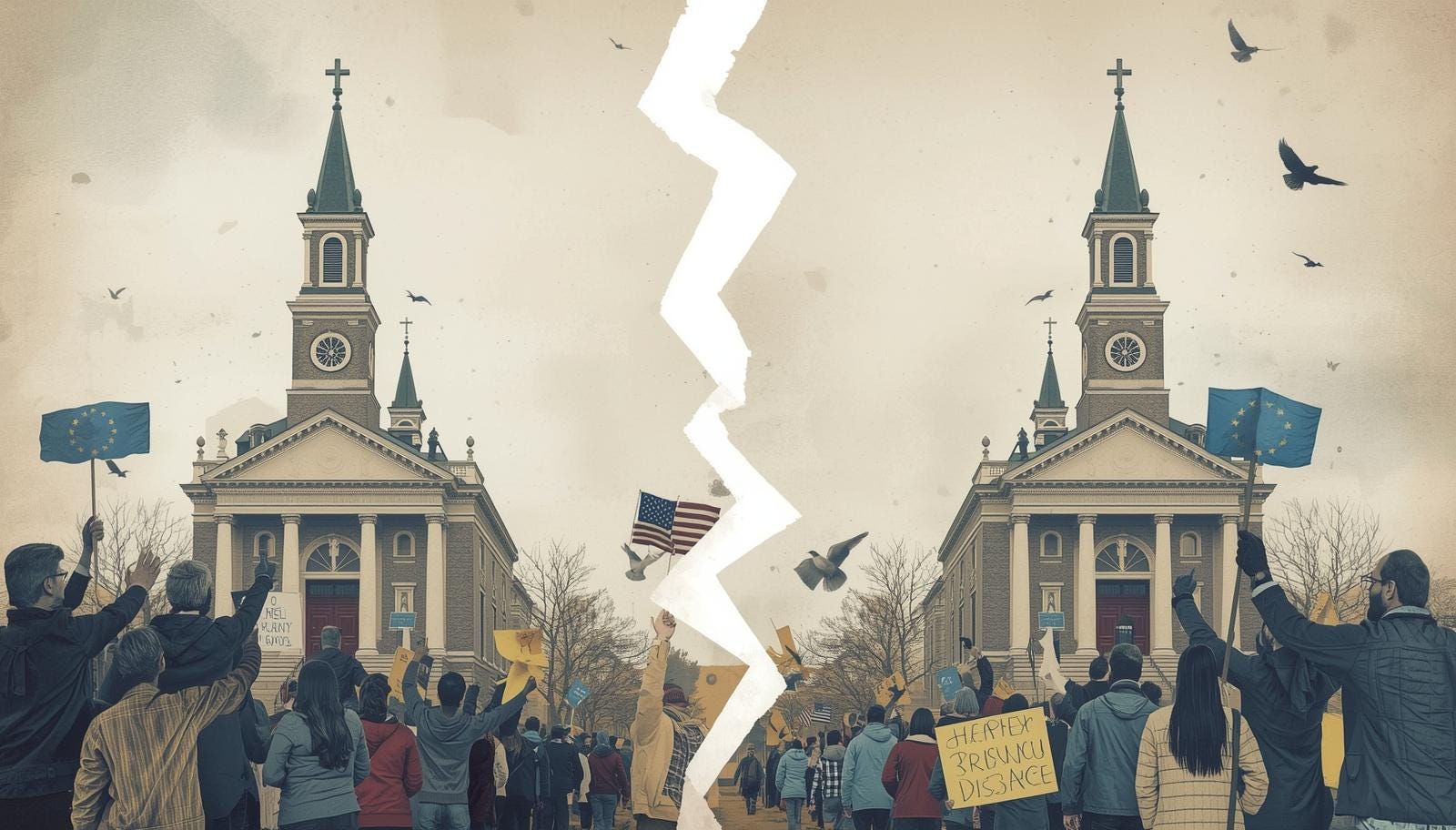
A tense conversation about a denominational immigration statement became a reminder of something increasingly rare: a church where people with different political views can still worship together. Drawing on Ryan Burge’s The Vanishing Church, this essay reflects on how partisan “togetherness pressure” is reshaping American Christianity—and why churches that make space for honest disagreement may be more important than ever.
When the Church Still Makes Room
He was shaking as he showed me an article on his phone.
To steady it, he placed both hands around the device so I could read clearly.
It was a denominational news article describing a recent rally opposing immigration enforcement by the current administration.
Pointing to a particular paragraph, he asked, “What do you think this means?”
I offered my best on-the-spot summary, but he seemed unconvinced.
“Let’s have a seat,” I said, “so we can talk more about it.”
The Conversation
That evening, I was participating in regularly scheduled programming at a Mainline church when one of the other participants—having strong feelings about the denominational article—tried to initiate a conversation with a local church leader about it.
That leader, knowing I was there and aware of my role as a chaplain and my experience with difficult conversations, suggested he speak with me instead. I was caught a bit off guard, but happy to oblige.
He began sharing more of his backstory—military background, from the Midwest, wary of talking points that seemed too neatly politically aligned.
We talked through the article and what bothered him.
I used phrases like:
“If I understand…”
“If I’m hearing you right…”
“I can see why you’d feel that way.”
I tried to remain patient and non-reactive, listening for what was really underneath his frustration. As I understood it, he felt that a denominational leader’s statement—quoted in the news article—was overly stark and not biblically grounded. For him, that mattered.
“We should be based on the Bible,” he said—or something close to that.
I then shared my own perspective. I spoke about what I see as a biblically grounded posture toward immigration: that all people are created in the image of God (Genesis 1:27), that God loves all (John 3:16), and that Christ died for all (2 Corinthians 5:15).
“So for me,” I said, “I’m willing to have some flexibility around policy, acknowledging that I don’t always know what’s best—but I think it must respect the dignity of the human being.”
“That’s fine,” he replied.
What truly bothered him was the use of the word “heresy” in the statement—particularly the implication, at least as framed in the news article, that anyone who disagreed with the speaker’s view was “heretical.”
That was a bridge too far.
“I can see why you’d feel that way,” I said. “Heresy has historically been a word used to divide people of faith, and those words cast the issue in a very stark, right-or-wrong frame.”
Even though this was not a Disciples of Christ church, I referenced a principle from my own tradition—Thomas and Alexander Campbell’s call to “Speak where the Bible speaks and remain silent where the Bible is silent.” The Bible does not describe detailed policy positions, but it does prescribe how we treat people.
In the end, I’m not sure we settled anything. I suspect he still disagrees with the article and the statement he found offensive.
And frankly, I think that’s okay.
The church was such that people of varying political convictions could coexist and worship together without partisan alignment becoming a test of fellowship.
The Vanishing Center
That kind of church is becoming rare.
Ryan Burge, in The Vanishing Church, argues that Christianity in America has become an “‘all or none’ proposition—conservative evangelical religion or none at all” (6). Moderates are being driven out, creating “a divide in which a whole bunch of people on each side are convinced that those on the other side are immoral or bigots” (8).
Burge warns this polarization is “a problem for us all” (8).
He traces much of this shift to the decline of what we call Mainline Protestantism—denominations like the United Methodist Church, ELCA, United Church of Christ, and others.
“At one point, about half of all Americans were part of this moderate, mainline tradition. In twenty or thirty years,” he warns, “if current trends continue as predicted, the mainline tradition will largely be extinct across many parts of the United States” (5).
The data is sobering.
In post–World War II America, mainline denominations functioned as a kind of civic religion—“God and country” churches for middle America. Burge is less interested in evaluating that era and more concerned with what has happened since its decline: growing polarization.
He notes that “Striving for a tradition that welcomes all viewpoints and political proclivities may represent a deeply held conviction for many proud members of the mainline, but it has not proven to be a viable pathway for organizational vitality” (46).
Political partisanship, Burge argues, has become “the master identity of our lives,” with “everything…downstream of that” (78). “In essence,” he writes, “the public is sorting itself into camps based not on theological convictions but on partisan affiliation. Their religious identity is downstream of their partisan affiliation” (81).
He describes what family systems theory calls “togetherness pressure”—the growing expectation that individuals must align fully with the loudest voices in their tribe: “what seems to be happening is that the average American is becoming more and more convinced that they should at least feign support for the most strident voices in their tribe” (178).
That pressure exists in churches too.
While Burge critiques evangelical churches more directly, the same dynamic affects the mainline. Many with moderate or conservative theological views have felt less welcome. As Burge notes, “Questioning the prevailing opinions of one’s own group once or twice is acceptable, but like-minded people quickly tire of such inquiries” (179).
Eventually, people either fall silent—or they leave.
Within evangelicalism, where social pressure to attend church remains strong, silence is more common. Within the Mainline, leaving is often easier.
Who Is Left?
Burge does not spend much time analyzing the political distribution within mainline congregations in this book, though he has elsewhere. His data has often shown that many mainline members are politically “purple” or even center-right.
This next part is my own reflection, not Burge’s.
I sometimes wonder whether some of what has happened in the Mainline is simply that more progressive members have left—either because they found the church unnecessary or because progressive secularism has devalued institutional religion altogether. I’ve certainly written previously of the trend within Progressive Christianity to minimize the importance of the faith. But, that’s my speculation, not his.
What is clear—and startling—is how much the political left is increasingly shaped by the most secular and nonreligious voices.
But that’s another discussion.
What Burge consistently emphasizes is that many American Christians are comfortable with women clergy and same-sex marriage and want churches that allow for that.
I agree.
But I also long for churches where Christians who are unsure—about sexuality, about abortion, about immigration—can wrestle honestly without fear of being labeled “racist” or “bigot” simply for asking questions.
To be clear: some who claim Christ do hold views that are racist and bigoted.
But I also believe many are simply afraid to ask questions publicly. And rather than risk the label, they quietly walk away.
Why It Matters
Burge is emphatic that church attendance matters:
“There’s nothing simpler and more consequential than people getting up on a Sunday morning, getting dressed, and making their way to a local house of worship” (205).
“The fate and future of American democracy may be at stake.”
I’m less concerned about American democracy—important as it is—and more concerned about the health of the body of Christ in America.
For the church to be healthy, I believe we must remain in fellowship with those with whom we disagree on matters of faith and practice.
That evening’s conversation did not resolve the immigration debate.
But it did model something rare:
Christians speaking candidly, listening patiently, and remaining in communion.
That, among many reasons, is why the Mainline church still matters.
And why I continue to hope—and pray—for revitalization and renewal among us.