


TL;DR: A line from Bonnie Kristian’s forthcoming In Defense of Evangelicalism has me thinking about what happens when we replace curiosity with condemnation. I’m no Trump supporter, but I’m increasingly convinced that understanding why someone sees the world differently isn’t the same as agreeing with them—and might be one small way we begin breaking down the walls dividing our churches and our country.
A line within it that has been haunting me…
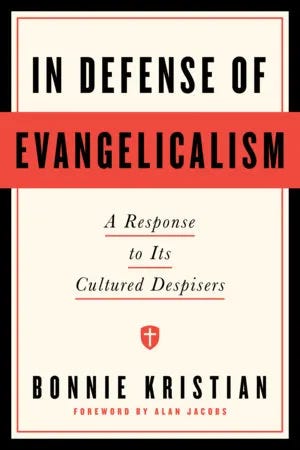
I’m reading the forthcoming book In Defense of Evangelicalism: A Response to Its Cultured Despisers by Bonnie Kristian, and while I don’t usually write anything about a book until I’m finished, there’s a line within it that has been haunting me since I first read it last night.
That, and it’s the first day back at school for the kids, the house is quiet, and I’m already tired of house chores.
So, here we go…
The book, releasing September 8, draws on research, original reporting, and Kristian’s lifetime in the evangelical movement to address five serious criticisms of evangelicalism and offer a deeply informed and theologically grounded defense. Kristian engages with influential critics of evangelicalism—including Kristin Kobes Du Mez, Beth Allison Barr, and Tim Alberta—as well as theologians, pastors, and other thought leaders, seeking to dismantle bad-faith critiques while acknowledging where reform is necessary and desirable.1
I’m maybe a quarter of the way in, and it’s happened before that books have taken a drastic turn for the worse—I’m looking at you, Critical Dilemma—but for now, I’m intrigued by what I’m reading.
The line in particular that I can’t get out of my head is this:
“…imagining a future with Hillary as president was just too unbearable.”
For some context, these words come from a conversation Kristian had with an evangelical woman, a pastor’s wife if I remember correctly, who was married to a Hispanic man and attended a predominantly Hispanic/Latino church. Kristian recalls this conversation in a chapter titled “Hypocrisy,” addressing the charge that evangelicals are deeply hypocritical based on their voting choices.
Now, a few things I must say immediately: I most assuredly feel very differently than this woman, named Jane.
For me, imagining a future with Trump as president—well, I don’t have to imagine—and frankly, I think it has been awful and unbearable at times. (I first accidentally typed “unlawful” instead of “awful,” which also fits.)
While I hesitate to get into voting choices or do deep dives into politics, let the record show I was and still am a fervent “Never Trumper.” That being said, I was on the fence with Hillary for some time and seriously considered voting for Jill Stein—but I thought she was being too paranoid about Russia at the time. I was wrong; Stein was certainly right!
I say all of this to say that I am, in many ways, quite the opposite of Jane—or perhaps Kristian, for that matter, even if I don’t think she has revealed her presidential voting choices in the book yet.
But still, there’s that line I just can’t get out of my head:
“…imagining a future with Hillary as president was just too unbearable.”2
Curiosity Before Condemnation

The other day, before I started reading Kristian’s book, a Facebook “friend” and “exvangelical influencer” posted the above statement on social media.
My immediate thought was this: This “influencer” has had ten years to try to understand these perspectives so as to change people’s minds and still hasn’t.
Moral grandstanding is great, but it doesn’t do much good in the long run.
More, I’d add that, in my memory, a lot of evangelical leaders actually expressed significant concerns about Trump’s character.
But I digress.
I want to be absolutely clear: I am vehemently opposed to Trump, and I think his legacy will be one of moral and institutional disaster for our nation.
That being said, rather than simply trying to judge and condemn Trump voters, I’m really interested in trying to understand what could make him the LESS repugnant choice over even someone like Kamala Harris most recently.
To that end, I’ve begun purposely seeking out more opportunities to engage with people who feel differently about this topic than I do.
For instance, for the last six months, I’ve been getting my hair cut by a woman who quite clearly votes differently than I do. To be sure, we didn’t immediately share our voting choices, but let me just say it has been obvious based on other things I’ve seen around her studio.
Yet, as much as we barely know each other, she’s already shared with me compelling stories of tragically losing her son in an accident and her husband’s brush with death from an illness.
To say it bluntly, I don’t think she’s the monster the above exvangelical influencer would have us believe.
The summer before the election, I had a similar experience over dinner with a fellow pastor who stated quite clearly that he was going to vote for Trump.
We’d been having a good conversation up to that point, so I took a deep breath and kept listening.
Interestingly, as he explained his thinking, he brought up a couple of things I either agreed with or could at least understand why he saw things the way he did. I gently suggested that I would probably be voting differently than him, but we kept talking.
And we left on good terms. I didn’t change his mind. He didn’t change mine. But I understood him a little better than I had before.
Now, in fairness, many might point out my “privilege,” in that I am a straight white guy who doesn’t have a whole lot to lose—just my sad attempts at fashioning my “hair”—which is true.
But that’s also why the above exvangelical influencer has no excuse for his unwillingness to engage the other side. He, after all, is a straight white guy like me (though with much better hair) and could easily enter into some “unsafe spaces” with some measure of courage and curiosity in hopes of building some bridges.
I want to emphasize this point: I’m not asking members of marginalized communities to immediately enter into relationships with people who don’t respect them.
Although my barber might lose some respect for me if I shared my true opinion on certain matters, but still.
Here’s an opportunity where I can use “privilege” for good.
Maybe it’s my training and experience as a hospital chaplain, or maybe it’s just what I hope is some well-worn wisdom, but when I hear someone say the other choice was “unbearable,” while I am a bit offended, I am also curious.
Why?
What makes a future I might prefer feel literally unbearable to someone else?
And which posture is more likely to create some unity or break down the walls of division within our nation and our churches: condemnation or curiosity?
I can tell you with certainty, it won’t be the posture of the exvangelical influencer.
P.S. One More Thought…
I was tempted to write about this too, but figured I’d get back to the house projects.
Kristian’s book maintains that the evangelical movement is a force for good that every American should want to preserve.
The last decade or so in America has been VERY anti-institutional, some of which I’d argue has been fostered by Trumpism. But the broader question is one I’ve been wrestling with myself:
Are imperfect institutions better than no institutions whatsoever?3
If I had to give an answer right now, I’d say something is better than nothing.
But maybe that’s another blog.
This description is adapted from the book’s webpage.
I had the thought that perhaps Jane is being dramatic or unreasonable. But then, am I too in being a Never Trumper? This is why I can’t let this quote go…
This feels like a question Paul Anleitner has been wrestling with also.
"...trying to understand what could make him the LESS repugnant choice over..."
This should not be nearly such a difficult thing for anyone to imagine, without even asking anyone. Pick one policy from your side. Figure out who suffers the downside of that policy. That's all it takes to vote against you. (If you're stumped, remember that you wouldn't need the government involved at all if the policy didn't have losers, as people do tend to voluntarily work together when everybody wins.) Now, do that for all of your side's policies, and recognize that any combination of those things can add up to move the needle over the line, even if your opponent is in other ways reprehensible. You should still actually talk to people from the other side to gauge how things add up in practice, but the possibilities should not be evading the imagination of any halfway-decent critical thinker (and there are plenty of those even in "marginalized" communities, so that's no excuse.)
The left in particular has had a problem with thinking they can morally checkmate their opponents into victory by pointing to the flaws of their opposition, but that's just not how it works. We only get the two choices, and most people are not choosing what's best for the whole country if it's the worst choice for the things they personally care about, nor should they. Kodos could bring utopia to the rest of society, but if he's going to leave you personally locked in a cellar, you're completely justified in voting for Kang. There's no escaping the trail of losers your policies leave behind, and that's where you'll find your answers.