



The question of theodicy—or essentially—where is God when bad things happen to good people,
has been and continues to be one of the most vexing challenges to the Christian faith.
Recently, I wrote a short post on the topic, inspired by a conversation my co-host, Martha Tatarnic, had with Rev. Kyle Norman on our podcast Future Christian. Kyle shared about his own experience of suffering and faith deconstruction when his wife, Alicia, was diagnosed with cancer. Kyle asked the question we all ask in tragedy: Why is this happening?
But, as he reflected on that question, something shifted:
“I asked, Why is this happening? And it dawned on me—if someone could actually say, ‘Kyle, Alicia got cancer because of this reason,’ would that make it less painful? No. It wouldn’t help me at all…
There’s a beauty in the fact that we don’t get an answer. Because when we try to give one—like Job’s friends—we’re almost always wrong. God doesn’t meet us with a rationale. God meets us with presence. With love. With grace.”
Kyle continued:
“God didn’t give me answers. God didn’t give me a roadmap. But God was with me.”
“Job never got an answer, right? God shows up and basically says, ‘I’m God, and you’re not.’ And for Job, that’s enough. Job is comforted by God’s presence—not by an explanation.”
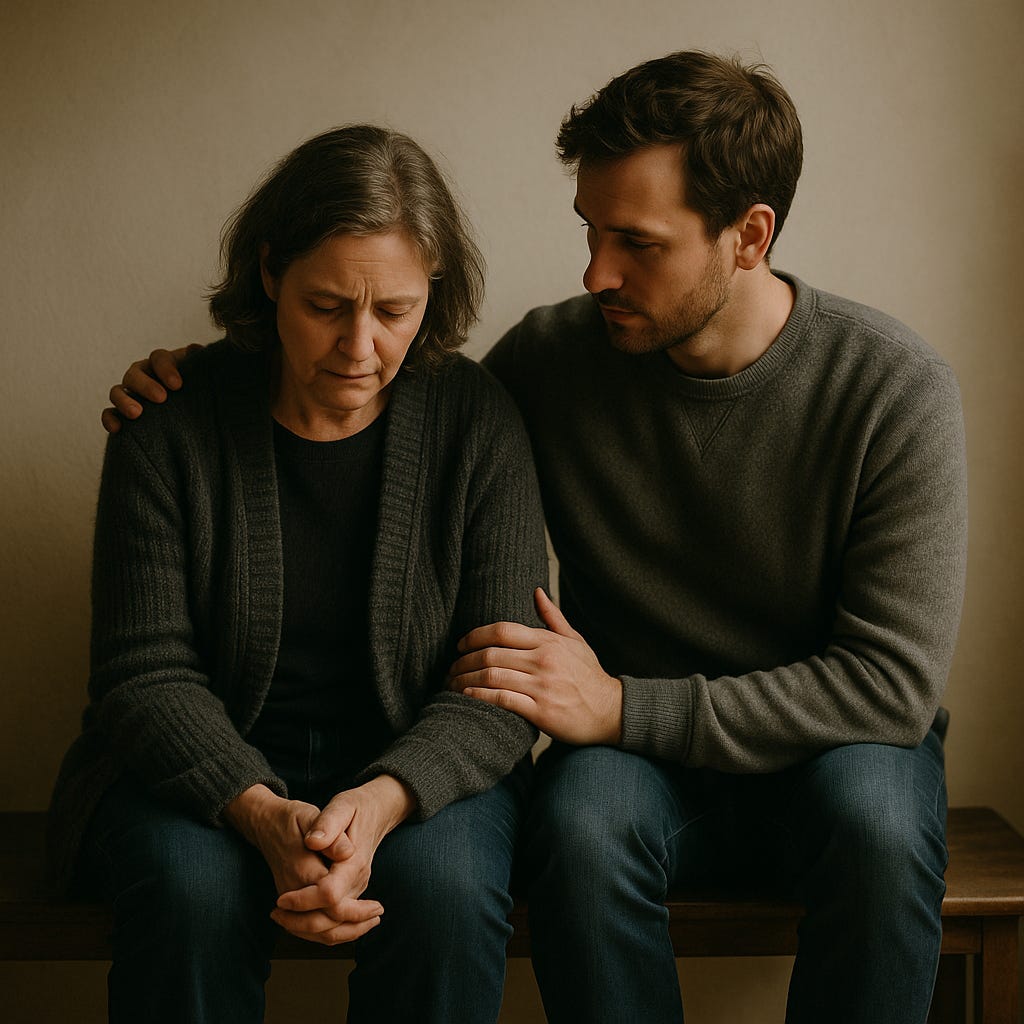
“Sometimes in ministry we feel the pressure to say something helpful, but often what people need is simply someone to sit with them—to be present. That’s where God shows up.”
Thor, theodicy, and the presence of God

I’ve never been a big fan of the Marvel Cinematic Universe. Even during the early years of the franchise, I mostly tagged along with my wife whenever she wanted to see the newest release in theaters. I didn’t follow the intricate timelines, world-building, or character lore, but one thing I did appreciate—especially in the earlier films—was a good chara…
In response to that post, I was pleasantly surprised to see a comment from Thomas Jay Oord on my post. Tom is a great human being and brilliant theologian, someone who I’ve had on my podcast multiple times and have had the pleasure of meeting in person. As a scholar of Open and Relational Theology, the question of theodicy is one he thinks about perhaps on a daily basis. So, I was not shocked when he had this to say in response to my post:
“I'm not a fan of the "presence over answers" response to the unnecessary suffering. A God present and able to stop the evil isn't loving. That deity is a sadist. Or worse. But if God can't prevent the evil and suffers with those who suffer, we can realistically say that God is loving.”
I replied to his comment by suggesting a previous post I had made. He thought I made some good points, and also some that he felt were weaker. Regardless, any day I get to trade theological jabs with someone as esteemed as Oord is a good day!
The Problem of Parental Perspective in Process Theology

This past weekend (as I am writing this) I was fortunate to attend the “God after Deconstruction” conference at St. Andrew United Methodist Church in Highlands Ranch, CO which was led by noted Process/Open and Relational (ORT) thinkers Thomas Jay Oord and Tripp Fuller. I’m especially grateful that I was invited to be on a panel discussion amongst other …
Oord’s argument—maybe God can’t
When faced with suffering, many of us ask the same haunting question:
Where is God in all this?
For some, like Oord in his book God Can’t, the answer is that God simply lacks the power to prevent evil. Oord argues that God cannot intervene to stop tragedy or override human freedom. Oord has another book The Death of Omnipotence and Birth of Amipotence in which he asserts that the Bible does not assert God’s omnipotence bur rather God’s power is made manifest through love.
In fairness, I never read through the entire God Can’t book. It’s much less academic and written for a general audience. Oord recommended me to read his book The Uncontrolling Love of God, which is a more academic and in-depth analysis. His other book, Open and Relational Theology is also worth checking out.
Even still, while I appreciate Oord’s efforts to defend God’s goodness— it comes with a troubling conclusion: that God’s presence isn’t enough. After all, he literally said as much on that comment to my post.
But what if presence isn’t a fallback? What if presence is exactly how God chooses to act?
This is where theologian Andrew Root offers a much different perspective. While Oord says God can’t, Root quietly insists:
God can—but God won’t. Not because God is powerless, but because God has freely chosen to be something greater than a fixer or force. God has elected to be a minister.
That God is a minister is a point Root makes again and again throughout his Ministry in a Secular Age series.
“God ministers to the world” — The Church in an Age of Secular Mysticism
“God is so deeply a minister that he is willing to leave is action open…” — The Pastor in a Secular Age
“…the living God who is ministering new life out of nothingness.”—The Church after Innovation
“God is free to be something other than a minister… But God has chosen to be a minister, coming to us through hypostasis in kenosis.”
—Andrew Root, Faith Formation in a Secular Age
Evangelism as Theodicy
Recently, I finished Andrew Root’s new book Evangelism in an Age of Despair. On the surface, Root’s book is about rethinking how we share faith in a secular, disenchanted world. But beneath its practical reflections, it quietly unfolds as a pastoral theodicy—an answer to the problem of suffering that doesn’t rely on abstract philosophy, but on the lived experience of God's presence.
Root reframes sorrow—not as evidence of divine absence, but as the very place where God’s ministering presence is most active:
“Sorrow is not a sign of God's abandonment but of God's election… God is moving in this very moment inside their sorrow to bring life out of it.”
—Evangelism in an Age of Despair
For Root, evangelism isn’t about offering people escape from suffering. It’s about helping them recognize that God is already with them, ministering in their weakness, consoling them in their despair. Presence isn’t insufficient. Presence is the very form of God’s power.
The God Who Chooses Vulnerability
We often imagine power as control—the ability to prevent pain, to dominate circumstances. But Scripture offers a radically different picture of divine strength.
When Paul cried out for deliverance, Christ answered:
“My grace is sufficient for you, for my power is made perfect in weakness.”
—2 Corinthians 12:9
God’s power isn’t displayed by avoiding weakness—it’s revealed through it.
Walter Brueggemann captures this paradox beautifully:
“The God of power and might chooses instead to be the God who speaks in vulnerability and stillness.”
This is the heart of Root’s pastoral theodicy.
God doesn’t lack the ability to act differently. God chooses love over force, presence over domination, ministry over might.
Even death itself isn’t beyond God’s reach—not because God smashed it with raw power, but because God entered it.
“Death becomes locked within God's being, never again outside the reach of God's ministry… We are promised new life because God has elected to be a minister.”
—The Pastor in a Secular Age
Bearing Witness to Tragedy
I want to pause here and acknowledge just how hard and painful loss and tragedy truly are. My perspective is not one of ignorance, apathy, or distance. As an on-call hospital chaplain, I carry vivid memories of these moments—including a recent, tragic death of a young man in his twenties. I can still hear the cries of his family as they wept over his body, repeating through sobs: “No, no, no,” “Why?” and “My God, oh my God.” These conversations are never easy. They are raw, sacred, and charged with unbearable emotion.
And yet, even in that moment, I was profoundly aware of what I could—and could not—offer as a chaplain. I couldn’t give answers or take away their pain. But I could be there. I could stand in the sorrow with them. And that, I believe, is exactly what God does. Not explaining. Not fixing. But ministering through presence. As Andrew Root reminds us, sorrow is not the absence of God—it’s often the very place where God’s love is most deeply at work. In those anguished cries, in the heavy silence of that hospital room, I trusted that God was already there—suffering with them, holding them, speaking not in power, but in stillness.
(Details have been generalized to preserve confidentiality.)
God’s Silence Is Not Absence
In moments of deep pain, it’s easy to mistake God’s quiet presence for disinterest. We want action. We want noise. We want solutions.
But as Pastor Don Bird reminds us:
“God's silence is never absence. God's stillness is never disinterest. God is always with you—even when the only sound is your own breath.”
This is the hope Root offers—not a God who "can't," but a God who won’t abandon the path of love. A God who chooses to minister in stillness, vulnerability, and presence—because that’s where redemption begins.
To be fair to Oord, his book Pluriform Love does highlight the centrality of Love as part of God’s character and action (at least as I remember reading it). More, I do wonder if there’s more alike than dissimilar between Root and Oord ultimately in how the understand God’s power in action.
God’s Power in Action: The Ministry of Consolation
Either way, the crux of Root’s argument in his Evangelism book is that when we humans enter into the sorrow of another, God shows up—we encounter the presence of the living Christ. When we sit with those in sorrow, when we offer presence rather than answers, we are proclaiming the deepest truth of the gospel: That God is here. That sorrow is not abandonment—it’s the place where God is working to bring life out of death.
I plan to expand on this in future posts, but I’m convinced that this vision—of God’s ministering presence—is ultimately more fulfilling and sustaining than having tidy answers. More than that, while Root hints at this truth throughout his book, I believe it’s a reality pastors and chaplains grasp far more deeply than academics. My hunch is that Root understands this so well because of his own proximity to pastoral ministry—through his wife, who is herself a pastor.
Conclusion: The God Who Won’t,
So no, it’s not that God can’t.
It’s that God won’t because God knows that’s not what we need.
God could dominate.
God could be absent.
But instead, God chose to be a minister.
A God whose grace is sufficient.
A God whose power is made perfect in weakness.
A God who speaks in vulnerability and stillness.
That’s not a limitation.
That’s love.
And in every sorrow, that’s exactly the God we need.
Thanks for continuing the conversation, Loren.
I reject the "God won't" position, as I explain in several books. It's not good news to victims and survivors. It says God can prevent evil but won't always do so.
I can't look a rape victim in the face and say, "God could have stopped your abuse but chose not to." That's not loving. A perfectly loving person prevents evil that's preventable.
To illustrate why God's presence isn't enough if God can stop evil, here's a letter sent to me by Monica:
"Let me tell you a bit about my story. I’m a survivor of sexual abuse, a lot and for a long time by my brother. In the midst of the worst years of my life, I had a very vivid dream of God walking over to my bed as I was being raped. God simply reached out, held my hand, and cried.
"For a few short days, I was elated: God hadn’t left me after all! Then came the anger. Anger that God was there, and instead of stopping it, God simply held my hand and watched!
"For a long time, years, I was angry about that. I prayed for a breakthrough. But I never got it, so I buried it. Now paging, praying, and contemplating through your book, I can see more clearly what may have been happening. God could not stop my brother; God gives free will. How could God have stopped him?
"The reality is God couldn’t, not that God didn’t. For me, this is a complete game-changer."
- Monica