


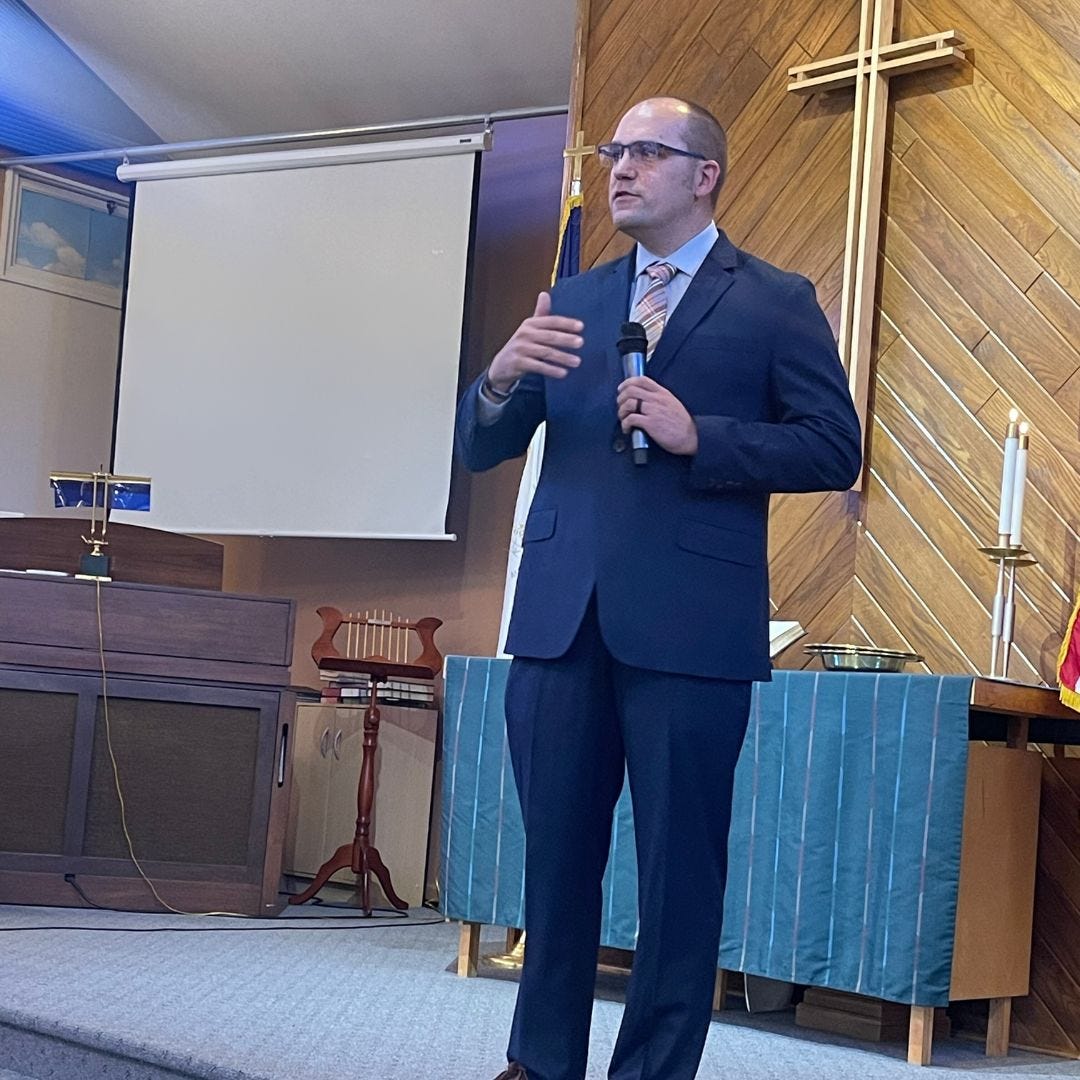
What habit do you have? What habit do you have that you just cannot quit? For me, I really like Diet Pepsi.
I really like Diet Pepsi. Yesterday, I was trying to not have a soda, and I took my son to raising canes, and I was good. And I got an honor, Arnold Palmer, to start with. And then rather than wait in line to get another lemonade and iced tea, I said, oh, well, it was, it was diet coke, so, you know, whatever, right? Doesn't count. And my, you know, doctors, they say, hey, lay off, lay off soda. Lay off the diet soda. Aspartame, not good for you. They say soda makes you want to drink or not drink. Eat more, even diet soda. Um, um, the dentist obviously discourages soda. Not good for your teeth, so. I really like Diet Pepsi, though. And, like, I've tried to quit. There's times I've gone for months without a diet soda, but I just like soda. And I'm not, like, drinking it 24/7 I'm not having, like, ten cans a day or five cans a day. I'm drinking one bottle of soda a day, unless I go, you know, to a restaurant. But even then, I'm still drinking probably more than I should be.
And it just got me thinking, what are some habits that you have, if you're willing to share, that you just cannot quit despite your doctor or your dentist or whoever telling you you should lay off of so you, you don't have to go. Full disclosure here. Deep and dark and dirty. But I'm curious, any habits, anyone willing to share, some habits they know they should quit. Too much candy. Okay, we got one. Too much sweet, especially. Yeah. Dark chocolate. Yeah. Okay, we got one. Who else? Yes, sir. Beanie butter jelly sandwiches, cookies of almost any kind, candy bars of all bostonica. Yeah. Yeah. You know, it was my problem. Friday, uh, I had a hard day at work. Very stressful. We won't talk about it. And I was like, I want some candy and a diet Pepsi. Just bad combo. And you know what the problem is? I went to 7-11, and I didn't want to splurge on, like, the real good candy, so I bought the bad candy, and it's like, why don't I even waste my money on this non good candy?
Okay, who else? Who else? Something, you know, you should quit. Sweets. Yeah. M. Okay. Anyone else? Okay, in the back. Hey, that's good. You're an example for assault. That's great. That's great. You know, smoking again, one of those things that many people just have this habit that they don't want to let go of.
We all kind of pick and choose, right? We all kind of pick and choose what elements of, uh, what our doctor says or what our dentist says or what our health professional advises us. We all kind of like pick and choose, for better or worse, some of the things we're going to listen to and some of the things we're not going to listen to. And as much as we kind of chide ourselves heartily or softly about these kind of things, I think we all kind of do the same thing in our life of, uh, faith as well. We may not like to admit it, we might not want to raise our hands and say, this is something that I kind of pick and choose, that I'm going to follow the way of Jesus in this aspect or not, but we all kind of do that.
And maybe I'll just disclose, you know, for me, I know that the Bible says to be generous, Jesus says to be generous, but for some reason, for me, generosity is a hard thing. Like, I grew up in a household. Thankfully, my daughter here doesn't agree. Uh uh. But I, I think I can be more generous, I'll say that. And I grew up in a household where we didn't always have a lot of money growing up, sir, when I have money in my pocket or money in the bank account, it feels good, feels good, it feels secure. And I don't necessarily want to let go of that money. You know, I think another one that I can pick and choose on island forgiveness, I think we can all kind of agree on that. Picking and choosing to, we're going to forgive when we're going to forgive them. I know, boy, we could spend all morning, I could talk about all morning, a situation where I had to really take some time and really be intentional and pray a lot about eventually forgiving someone who wronged me. And that's a hard thing.
I think we all have aspects of our lives where we pick and choose, like this aspect of following the way of Jesus I will commit to and this aspect I'm not so sure about. And as much as we can do this in our personal lives, I think we can also do this as a community of faith. As churches. We probably all heard stories, right, about churches behaving badly. And I don't mean, of course, the obvious ones, you know, there's churches who've overlooked horrible things and of course we'd all agree, like, that's never okay, but it's like the more, like, embarrassingly bad of things. Like churches that fight over the color of carpet. Have you heard stories about that? Churches get nasty disputes over the color of the carpet they're gonna install. You know, the churches get in fights about what kind of music they're going to have. Churches get in fights about what version of the Bible they want to read. And Linda, I guess I got to get mad at you for reading a different version this morning. Uh, right.
But churches pick and choose what aspects of, uh, following the way of Jesus they're going to commit to. And we were actually talking about this in my church this past week, when churches put the foundation on the wrong thing. When they. When they build their foundation on the wrong thing, oftentimes it's being right. Whether they're right or not, they want to build their foundation on being right or being loving or kind or generous or compassionate. Sometimes churches build their foundation on being the coolest and the hippest and the most trendiest. Sometimes churches build their foundation on, we're going to be the most traditional and by the book, without any kind of compassion again, or inclusion or generosity.
It can get to where, whether that's us individually or as a church, it can get to where we're telling Jesus, essentially what it means to be followers of Jesus, rather than Jesus telling us what it means to be a disciple of Jesus. Almost like that guy Linda read about this morning, Peter, in our gospel reading. I want to kind of just read it again because there's a lot going on. And plus, I'm mad at you for reading the wrong passage, the wrong version of scripture. I got to say, how many of us here. How many of us here grew up with King James version bibles? Okay, we got a few. We got a, ah, half. Half of us. That was kind of my version of my childhood faith. So. And, uh, I grew up in a tradition where it was very much memorizing scripture. So whenever I think about scripture, it always comes in my brain. In the King James version. But I digress.
In Mark, chapter eight, verse 27, Jesus went on with his disciples to the villages accessory of Philippi. And on the way, he asked his disciples, who do people say that I am? And they answered, John the Baptist. And others say, elijah and others, one of the prophets. And Jesus asked them, who do you say that I am? Peter answered him, you are the Messiah. And he, Jesus, sternly ordered them not to tell anyone about him. Then he, Jesus, began to teach them that the son of man must undergo great suffering and be rejected by the elders, the chief priests, and the scribes and be killed. And after three days, rise again. Jesus said all this quite openly, but Peter. Peter took him aside and began to rebuke him. But turning and looking at his disciples, Jesus said to Peter, and he rebuked, Peter, get behind me, Satan, for these things you are setting your mind on are not divine things, but human things.
I could continue reading, but it's a lot happening in that passage of scripture, and I want to share. There's a lot happening here overall. First, this is, interestingly, this is the first time in the book of Mark where Jesus predicts his coming death. So this happens three times in the Book of Mark. This is the first time. And each time this happens in the book of Mark, the disciples respond poorly. Like, this time, Peter gets mad at Jesus for saying he's going to be crucified. Another time, Jesus predicts his own death. And James and John. Do you remember James and John, uh, the sons of Zebedee? I believe they are. They're like, hey, we want to have a prime spot. I think it's their mom. Actually, if I remember correctly, their mom says, hey, can we get my son's and primo positions of leadership when you're reigning and ruling? Not the right answer. And then another time, the disciples, like they made among themselves. Who among themselves is going to be the greatest in the kingdom of heaven once Jesus is dead and rises again?
It's like these folks did not get it. They did not get what Jesus was trying to get them to catch on to. But more so, something that I find interesting about this passage is that Peter says the right thing, that he says what is true. He says, again, you are the messiah. In other sections of scripture, Peter is recorded as making bold, beautiful, profound statements of faith about who he believed Jesus to be. And he's right. Yet, for some reason, this confession of faith was not enough. Jesus wanted more. And as we see again later on in the passage that Linda read, we see what Jesus asks of, uh, Peter and all the disciples is to lose their life, just as he, Jesus, will lose his life to be willing to follow and sacrifice everything for the sake of the gospel, for the sake of the good news of Jesus, to be willing to sacrifice everything.
See, the call to follow Jesus is to be willing to sacrifice everything. Author J. Michael Jordan says it's something like this. He writes that the authentic life of discipleship does not leave untouched any part of who we are. And in fact, it may very well challenge core parts of our identity, whether that be as a father, as a husband, as a son, as a family member, as a friend, as a spouse, as a grandparent, as a friend, as a neighbor, as an american, as a citizen, as their Democrat, as a Republican, even as a church member. Simply put, following the way of Jesus is not simply about saying the right thing. And that's hard, because so much of what we know, what we've been taught of american Christianity is about confession. It's about saying the right thing.
Whichever tradition you grew up in, likely, like me, confession was probably a very big part of your experience of faith, just like mine, whether it be a more conservative evangelical tradition where I grew up in, where, where your identity was judged based on saying the right words. I remember when I was a kid growing up, there was so much emphasis and obsession about, did you pray a, uh, prayer of salvation? Did you say the right words? For me, it was, you had admit you were a sinner, you had to believe that Jesus was God, and you had to confess your sins. And if you didn't say those right words in the right pattern, the right way at the right time, it was like, oh, uh, you weren't really a Christian. And sometimes, sometimes, even if you did say those words, folks could have you questioning whether you really meant those words or said them the right way, on and on and on.
And while some of us in the more mainline or, uh, progressive or liberal traditions might think, oh, how silly, we know that being a Christian is about more than just saying the right thing. I think we all have to admit, right, that our traditions even have elements of confession or proclamations of faith that are still very important to our tradition. Many people, upon joining a church, still have to make a confession of faith when we go through confirmation. If any of us here went through a confirmation class as a child or teenager, at the end of a confirmation class, there's often an opportunity to make a confession of, uh, faith. In this tradition, the United Church of Christ, child baptism, infant baptism. Obviously, the child, the young infant, cannot make a confession of faith. So what do we do as parents? We confess our own faith and we confess that we will raise the child in the faith.
Now, this is not to diminish in any way confessing our faith. I believe in the importance of, uh, confessing the faith, confessing our own faith, giving testimony and witness to what we believe and that we believe. These are all great things. Peter's confession of faith is a great thing. But I think we can get ourselves thinking that just the confession of faith is enough. And if we need a bad example, I'm reminded of a bad example. Jerry Falwell Jr. Does everyone remember that name? Son of controversial figure in his own right, Jerry Falwell. Now, a few years ago, Jerry Falwell Jr., who was at least the president of Liberty University, he was in the news for all the wrong reasons. Financial improprieties, immorality, infidelity, corrupt leadership. I mean, everything you can imagine, news story after news story was coming out about this man just being, I don't want to judge too harshly, but just making some poor choices, right? We'll say it that way.
Yet just when it seemed like the news was swirling, the pressure was the most intense, like everything was focused on him. Just when things were the worst, what did he do? He came out publicly and he made a confession of faith. He said, hey, guess what? I still believe x, y, and z about Jesus and God and all of that. And again, I don't want to diminish the importance of confessing our faith, of proclaiming our faith in Jesus and proclaiming that we are followers of the way of Jesus. But it seemed like after he made this confession of faith, it seemed like there's this big kind of like, oh, uh, okay, okay, okay, okay, he's okay, right? He is okay. Like, amongst some people in his circles, perhaps, at least, there's, there seemed to be this kind of like, okay, he's okay. He's okay. He believes the right thing. He confesses the right thing.
And, you know, those of us in mainline, progressive, liberal circles can be like, oh, that's. That's so preposterous. We can be cynical and skeptical, and I think somewhat rightly so. But as much as we can be skeptical and cynical, I think if we're paying attention, if we're self critical of ourselves, we might due some time to acknowledge our own shortcomings. You know, in many mainline circles across our country, and mainly mainline, uh, churches across our country, we'll often say things about welcoming all. We'll talk about how all are welcome to the table. We'll talk about being an open and affirming church. Yet I have to ask, and I have to wonder, when we think about welcoming all and including all and being an inclusive congregation in so many mainline churches, the people we claim to welcome, the people we claim to include, are not present in our midst. And I just wonder, where's the disconnect between what we confess and what we practice, what we live out? How do we move from talking the talk from saying the right things to walking the walk, from putting these things into practice.
I'm reminded of a story I heard recently from a former pastor. He's a professor now, Todd Bolsinger, and he shares a story about when he was pastoring a Presbyterian church. He was a 50 year old pastor, and he had a young, dynamic, 30 year old worship leader, a young woman. Now, actually, this worship leader, she was 29, I guess, and she was having her 30th birthday, and she wanted to have a big celebration to celebrate 30. They want to remember 30 for some of us, more long ago than others, right? She wanted to celebrate and bring together her closest friends and relationships. And this pastor was one of those people. So the pastor, being 50 years old, was a little nervous. You know, how am I going to, how am I going to get along with a bunch of 30 something, 20 something friends? How am I going to, how am I going to relate to these people? But it's like, you know what? I'll go. So him and his wife, they went to this young woman's birthday party, and they had a great time interacting with these young people. It was a great time. The young woman had a great time celebrating her 30th birthday.
But this one thing the pastor noticed when he was there is that many of these people who were at this young woman's birthday party were themselves former members of his church, folks who used to come but no longer came. So he left that party having had a great time, but also wondering, boy, is it something about me? Is it something about me why they don't come to church anymore now, as, uh, things would go that next week, perhaps during a staff meeting or conversation in the hallway, the young woman worship leader crossed paths with the pastor. And you know, the pastor, man, I have a great time. And perhaps a little sheepishly, the young woman said to her pastor, I'm so glad you came, too. But I was a little, I'm a little nervous because I wonder if you wonder, why can't I get my own friends to come to church?
Here was this young woman wondering herself if she would be judged that she couldn't get her own young friends to come to church. So the pastor had an idea. He said, oh, uh, you know what? Here's something we can do. Why don't we have a dinner or several dinners, small groups, and we'll get these folks together and just simply ask them, why don't you come to church anymore? What is it about church that doesn't work for you anymore? So that's what he did. He says, over the course of three dinners, he bought three pizzas and had three conversations with these people about why they don't come to church anymore. You know what the hardest, most interesting thing about this is? He doesn't sell you what they said. As he tells this story again and again, repeatedly, he says he never tells his listeners of the story what the people said, because he wants to emphasize that the important part of that process is asking the questions, not what they said, because it's gonna be different for different people. And he says the important thing is asking the question.
There are. Because there are no magic bullets or easy answers or simple solutions to getting young folks back into church. It's asking the question. So I have a simple assignment for you. All this morning and throughout this week, I wonder, is there one person in your life, a friend, a family member, a child, a grandchild, a coworker? Is there one person in your life you can ask? Why don't you go to church anymore? And please do your best. I know it's like an awkward question. Please do your best to ask without judgment or suspicion. Don't try to give responses or answers. Just simply write down what they say. What is it about church that doesn't work for you anymore? And maybe this come together some time and talk about those things. So here's the thing. Churches across America are facing these same challenges. Declining attendance, declining resources, lack of engagement among young people.
Now, obviously, there are some things we cannot change, but there are some things we can change. And I think we have more choice in the matter than we may like to admit. I'm reminded of a church, I won't say the name, not too far from here, a classic mainline church. And interestingly, they have in the walls of their basement, if you can imagine, pictures and pictures and pictures of confirmation classes. Now, back in the early days of the church, those pictures are full of young people, of teenagers, 2030 people. In each picture, conformance confronts confidence. And as you progress a little further, from 20 to 30, gets down to 15 or 20, and then the ten or 15, and then you move forward, it's maybe a dozen, and then it's five to ten, and then maybe two or three. Skip a couple years, one or two. And then for the last several years, no one at all.
In contrast, I'm, um, reminded of a church, another church I know of facing much the same challenges. Declining attendance, declining resources, struggling to engage the younger demographic. But they made some hard decisions, and they decide, we're going to ask ourselves some hard questions. And the folks who don't engage with us, to share with us some hard questions. And they went through everything to the point where they were looking at items in their church, wondering, does this help us reach the kind of person we want to reach? We say we want to include, or does it not help us? And that church, unlike the first, is a growing, thriving, healthy church. They were once in the position of the first church because they were willing to ask themselves and others some hard questions. They found themselves reinvigorated and re-inspired by the call to faith, the call to sacrifice anything and everything.
This is, I believe, this is, I believe, the life of discipleship, to be willing to sacrifice all so that more may come to follow the way of Jesus.
Let us pray.
God, the path that you invite us on to follow the way of your son is not easy. It will cost us something. God and I know we all have parts and things that, uh, we struggle to let go of or to sacrifice, both as individuals and in our life as a community of faith. God help us. Help us, God, in our individual lives and as a community faith, to sacrifice where we need to sacrifice so that we can move from a place of, uh, confession to a place of authentic and true discipleship. We thank you, God. We thank you for this church. These people, the, um, call of faith they've been following. We ask this in Jesus name. Amen.