


TL;DR: I recently argued that progressive Christians often prefer "hard" preaching over grace. After a conversation with an evangelical churchgoer, I realized the same instinct exists there too. Different vocabulary. Same story. Both can quietly turn Christianity into a project of self-improvement rather than a proclamation of grace.
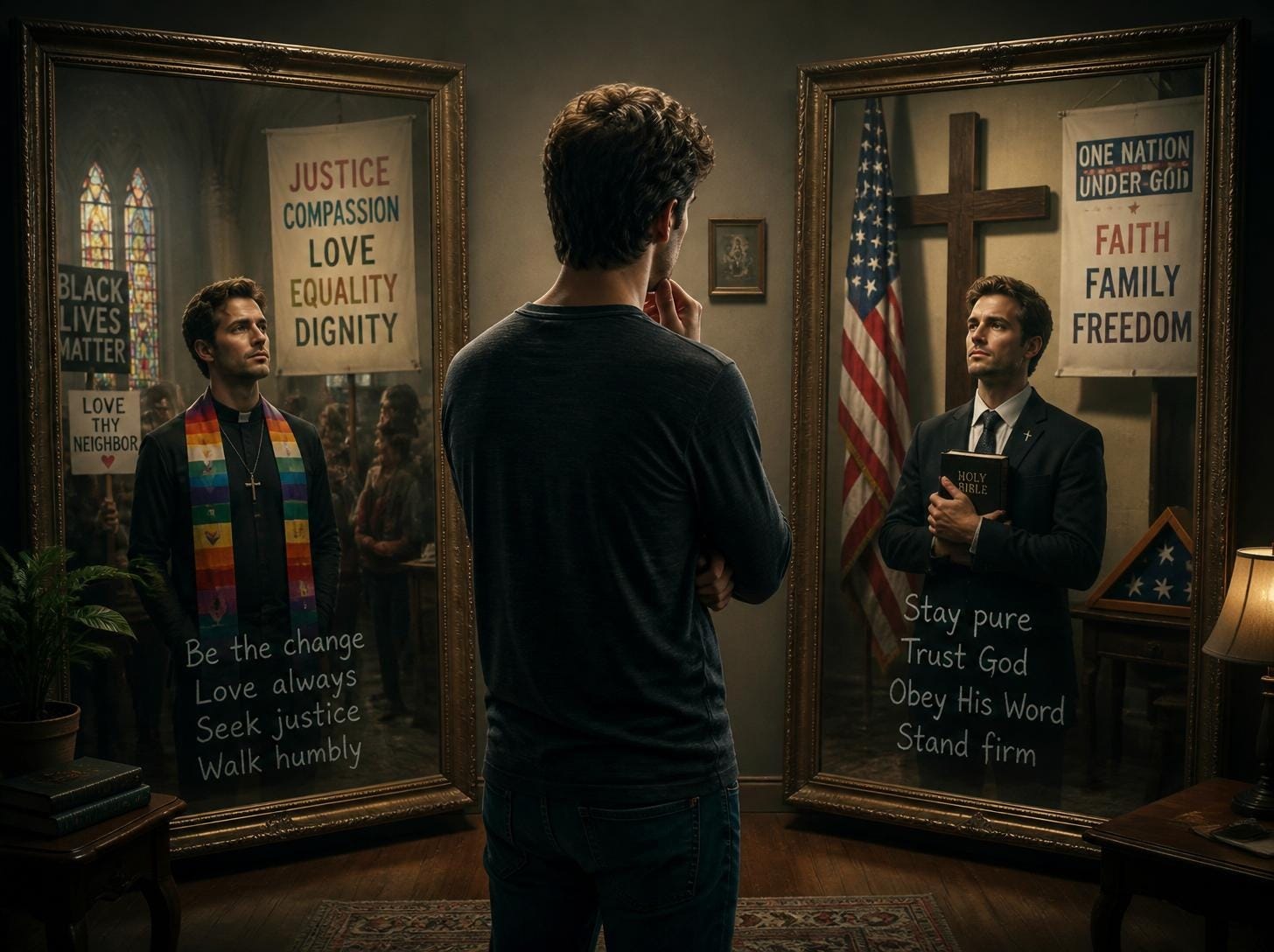
Same Story, Different Moves
If you’ve been following my writing for any length of time, you know I spend a fair amount of it critiquing my own tribe: mainline Protestantism and progressive Christianity. Plenty of voices on the left spend their time criticizing evangelicalism, and while there is certainly PLENTY there to critique, I often find those efforts a bit too easy.
More importantly, I think we on the Christian left have plenty of our own blind spots to examine.
In a recent post, I wrote about the tendency within some mainline and progressive churches to want “hard” preaching—to lean into what my Lutheran friends call the Law side of the Law/Gospel framework. I won’t repeat that argument here when you can simply read it for yourself.
What surprised me recently was hearing how that very same instinct shows up within evangelicalism.

A Surprising Conversation
Because of the work I do, I regularly find myself in conversations with Christians from across the theological spectrum. Recently, one such conversation caught my attention.
We were talking about another area evangelical church—one that perhaps flirts with Christian nationalist themes—and why thoughtful, level-headed people would choose to attend.
From the Christian left, I think we often assume those congregations are filled with brainwashed, MAGA-hat-wearing drones who’ve checked their brains at the door.
I’m sure a few exist.
But I suspect the vast majority are something else entirely.
In fact, I wonder if they’re the mirror image of the well-intentioned liberal do-gooders I described in my previous essay.
What startled me was something one regular attender said. By every other measure, this seemed like a thoughtful, level-headed person.
They said they attended because they “needed someone to kick me in the ass.”
As I argued in my previous piece, this is simply another way of saying, “I want hard preaching.”
Different vernacular. Same instinct.
One seeks transformation through acts of justice and activism.
The other seeks transformation through behavior maintenance/modification.
But both assume that the Christian life is fundamentally about becoming better through our own effort.
That got me wondering why Christians from such different traditions could have the very same instinct.
I’m reminded of my own upbringing in conservative Christianity. There was a reason certain pastors repeated the same talking points week after week, and why those sermons were met with so many “Amens.” They clearly told me what I needed to do—or stop doing—to become a “good Christian.”
Different Flavors of the Same Move
Andrew Root has written about our tendency to flatten God into something we can control for our own purposes (The Pastor in a Secular Age, 197), writing that “we long for power and political control so we can secure happiness and be our truest self” (Evangelism in the Age of Despair, 22).
I won’t belabor the point, but I increasingly wonder if evangelicalism and progressive mainline Protestantism often do the very same things.
Both flatten God.
Both make Christianity fundamentally a project of self-improvement.
Both assume the Christian life is, at its core, something we’re responsible for managing.
The moves simply look different.
For the evangelical churchgoer I mentioned above, the project wasn’t becoming more socially conscious or justice-oriented. It was becoming a better person and a better Christian through greater self-control and personal holiness.
Structurally, though, it’s the same thing, just different moves.
We don’t actually think we need grace.
We think we can handle it ourselves.
David Zahl recently spoke of Christianity's tendency toward "maintaining self-sufficiency." It struck me that this is especially true of white American Christianity.
Perhaps that’s what all of this ultimately comes down to.
Our culture prizes individualism and bootstrapping, and both traditions have baptized those instincts.
Within progressive mainline Protestantism, the project becomes deep introspection to ensure our actions and choices are sufficiently justice-oriented.
Within white evangelicalism, it becomes deep introspection to ensure our actions and choices pass the test of personal holiness.
Different virtues.
Different vocabulary.
Same story. Different moves.
Both law. Neither grace.
P.S. My new book The Church as Community Hub is available for pre-order now!
Very true. The American spirit despises grace, mercy and peace. Infant baptism is particularly hated - how can God give away all the riches of the kingdom in a single promise to an undeserving person?