


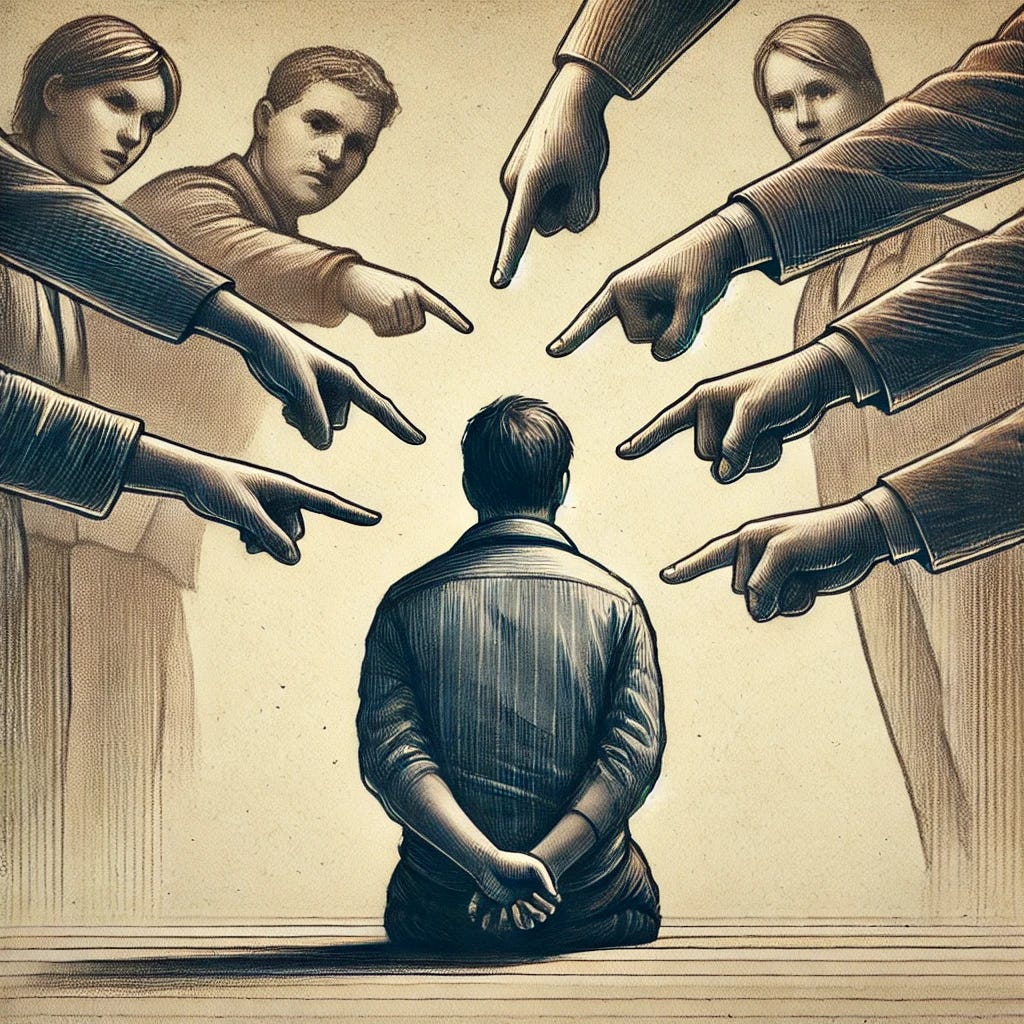
As I spend a lot of time commuting or driving between buildings at work, I tend to listen to sports radio. It’s mostly mindless, shallow, and stress-free listening—except after a playoff loss by the home team. Then, it’s anything but. Case in point: just today, as I was driving between buildings, one of the local sports commentators made the remark, “There’s going to be a fall guy. There always is after losses like these.”
The commentator was referencing the recent Denver Broncos loss to the Buffalo Bills, a game where the Broncos trailed 10-7 at halftime but ultimately fell apart, losing 31-7. They were dominated on both offense and defense in the second half.
I don’t always agree with the hot takes that dominate sports commentary, but in this case, the commentator may have had a point. This isn’t just a sports phenomenon; it reflects a broader cultural tendency. The NFL, like much of American society, operates in a reactionary context where leaders often look to assign blame quickly rather than take a more patient and systemic approach.
This reactionary tendency got me thinking about scapegoating.
The Psychology of Scapegoating
In Family Systems Theory, developed by Murray Bowen, scapegoating is a common dynamic in which one individual within a family or system is unfairly blamed for the group’s problems, dysfunctions, or failures. This mechanism serves to relieve anxiety within the larger group by projecting it onto a single member, allowing others to avoid addressing the deeper systemic issues at play. Edwin Friedman, a prominent proponent of Bowen’s theory, explains that scapegoating often arises in high-stress environments where the group seeks a quick and simplistic solution to its distress.
The scapegoated individual becomes a lightning rod for unresolved conflict, often leading to their marginalization or removal. This might temporarily stabilize the system, but it leaves the underlying dysfunction unaddressed (Generation to Generation: Family Process in Church and Synagogue). In organizations, such as churches or businesses, this dynamic is particularly harmful, as systemic challenges—like leadership struggles or external pressures—are offloaded onto one person rather than being faced collectively. The cycle perpetuates anxiety and prevents meaningful growth or healing within the system.
A Personal Connection
I’m particularly attuned to this topic because I’ve experienced scapegoating firsthand. After the new church start I led closed down, I was assigned a disproportionate share of the blame, which had significant consequences for my career and personal well-being. It was a difficult and deeply formative experience, one that I’m still processing. I plan to share more about it in a future post, but for now, I’ll say that being unfairly singled out for systemic challenges was a profoundly challenging experience that left a lasting impact.
Scapegoating in Sports
In the case of the Denver Broncos, the scapegoat is likely to be Defensive Coordinator Vance Joseph. The defense gave up 31 points in the loss to Buffalo, so it’s easy to point fingers at him. But this is both illogical and short-sighted. Joseph has a proven track record as a quality defensive coach, and the Broncos’ defense has been one of the team’s strengths all season.
That’s the thing about scapegoats—they’re not chosen based on logic but on the need for a convenient target. Scapegoating isn’t about firing someone who is genuinely incompetent or underperforming; it’s about firing someone indiscriminately because “someone needs to take the fall.” Consider the case of Nathaniel Hackett, the Broncos coach fired mid-season a few years ago. That wasn’t scapegoating—it was accountability. The team was performing terribly, his leadership was questionable, and he appeared to have lost the respect of his players. Scapegoating, by contrast, is reactionary and often baseless.
The Starbucks Example
This tendency to scapegoat isn’t limited to sports; it happens in corporate environments, too. Consider the case of Shannon Phillips, a regional manager at Starbucks who was fired in the aftermath of the 2018 incident where two Black men were arrested at a Philadelphia store. The arrests sparked widespread protests and accusations of racial bias against the company.
Phillips, who managed stores in the Philadelphia area, was tasked with placing a White employee on administrative leave, despite knowing that employee had no involvement in the arrests. When she defended the employee, Starbucks fired her. Phillips sued, alleging racial discrimination, and in 2023, a federal jury awarded her $25.6 million in damages.
Firing Phillips was not a solution—it was a distraction. It allowed Starbucks to redirect public outrage and anxiety onto one person, rather than addressing deeper systemic issues. Closing 8,000 company-owned stores for an afternoon of mandatory anti-bias training for 175,000 employees was a meaningful step toward addressing the problem. Firing someone to make a point? That was scapegoating.
Why Scapegoating Fails
What frustrates me most about scapegoating is how counterproductive it is. It doesn’t address the real issues—it simply shifts attention and blame onto someone else. Whether it’s firing a coach in the NFL or a manager at Starbucks, the result is the same: systemic problems remain unaddressed, and anxiety continues to fester within the organization.
As someone who has been on the receiving end of scapegoating, I know firsthand how harmful and unjust it can be. It’s not just about fairness; it’s about the missed opportunity to confront deeper issues and make meaningful changes.
Instead of scapegoating, we need to embrace patience, accountability, and systemic thinking. That’s the only way to move forward—whether in sports, business, or any other area of life.
Scapegoating the essential worker

At the beginning of the onset of the economic shut-downs and stay at home orders—and especially now over the last few weeks as states and communities have talked about “reopening the economy,” –there’s been a small but vocal minority suggesting that we be willing to sacrifice some for the sake of the greater whole.
Beyond the Quick Fix: Why Patience and Foundations Matter in Sports and Life

The Obsession with Quick Fixes: A Societal Challenge
Works Cited
Friedman, Edwin H. Generation to Generation: Family Process in Church and Synagogue. Guilford Press, 1985.
Ellis, Ralph. “Starbucks Ordered to Pay $25.6 Million to Employee Who Claimed She Was Fired Because She Is White.” CNN Business, 17 Aug. 2023, https://www.cnn.com/2023/08/17/business/starbucks-payment-racial-discrimination-white/index.html.