


Childhood Confusion and Fading Hymns
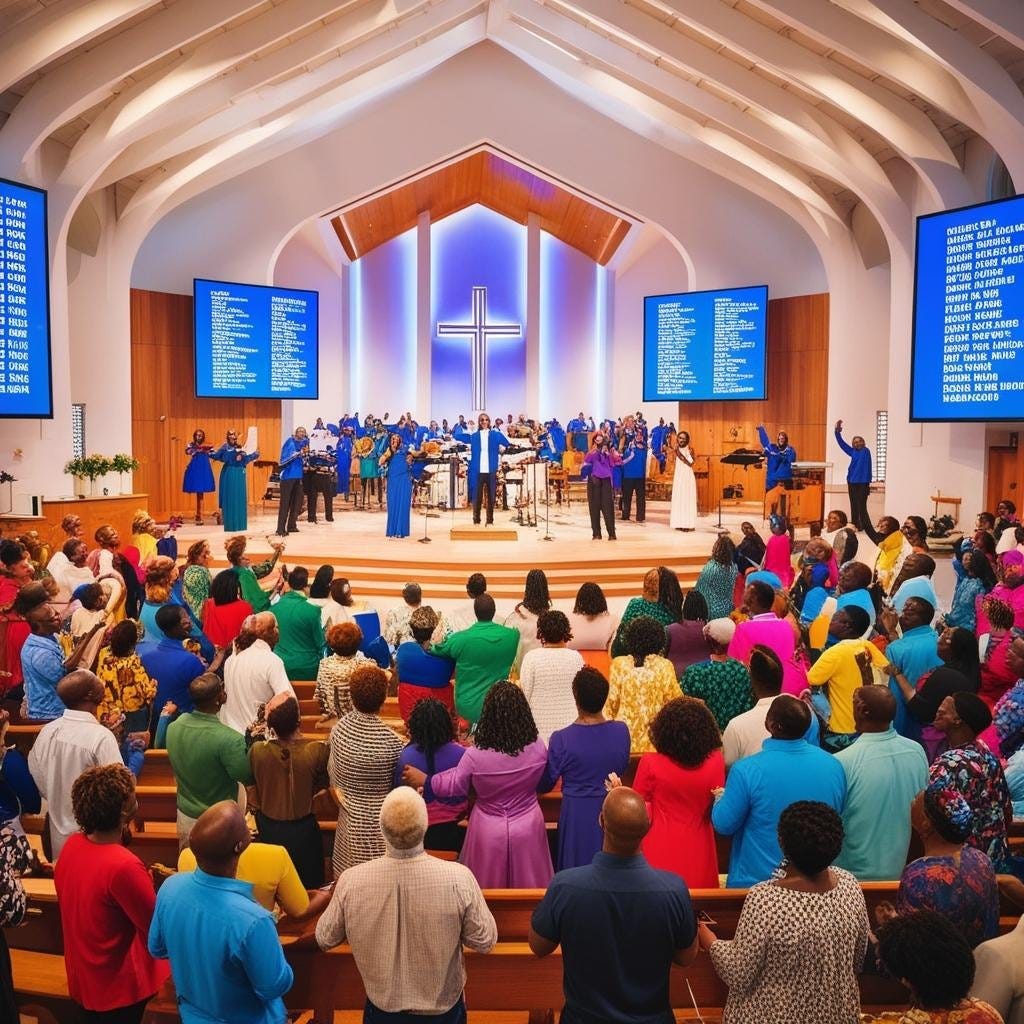
If you grew up in church—especially evangelical or revivalist settings—you probably remember singing hymns like “There Is a Fountain Filled with Blood” (1772), “Are You Washed in the Blood?” (1878), “Nothing But the Blood” (1876), or “Power in the Blood” (1899). These songs were staples in many hymnals and worship services, filled with vivid imagery of Christ’s sacrificial death: blood poured out, sins washed clean, and souls redeemed by crimson streams.
I especially remember singing the rousing hymn, "Are You Washed in the Blood?" as a child and being puzzled by the image of robes being dipped in blood and somehow turning white. To my young mind, it seemed more like a contradiction. After all, how could something dipped in red possibly come out white? I didn’t yet understand the symbolic power of blood in Scripture or the theological claims the hymn was making—I only saw the contradiction. But in many progressive and mainline churches today, these hymns are rarely sung. In fact, some hymnals have even edited or omitted their more graphic verses. Why have they fallen out of favor?
Theological Shifts on Atonement
Part of the answer is theological. Many contemporary Christians are reexamining substitutionary atonement, the belief that Jesus had to die in our place to satisfy divine wrath. Critics of this theory argue it portrays God as violent and transactional rather than merciful and gracious. In response, churches have increasingly embraced other atonement models—like Christus Victor, moral influence, or solidarity—that emphasize God’s love, justice, and restorative power over penal exchange.
A Cultural Shift Toward Disenchantment
But there’s also a deeper cultural shift at play—one that goes beyond theology and into how we understand the world itself.
We live in what philosopher Charles Taylor calls a “secular age.” In pre-modern, pre-Enlightenment societies, the world was full of sacred meaning. Blood was not merely a bodily fluid—it was a symbol of life, covenant, power, and spiritual consequence. Leviticus 17:11 says, “The life of the creature is in the blood.” This was taken seriously: in an enchanted world, to speak of the blood was to speak of something mystical, even mysterious.
Early Christians and the Power of Blood
The hymns we now find uncomfortable were likely written from within this worldview. William Cowper’s “There Is a Fountain” begins with the line:
“There is a fountain filled with blood, drawn from Immanuel’s veins;
And sinners plunged beneath that flood lose all their guilty stains.”
To Cowper and his contemporaries, this wasn’t morbid—it was mystical.
The New Testament writers, too, seemed to find deep significance in the shed blood of Jesus. Hebrews 9:22 declares, "without the shedding of blood there is no forgiveness of sins." Paul writes in Romans 5:9, "we have now been justified by his blood," and in Ephesians 1:7, "In him we have redemption through his blood, the forgiveness of sins." Revelation 1:5 praises Jesus as the one "who loves us and has freed us from our sins by his blood." These verses reflect an early Christian understanding of blood not merely as a metaphor, but as a means of divine reconciliation and spiritual power. Blood was a divine agent of purification and covenantal healing.
Blood in a Disenchanted World
But in the modern West, we no longer see the world that way. The Enlightenment introduced a scientific, materialist lens through which everything is explained by natural causes and empirical proof. Blood is now understood almost exclusively as a medical necessity—essential for life, but stripped of any deeper significance. Outside the body, blood is treated either as a clinical emergency or a tool for healing through transfusion or surgery.
No wonder, then, that singing about blood as spiritual or salvific feels strange to modern ears. The language no longer lands the way it once did—because in the pre-modern world, blood wasn’t a metaphor. It was understood as having literal spiritual power. Today, those same phrases sound foreign because we've lost the framework that made them resonate.
A Worship Song Example
For instance, recently in church we sang the song Christ Be All Around Me, a contemporary worship song I genuinely appreciate, inspired in part by St. Patrick's Breastplate Prayer. One line in the original lyrics says, “Your life, Your death, Your blood was shed for every moment”—a phrase that clearly references blood, though not in overtly substitutionary atonement terms. Yet as we sang it, the line had been altered to: “Your life, Your hope, Your love for me, in every moment.” The reference to blood was completely removed. Whether the change was made to avoid discomfort or to reflect theological preferences, it underscores just how far modern worship has moved from seeing blood as sacred, powerful, or spiritually meaningful.
Flattened Faith in a Modern Age
But I’ve been wondering if succumbing entirely to this kind of thinking flattens something vital about the Christian faith. When we lose the sense of blood as mysterious, sacred, and powerful, do we also lose something of the spiritual depth of Christ’s life, death, and resurrection? In modernity, Christianity often seems to be valued primarily for its positive psychological impact—as a source of comfort, moral uplift, or community support—rather than as a proclamation of metaphysical truth. Have we reduced the gospel to a series of abstract ideas, rather than a cosmic drama that touches body, spirit, and soul?
What Do We Lose Without the Blood?
So it makes sense that hymns about blood atonement no longer resonate for many worshippers today. Without a shared sense of the sacred nature of blood, the claims fall flat—or worse, they feel grotesque. The very images that once inspired awe now inspire discomfort.
As we navigate life in a disenchanted age, we must grapple with whether our worship language can still carry the weight of sacred truth.
While I suspect it was overdone in some circles heavily into PSA, we Presbyterians didn’t have that much of it. Fwiw. But it remains key to the necessary metanoia out of a Modern mindset. We simply cannot understand the NT without getting that blood means life. We can’t even say the words of institution without it. We can’t go changing the basic elements of Christianity to accommodate the ignorance of Modernity. We are the ones who have to change.
It's funny how this gets brought up in some of my UMC circles. I think some people just think of it as something "Baptist" and we should stay away from it. I don't hear theological nuance in their disagreement.
I'm sure if I pushed in, some of them could articulate issues with substitutionary atonement. I really think a lot of it, especially with the changing of lyrics, is simply some desire to signal difference.
I'm not a fan of it.
I also think if we look into the lens of mystagogical preaching in the early church we can clearly see that many part of Christian practice are used in such a way.